Filed under: Book reviews | Tags: classic novels, Comedy of Manners, England, Feminist, film adaptations, Jane Austen, Northanger Abby, Persuasion, psychology, Subversive writing
 On a long list of my favorite authors and beloved books, Jane Austen is always prominently featured. I think she’s hilarious and subversive. I’d even argue she’s a feminist. Other readers have obviously found Emma irresistible because the book has continuously been in print since 1816 (it helps, however, that it’s mandatory reading for most secondary schools in the English-speaking world).
My favorite Austen book is without-a-doubt Persuasion, even as I truly appreciate Northanger Abby. Nonetheless, this is a brief review of Emma, which I have just re-read, so while it’s fresh I thought to write a note encouraging readers to read this novel if they haven’t already.
Emma is a special work. Along with Pride and Prejudice it’s frequently adapted for film and television. Austen wrote this book shortly before she would die and by this time, she was at the height of her authorial skills. While the deceptively simple plot of Emma is similar to Austen’s other novels – a cycle of wrong-headedness, misunderstandings, remorse, penitence, and, finally, self-realization (inclusive of a romantic pairing of ‘equals’) – this work is richer in its twists-and-turns even as it maintains narrative control. Moreover, the themes of status and marriage are still relevant. As is the ‘moral’ of the book, which is that self-knowledge is elusive, and vanity a source of pain. What appeals to me most about Austen’s work in general is that they are all acute studies of humanity: “the happiest delineation of its varieties,” prompted by “the most thorough knowledge of human nature.” Her ability to create compelling and universal characters is awe-inspiring. Sly and subtle observations, humorous quips and asides, and we’re chuckling at the foibles and frustrations of humankind. Moreover, the omniscient narrator, which Austen had perfected by the time she wrote Emma, means the reader is privy to the innermost thoughts of our heroine as she finds her way through the narrative. And this heroine is complex and difficult. Austen famously wrote to a friend that in Emma she had created “a heroine whom no one but myself will much like.” It’s true. There are times when I find Emma’s character repugnant – snobbish, rude, obstinate, foolish and thoughtless – but then I find patience and kindness for her. She is young after all, and she doesn’t mean to be hurtful. In the end, I find my own best nature in my judgement of Emma, which parallels the heroine’s own journey, and makes for a richer literary experience.
Filed under: Book reviews | Tags: 19th century England, Arab, Arab politics, Churchill, England, English colonialism, Georgina Howell, Gertrude Bell, Turkey
 An English friend of mine loaned me this “must read” book because she had so thoroughly enjoyed it and wanted me to share in the experience. Indeed, Queen of the Desert: The Extraordinary Life of Gertrude Bell by Georgina Howell is fascinating because Bell is a strong female character and the Middle East remains relevant.
The book begins with Bell’s birth in 1868 to industrialists in the North of England. Outspoken and quick-witted, she became a historian, a linguist, an “Arabist,” an archaeologist, a mountaineer, an author, and a photographer. After many explorations into the Arabian deserts and a passion for Arabian culture, she became one of the architects for an independent kingdom in Iraq, helping to put its first king, Faisal, safely onto the throne in 1921.
Queen of the Desert is superbly researched and includes Bell’s own writing, both published and unpublished. However, while I admired Bell’s courage and persistence, I was not particularly intrigued by her personal story. Even as she was a woman in a man’s world who achieved things most women wouldn’t dream of, she was the daughter of an extremely privileged family with immense resources at her disposal. Instead, I found the information about the history and politics of the region captivating. The insight into the historical meddling from foreign countries, the social protocols of the desert, the diverse sects that abound throughout the Middle East, and their respective perceptions of the world as well as their feudal wars, are, in my opinion, the most engrossing aspects of this book. The information gained from reading Queen of the Desert also made me realize that the challenges that existed at the turn of the 20th century in the Middle East still exist today.
Filed under: Book reviews | Tags: American, Americana, heartlands, Kent Haruf, novel, poetry, popular fiction, prose
 A small town community in the ‘heartlands’ is the setting for Plainsong and its rendering of the quintessentially American experience. Kent Haruf interweaves the stories of a lonely teacher, a pair of boys abandoned by their mother, a pregnant high school girl, and a couple of brittle old bachelor farmers as they undergo radical changes over the course of a year. With lyrical, eloquent prose that is richly nuanced, Haruf presents the steadfast courage of decent, troubled people getting on with their lives.
Weather and landscape set the quiet, observant mood of the narrative, while descriptions of rural existence are poetic invocations to the natural world. Haruf steers clear of sentimentality and melodrama, however. His beautifully imagined characters and the vivid depictions of their experiences, makes each of them seem non-fiction, which can evoke both heart-warming and heart-wrenching feelings (respectively) in the reader. Emotions that resonate long after one finishes the novel. This is a contemplative and compelling story about grief, loss, loneliness, and frustration, as well as kindness, love, benevolence, beauty, and what it means to be a family.
Filed under: Book reviews | Tags: Anne Tyler, characterisation, characterization, John Updike, Nick Horby, popular fiction, prose, stories with bank robbers, stories with obese people
 For thirty-five-year-old Charlotte Emory, leaving her husband is the only way out from the humdrum of her days and the banality of life’s earthly possessions. She goes to the bank to withdraw what money she has, but finds her getaway is not at all what she expected when a young bank robber takes her hostage and they head south for Florida in a stolen car.
I don’t read the “blurbs” on the back of books anymore, relying, instead, on its reviews. John Updike, Nick Hornby, The Times on Sunday, and The Observer all write that Ann Tyler is “wickedly good.” So I dug in. While I appreciate Tyler’s prose and her astute eye for the “ordinary” detail that’s telling about a person, circumstance, or context, I didn’t rush to bed at the end of the day to read the book, nor drag it everywhere I went in case I found a moment to read a page or two.
That said, the book remained with me after I finished it. I found myself lingering on elements of it, particularly the characterization. Our heroine, seemingly mousy in all ways, from her looks to her actions. The obese mother who told her own daughter she was a changeling. The husband, who seemed so romantic and moody. The bank robber who appears to be a greasy loser. It was only upon reflection that I understood how expertly Tyler had developed these characters and given them a wholeness that wasn’t immediately apparent. They are at once repellent and utterly sympathetic. There’s a line in the book that reads, “I never did have the knack to realize when I was happy.” This sentiment remains with me because of its message, and also its subtlety, truthfulness, and its poignancy — three words that encapsulate Anne Tyler’s book Earthly Possessions.
Filed under: Book reviews | Tags: Amsterdam, bestselling book, Calvinism, Calvinist, dollhouse, Good books, Great books, Jessie Burton, The Miniaturist
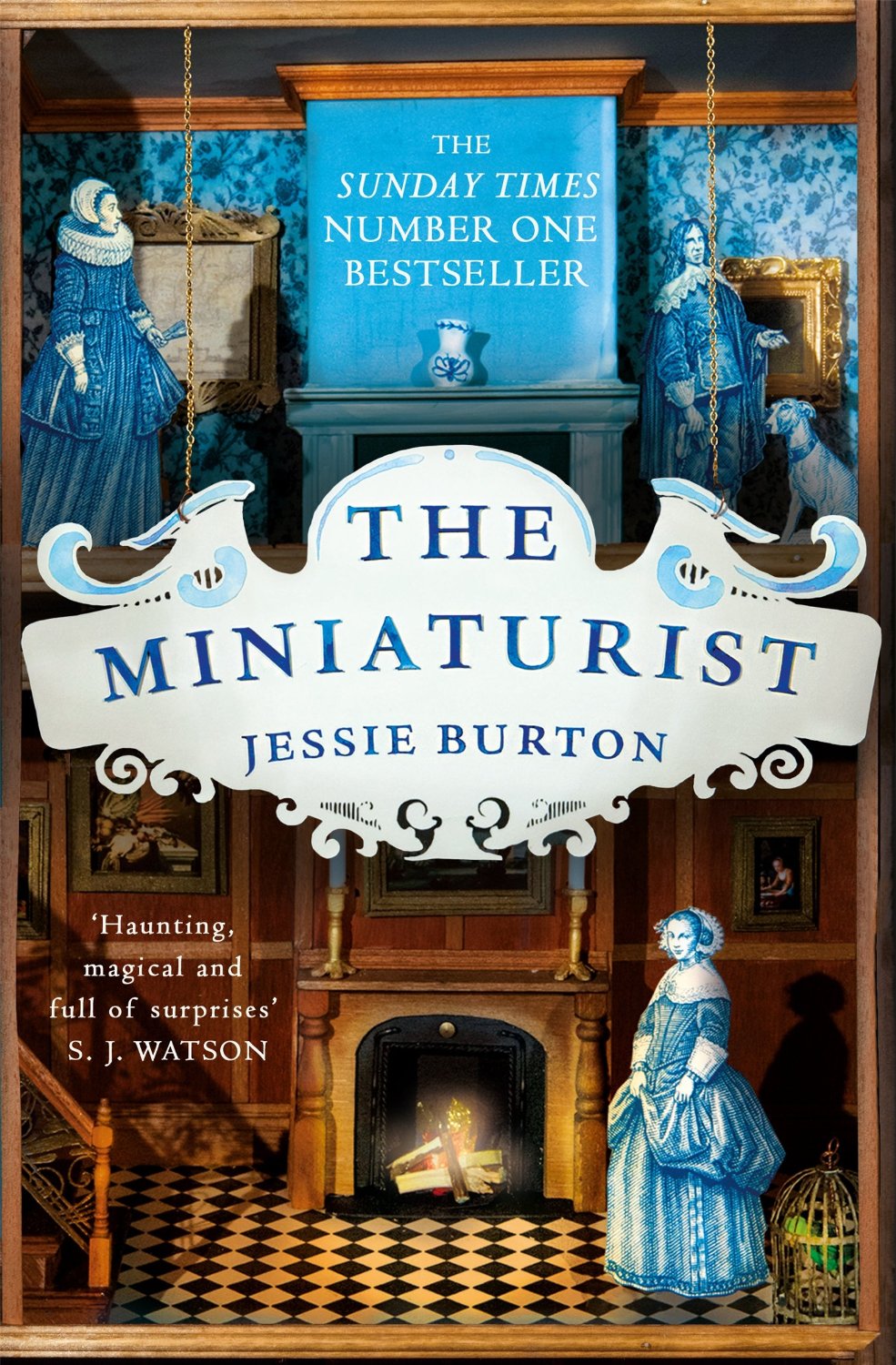 The year is 1686 and the locale is Amsterdam. Eighteen-year-old Nella Oortman arrives at the imposing house of her new husband, Johannes Brandt, a successful and wealthy shipping merchant. A marriage arranged because of her name and his wealth, Nella finds herself overwhelmed with loneliness and by her new surroundings. Due to the Calvinist authorities, the people in Amsterdam are repressed and colorless – they even eat their sugar in secret. Johannes’s peevish sister frightens her. The maid disrespects her. And his manservant, a former slave, alarms her. Moreover, Johannes never visits her in her rooms during the night or at any other time, leaving her doubtful and confused about herself and marriage in general.
He does, however, give Nella an exquisite dollhouse that is the exact replica of his grand home, and invites her to fill it with miniature furniture at his expense. To this end, she commissions a miniaturist to make a few initial items for the dollhouse. What ensues for Nella are a series of puzzles as the elusive miniaturist sends Nella items which are exact replicas of the people and things in her home and which Nella has not ordered. How does the miniaturist know so much about her and the other members of the Brandt household? Does the miniaturist know the future? What secrets are Johannes and his sister keeping from Nella?
What should have been a charming book given its plot, its vividly drawn setting (having been impressively researched by the author, Jessie Burton), and some beautiful passages, left me feeling indifferent. While our heroine exhibits an exhilaratingly modern attitude as the story unfolds, I didn’t feel compelled by any of the characters or their events and circumstances. We discover each of their tastes, and we’re even told about each character’s failings, but we never learn what is in their hearts or what motivates any of them. As a consequence, I felt the characters lacked depth and the novel was a lukewarm experience rather than the passionately engaging one promised by many reviewers.
Filed under: Book reviews | Tags: 19th century Iceland, Alias Grace, debut novelists, Hannah Kent, Iceland, Icelandic stories, Margaret Atwood
 The novel, based on a true story, takes place in Iceland in the early 19th century. Agnes, a housemaid, has been charged with murdering her former master and is sentenced to death. But as the ground is too hard to bury a body till the spring, she awaits her execution at an isolated farm located in the valley where she grew up.
Initially, the family who own the farm are horrified that a convicted murderess will be living with them and they avoid her as much as is possible. It is only Toti, a young, inexperienced priest Agnes has chosen to be her spiritual guardian, who listens to and attempts to understand her. Despite being a pariah to the family on the dilapidated farm, however, Agnes finds the routine of its chores comfortingly real, and slowly opens up to Toti about the circumstances surrounding the murders. It is through her telling of these details that the family – overhearing her in the small shack of a farmhouse – learn that there is another side to the scandalous story they’ve heard.
A dear friend who recently visited left this behind for me to read. Hungry for English, I devoured it. I found it lyrical, haunting, and quietly dramatic, particularly as it takes place in the harsh environment of Iceland among the impoverished (majority). So I truly did enjoy it and I appreciate that this is author Hannah Kent’s debut novel, which is a great accomplishment. Even so, its primary tale (a convicted housemaid kills her masters), based on a true story, as well as its circa (early 19th century), keenly recalls Margaret Atwood’s book Alias Grace. As a result, I couldn’t help but read Burial Rites in a critical fashion, comparing it to Atwood’s book throughout. In my opinion, while a good read in a very similar ‘vein’, this book is not as good as Atwood’s in terms of literary prowess, insight, wisdom, and cultural and historical knowledge and complexity.
Filed under: Book reviews | Tags: Devil, Faust, Gideon Mack, God, James Robertson, near-death experience, Satan, Scottish folklore, Scottish writing
 Reverend Gideon Mack is a troubled man, an unfaithful husband, and a theological skeptic. For him, the existence of God, the Devil, heaven and hell are on par with the existence of fairies and ghosts. Till he nearly dies and is rescued by someone who seems to be Satan himself.
Inspired by a Scottish folk story, this novel is an intriguing blend of legend, history, memoir, and fiction. The subject matter is compelling and the writing is exceptional. I love the concept of a conversation with the Devil (very Faustian and potentially epically moralistic) borne of the Scots, who are down-to-earth, wry, and irreverent. I also appreciate that while the story is focused on Gideon’s experience in life, death, and resurrection, it also prompts the reader to consider the very nature of faith. All this said – and allowing for the possibility that my mind wandered too easily from the lyrical pacing of the book – I found the tale overly long and felt it was a bit of a chore to finish the last several chapters…
Filed under: Book reviews | Tags: England, France, Jacobite, Scotland, Scottish crown, Scottish Highlands, Stuarts, Stuarts in exile, Susanna Kearsley, The Winter Sea
 In 1708, a fleet of French and Scottish soldiers almost succeeded in landing the exiled Stuart prince in Scotland to reclaim his crown. In the present day, author Carrie McClelland wants to turn this story into her next bestselling novel. Settling into the shadows of an ancient castle in the highlands of Scotland, she creates a heroine named after one of her own Scottish ancestors, and begins to write the tale. Soon after, she finds that the details she’s intuitively including in the book are factual, and she ponders whether she’s dealing with ancestral memory, making her the only person alive who knows the truth about what happened over 300 years ago.
I was skeptical about reading what looked like a tome of historical fiction, but my doubt was quickly allayed. The concept is great – a writer has characters and their actions, circumstances, and dialogues, coming to her as memories, blurring the lines between fact and fiction. The locale is vividly, but not overly described, and the Scottish landscape is romantic. The characters – both in the present day and during the 18th century – are compelling. The story is suspenseful (and there’s a twist at the end that I didn’t see coming). Finally, without being drawn into tedious text-book-type writing, I learned a great deal about the Jacobites, the feuds between Scotland and England, and the alliance between France and Scotland, which is immensely interesting and explains a lot about the social politics between these three countries today.
Filed under: Book reviews | Tags: 18th century, Big Endians, classic novels, Colonialism, English colonialism, French colonialism, Gulliver's Travels, Jack Black, Jonathan Swift, Lilliputians, parody, satire, satirical literature, Small Endians
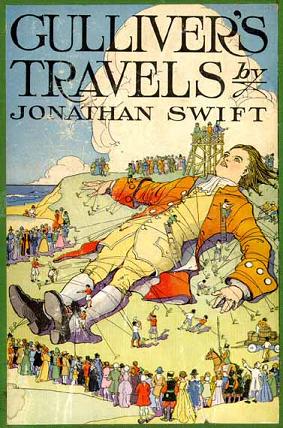 Author Jonathan Swift wrote that the purpose of his writing, “is to vex the world rather than divert it.” Throughout Gulliver’s Travels, Swift satirizes scientists, academics, snobs, politicians, lawyers, doctors, and – unfairly – women. Swift further parodies travel writers’ preoccupation with appearing to be “experts” in everything they write.
Lemuel Gulliver, a sea-loving surgeon and “everyman” travels to four lands and has numerous adventures. The imaginary worlds, fantastic characters, and exaggerated stories of Gulliver’s strange and exotic adventures, draw the reader into the narrative (and inspire film adaptations). Gulliver begins the journey larger than life in the land of the tiny Lilliputians, and after observing mankind’s tendency toward greed and selfishness, he finds himself most contented in a land of horses governed by reason. The moral of the novel suggests that the only ideal world is one in which humans do not rule.
“Satire,” Swift wrote, “is a sort of glass, wherein beholders do generally discover everybody’s face but their own.” The staying power of Gulliver’s Travels lies in the fact that the more things seem to change, they really don’t: mankind has been, and continues to be, motivated by avarice and folly. The practice of economically exploiting other countries was the policy of English and French colonial governments during Swift’s time, just as modern world powers go into underdeveloped cultures and consume their resources. Conflicts of religious ideology, as observed in the battle of the “Big Endians” and the “Small Endians,” are still apparent, as evidenced by the discord throughout the Middle East. Even the feuds between the “High Heels” and the “Low Heels” in the novel continue between and among current political parties.
Despite Swift’s critique of humanity and its institutions, however, he seems to have felt passionately enough about mankind to hope that those who read the book would reconsider themselves and the world around them in order to help make it a better place – “vex” readers into thinking, rather than “diverting” them into switching their thoughtfulness off.
Filed under: Book reviews | Tags: 19th century, Charlotte Bronte, Emily Bronte, feminism, Gothic fiction, historical romance, Jane Eyre, religious fervor, Rochester, romance, romantic novel, Victorian era, Victorian novels
 For Valentine’s Day, I thought I’d write about one of my favorite romantic novels, which I just happened to re read recently. It’s good that I re read it, too, because when I had to read it in high school, I was not impressed – I found it decorative, stilted, and, well, boring. This time, decades letter, I realize how much I didn’t understand in the first reading (as well as how badly my English teacher taught the book!). Jane and Rochester’s relationship is ‘saucy’ and risqué, with motifs of masochism. Moreover, Jane is not the dull woman I initially thought she was, but a spirited and thoughtful feminist who challenges the status quo of society.
Set in nineteenth-century England, the novel begins with the story of young Jane, an orphan who lives with an aunt who dislikes her and doesn’t show her any kindness or affection. When she’s ten, Jane is sent to Lowood, a charity school; despite the cruelty of its headmaster, Jane develops physical, intellectual, and emotional strength. She leaves Lowood School to become a governess for Adèle, the ward of Edward Rochester of Thornfield Hall. Jane and Rochester fall in love despite the difference in their ages and social positions. Mystery surrounds Rochester, however; strange sounds and occurrences abound in his manor. Jane leaves Rochester after the revelation that he is married and his wife, who is insane, is being held captive in the attic at Thornfield. After much suffering, Jane becomes the mistress of a village school. She later discovers that she has living relatives and inherits a fortune, which enables her to return eventually to Rochester as an independent woman.
Jane’s life unfolds as a dramatic adventure within an atmosphere of psychological dread and the constant threat of ruination, typical of Gothic novels. Even as there is mystery, suspense, and horror, which define the genre, the novel addresses social issues of the day. Throughout the narrative, Charlotte Bronte raises questions about the limited education provided in church schools, the expectations and opportunities for women, the value of family connections, and the importance of romantic love even when it conflicts with personal principles or the strict values of Victorian society. As a biographical note, which I think enhances one’s understanding of the book, Brontë incorporated into the narrative several elements from her own life. After Brontë’s mother died, an aunt assisted in caring for the Brontë sisters (Charlotte, Maria, Elizabeth, and Emily). The sisters were sent to Cowan Bridge, a school for clergymen’s children. The cruel and hypocritical fervor of the headmaster in Jane Eyre is based upon the evangelical minister who ran Cowan Bridge. Jane’s loss of her dearest friend at Lowood School to tuberculosis recalls the deaths of Brontë’s two sisters who died of tuberculosis at Cowan Bridge. Like Charlotte Brontë, Jane becomes a governess, which was often the only professional option for an educated woman at the time. The role of governess provided a good vantage point for Brontë to observe and write about the oppressive social practices of nineteenth-century Victorian society. Reflecting Brontë’s early feminist ideals, Jane is rebellious at a time when women were expected to be docile and obedient. Through Jane Eyre, Brontë challenges Victorian mores by suggesting a woman’s merits demand the same respect as a man’s; moreover, she challenges the conventions of Victorian literature by creating a well-developed heroine with a rich inner life.
But even as Jane questions gender expectations, societal conventions, religious practices, and the importance of love in marriage, this is not a didactic or dogmatic book. It is, ultimately, a passionate and seemingly impossible love story set within a spooky atmosphere, whose central tenet is the individual’s quest for an independent identity (still very relevant today), which is why it’s one of the most widely read novels all time.
 Victoria Jelinek