Filed under: Published film reviews | Tags: Aldous Huxley, Donald Sutherland, Dystopia, Gary Ross, George Orwell, Lenny Kravitz, modern life, scary future, Suzanne Collins, William Golding, Woody Harrelson
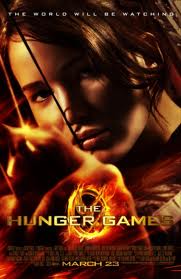 Set in the not-so-distant future, The Hunger Games are a televised death match for lottery-picked teens from each of the Capital’s districts. After volunteering to replace her little sister when she’s chosen to take part, Katniss Everdeen must endure the games, where she’s forced to make tough choices in order to survive, all-the-while facing quandaries about love and humanity.
Meant to take place in a Brave New World in which North America has fallen due to droughts, famine, fire and war, the games are a return to the brutality of early empires – part entertainment for the masses, and part intimidation of the masses. Add this context to our heroine’s moral dilemmas throughout her quest to survive the games, and you have a compelling concept for an action film, but it’s not original: reminiscent of the 1982 movie The Running Man, and the goddess Artemis (bow & arrow, prowess in the woods), with elements from the great classic books 1984 (cold, bureaucratic society), Brave New World (desensitized society), and Lord of the Flies (youth turning against each other), what’s worrying is that the book that this film is adapted from is mandatory reading for middle-school teens in the US…are they also reading the great classics (Orwell, Huxley, Golding) that this book is derived from? Are these teens exploring historical references here, too, such as the Aztecs and the Romans, with their human sacrifices? Are they considering the similarities of this book and film to reality TV? I hope so. Without delving too deeply into the implications of the popularity of this book and film, the fact is that it’s had such incredible box office numbers that it seems important to see the phenomena in order to comment on it. And, despite my ambivalence about the film, I found that it is entertaining fare. With cameos by Donald Sutherland, Lenny Kravitz, and Woody Harrelson.
Filed under: Published film reviews | Tags: cult life, Elizabeth Olsen, John Hawkes, Sean Durkin, Sundance Film Institute
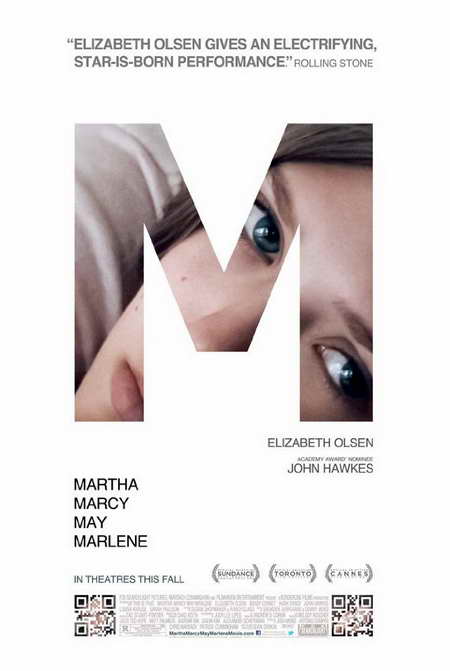 After fleeing a cult, Martha struggles to assimilate with her family and society because she’s haunted by painful memories and increasing paranoia.
Young director and screenwriter Sean Durkin is a new sensation with this movie and for good reason – this is a fine example of the spirit and craft of a great American independent film (the Sundance Institute helped finance it). As a result of his skilful direction, the movie flits between two completely opposing worlds – a backwoods commune and a luxurious lake house – effortlessly, with memories recalled through sound. Patiently, subtlety, Durkin creates an unflinching portrait of cult life that resonates with Martha’s increasingly odd behaviour in the present, creating a suspenseful and vivid portrait of a troubled soul. I was on the edge of my seat for every minute of this film, expecting something horrible to happen. John Hawkes as the cult leader is a believable ‘messiah,’ so gently persuasive with his warped ideas that almost make sense, that you can see how he could win over naïve hearts and minds, even as it raises the hair at the back of your neck (and potentially your ire). However, it’s Elizabeth Olsen as Martha who is particularly fantastic.
That said, “everything” – direction, the entire cast, the script, and the technical value – is stellar. This is absolutely one of the best films I’ve seen in a very long time. And you will remember the unwieldy title after seeing it.
Filed under: Published film reviews | Tags: 9/11, John Goodman, Max Von Sydow, Sandra Bullock, Stephen Daldry, Tom Hanks
 A nine-year-old Francophile, amateur inventor, and pacifist searches Manhattan for the lock that matches a mysterious key left behind by his father, who died in the twin tower bombings on September 11, 2001.
The plot is reminiscent of the film Hugo (an amazing movie by Martin Scorsese, also released this last year), with the great exception that this is about the emotional aftermath of 9/11 through the eyes of a child. Basing a film almost solely on the shoulders of a child actor is very tenuous – the audience will either sympathise with the boy or not. This child, Oskar Schell, is not easy to sympathise with despite his circumstances: he may or may not have Asperger’s; he’s obsessed with puzzle solving, becoming impatient and rude to those who don’t share his obsession; he rattles a tambourine whenever he gets anxious; and he’s often demanding and ‘brattish.’ The cast of actors are capable – Max Von Sydow and John Goodman are especially good, though sorely underused – but fine acting doesn’t save a poorly written script.
Nominated for a Best Picture award at the Oscars this year, this is arguably due to the subject matter, the previous triumphs from director Stephen Daldry, the power of the producer Scott Rudin, and the marketability of Tom Hanks and Sandra Bullock. Because, while some cinemagoers may find this film a universal journey from grief and loss to acceptance and reconciliation, others, like this viewer, will find it manipulative, flat-footed, and just plain boring.
Filed under: Letters to Leo | Tags: infant life, infant nursing, lactating, mothers nursing, nursing
 When I started nursing, my goal was to make it to six months, and even as I was also anxious to get my body back after a long time pregnant. In retrospect, I’m surprised that I made it past the first three months. You were “game” from the get-go, though you always preferred one to the other, which meant that my breasts were lopsided.
The first few months I was so sore that I dreaded it every time you fed (which was frequently, my good little eater). Add this to the sense of disorientation and sleeplessness of those early months and with my family ten-thousand miles away, and I’m surprised not only that I continued to nurse you, but that I didn’t go crazy. A midwife was called in to help, to no avail. A lactose nurse was called in to help, to no avail. I used so many creams – lanolin, wax based, bottom cream for babies, one even for cows – that I did, indeed, feel as though I had challenged “udders.”
But I persisted, and the pain went away almost as quickly as it had come. Six months of nursing you – which all of the doctors told me was the “least” that I could do to help you to get a good start and to fight allergies – seemed possible. We also fed you a bottle in the night because your father was generous and would give it to you, thereby allowing me to sleep through one feed. Once you were three months old and your father was away in the mountains working most of the time, you would have a bottle at your ‘nu nu’s’ once a day when you were there for three or four hours in the afternoon, too. At six months, and during a trip to Seattle to see my family, we integrated food – bananas and rice cereal – into your diet. In fact, it was your uncle Monnix who fed you for the first time. I then thought I’d make it to one year, my ‘secret’ goal, though one I never thought I’d make (hence its being secret), the date to finish nursing you, and even as at nine months, I only nursed you in the evening to help you to sleep, and in the morning, next to me in bed and in order to buy myself some time snoozing.
Now, we’re coming up on your first birthday, and my ‘outside’ goal is almost met, and then I’ll stop nursing you altogether. However, whereas I’d set out thinking that the whole nursing ‘thing’ was a huge responsibility and one that I’d welcome being over so that I could finally have my body back, I find myself feeling very sad. A monumental moment in time that will never be repeated for either one of us is reaching its conclusion. This tender sentiment tells me that it’s the right time to cease and desist. But even so, this tender sentiment is also because nursing you has helped to create an indelible bond between us (and was hugely convenient to do as it turned out!). One that I hope resonates forever, even when you’re too cool for your mother and don’t want to be a “big girl’s blouse” by hanging onto your mother’s protection and love. I worry, too, that because your father is eager and able to participate in your daily care, that I’ll no longer be ‘the apple of your eye.’ Certainly I have not been your primary ‘food source,’ your means to survival, for some time.
Even so, I also understand that this is a necessary milestone for both of us and I will embrace whatever comes to pass, and all of the stages of your life. I enjoy seeing the signs of your growing independence – communicating through your hands, facial expressions and sounds, observing and “commenting” on everything around you…crawling, wanting to explore every inch of any given floor or ground, and pulling yourself up to a standing position…and I look forward to knowing you as you grow and get older. So, I mentally begin to prepare myself for this separation from you next week. And I remind myself that in addition to looking forward to participating in the development of your growth and prosperity, I do look forward to getting my body back (and same-sized boobs) after two years of devoting my physical self, and even more of my emotional self (which will continue), to another creature’s life – you, my darling son.
Filed under: Published film reviews | Tags: Abi Morgan, Denis Thatcher, Jim Broadbent, Margaret Thatcher, Meryl Streep, Phyllida Lloyd
 Margaret Thatcher (Meryl Streep), now in her 80’s, is cleaning out her husband Denis’ closet (Jim Broadbent) and thereby putting his ‘ghost’ to rest. While doing so, and with the onset of dementia, she is confronted by memories of her extraordinary and controversial career.
The (side) love story between Maggie and her husband (as a ghost and as her foil) is interesting, humourous, and often touching. One can also almost relate to Maggie’s growing fear about her dementia. However, this film plays like homage to a woman who was divisive and ideologically driven and, as presented here, was this way with some justification. Sure, capitalism in theory is compelling, but once you factor in human nature, it’s incredibly flawed. Sure, she was a grocers daughter and so compared to the upper classes she was working class, but she wasn’t to the great majority. Sure, she went to university on a scholarship, but it was to Oxford. Sure, she was a pioneer by the fact of her being the only woman in Parliament at that time, but this was also a marketing tool for her.
Ultimately, Great Britain is still reeling from her actions – the miners, the unions, the Falklands, and the Poll Tax to name a few things – and, combined with “Reaganomics” in the U.S., her reign is arguably to blame for much of the disparity of wealth today. However, Meryl Streep in the title role is absolutely fantastic, and it’s because of her that one should see this film.
Filed under: Published film reviews | Tags: Carey Mulligan, dysfunctional behavior, Michael Fassbender, sexual addiction, Steve McQueen
 Professional Brandon (Michael Fassbender) lives in New York City and thinks he’s a normal guy with a robust sexual appetite. We see Brandon full of bravado at the beginning of the film, seeking out sexual encounters everywhere and with everyone. However, when his fragile and damaged sister Sissy (Carey Mulligan) arrives unexpectedly for a long stay, he realizes he might have a problem and the façade of his life begins to fall away.
While it’s understood from reviews, taglines, and marketing copy that “Shame” is about the difficult subject of sex addiction, I felt as though I struggled to fill in the themes and a story: is it about the emotional cost (shame) of conforming or not conforming to ‘normalcy’? Certainly I left the cinema feeling sad, lonely and bleak, but did I look for hidden meaning and symbolism that wasn’t there? Other than hurt looks, some non-sequiteur conversations, and some sordid scenes, there was no real story or new insight. Brandon is uncomfortable, at moments tender, and sometimes seemingly remorseful with his sister, but why? She’s first introduced to us taking a shower, he walks in on her, and she continues to let him see her standing there naked – even seems to invite it; at another moment he’s wrestling with her with a towel around him that falls. Did she pin her hopes of sexual understanding, and he his, on each other? Is this the basis for his sexual proclivity? We’re meant to imagine the worst but other than a suggestion by Sissy that they ‘come from a bad place,’ this is never explored or explained – was there incest between them or within their family? Certainly in life story lines and characters aren’t always well-developed or resolved, but this is cinema, sure, cinema verging on an attempt at cinema verite, but it felt very much like a glossy student film, preoccupied with its own agenda rather than any desire to reach anyone else. Perhaps this is the point, that we wrestle with concepts introduced in this film, sans more information, going out feeling unsatisfied, and feeling the self-absorption and isolation that arguably reflects our modern world….
This is director Steve McQueen’s second film, and like his first, the IRA hunger strike drama about Bobby Sands aptly called “Hunger,” it is visually interesting, well-acted and promotes conversation. That said, I felt the same as a fellow filmgoer in front of me who said on his way out of the cinema to his friend “Well, I’ll never get that two hours back.”
Filed under: Published travel writing | Tags: Aldous Huxley, California, Christopher Isherwood, Contrasts in life, existential, Hollywood, John Steinbeck, Los Angeles, Paradise, Southern California, travel
Los Angeles Reconsidered
 When I moved to Los Angeles for professional reasons, I was prepared to dislike it intensely. I brought with me from my native New York many unfavorable assumptions and negative stereotypes about California and Californians. I believed that LA was full of self-absorbed, superficial people; a cultural wasteland that existed as a city but was really a sprawling suburb; a horizontal city rather than a vertical one.
Initially, LA met my low expectations: it is a sprawling wasteland with Wal-Marts and K-Marts next to small streets of cafes, shops, residences and strip malls; and there are so many Mercedes, Ranger Rovers, and Hummers that I thought that people were automatically given them once they attained a certain income. I’d go to barbeques and have six-minute conversations with people I’d meet about what we each did for work and who would then offer to show me their headshots or resumes and get vacant-eyed when I changed the subject. Working in the film industry, I discovered that it could be, as I had thought, self-absorbed, unjust, and harsh.
Then about a year into living there, I began to see LA differently: I started noticing that the desert life is beautiful and courageous; the succulents, such as the Joshua trees and cacti, are resourceful, keeping water in their hard, leaves and stems; the Oleanders grow beside the dirty highways without any encouragement; the vines of pink, red and purple flowers are everywhere; there are birds singing in every neighborhood, in palm, lemon and lime trees. I started turning towards the dark, dusty hills that surround the city and took walks and horseback rides through them, seeing coyotes, skunks, and bobcats; and every time I’d come over a westward crest near the ocean, I’d find myself catching my breath with the first glimpse of the breaking waves.
CINEMA DISCOVERED
Buoyed by the city’s natural beauty, I started exploring further.
Cinema venues, of course, abound: there are the American Cinematheque and the NuArt, that run festivals from various countries and themed screenings in various genres; there is the El Capitan, where an organ player rises from the floor and plays while you’re being seated; there’s Grauman’s Chinese Theater, with its grand architecture and the footprints from the silver-screen actors of Hollywood to today’s superstars out front, combined with its supersonic sound and fine picture quality inside, is a movie cathedral. There’s the Arclight, where ushers wear nametags with their favorite movie characters and introduce the films. There’s the Kodak Theater special screenings of classic movies and where the Oscar ceremony is held.
THE GREAT OUTDOORS
There are free tennis courts everywhere, public pools for a dollar, and skating, bike-riding, and skateboarding activities along the long coastline from Malibu to Hermosa Beach. Tolerable skiing is only an hour away, and good skiing is a five-hour drive through the desert. The desert is also great for camping and visiting motels and hotels hidden away in the Joshua tree forest, or near Barstow or Palm Springs, where there are natural aquifers allowing ranches and settlements to seem like oasis’.
EMIGRES AND EXILES
I saw anew the colorful contributions of immigrant Mexicans: murals everywhere, little stucco churches with tall, simple steeples, colorfully painted houses terraced into the hills of Silverlake and Echo Park, and I was fascinated by the fact that Mexican families use the parks on the weekends en masse, having picnics and playing games with their extended families. I found a Korean town, a Japanese town, a China town, a Thai town, and an Armenian town, in each of which the people have retained their own culture’s foods, clothing, shops, and lifestyles, despite the inevitable move toward assimilation into the general culture, which is enhanced by this diversity.
Writers, directors, actors, migrated en masse to LA at the turn of the 20th century for a variety of reasons, and stayed. They still do. The long list is, in itself, a testimonial to the appeal, financially, symbolically, and topographically of Hollywood-Los Angeles.
Most people focus on the exploitive business practices of the many unprincipled executives in the film industry, which creates the negative stereotypes of LA, but there’s a well-developed infrastructure in the city, its highways, its airports, its businesses, its cultural scene, as well as the tropical climate.
THE PROMISED LAND
In time, I learned the subtle fact that Californians know and outsiders don’t: Hollywood and Los Angeles should be evaluated as two cities, which are separate but symbiotic. I then learned the history of the region that put the present day city in context—a place of easy money and easy ways, a place that cashed in on gambler’s luck, first with the Franciscan padres finding artesian wells in the late 19th century that made the region a veritable Garden of Eden, then the Gold Rush to Northern California, the influx of oil Sheiks of the 1920’s in Southern California, and finally the boom of the film industry. All of these events carried out the theme of California as a place that promised the American ideal of riches. I considered the harsh reality of those working in film, and the “truth” of these stereotypes – it’s a difficult city to penetrate, because it seems to exist on the surface, but it does deserve to be considered more fully.
IN CONCLUSION
I was, and am, still aware that there’s a sharp contrast between the haves and have-nots in Los Angeles. And the sentiments I held when I first moved to Los Angeles – basically that it’s a cultural wasteland that exists as a city but is really a sprawling suburb – still holds truth. But it’s not the whole truth.
I’ve since moved to Europe, and I often think of California. It’s to its credit that it convinced this skeptic of its charms. So much so, that I become defensive when listening to many stereotypes about Hollywood-Los Angeles uttered by people in my adopted country (and despite having held them myself at one point!), especially statements about the negative television and film images exported to the rest of the world (but eagerly seized upon, I may add) as the sole purpose of the city and examples of its offerings.
It’s unfair to LA to cling only to the negative, to the stereotypes – LA has various storylines – urban and suburban sprawl, ‘high’ and popular culture, sun and sand, mountains and trees, diverse languages and people. It’s all of these wonderful and unexpected elements of the city, in contrast to the pretentious and often tawdry goings on, that function as a chorus, and sometimes principal character, in the story of LA.
Filed under: Published film reviews | Tags: Carl Jung, David Cronenberg, Keira Knightley, Michael Fassbender, Sigmund Freud, Viggo Mortensen
 The plot is described as “a look at the intense relationship between Carl Jung and Sigmund Freud that gives birth to psychoanalysis.” Okay, sounds a bit stuffy, but I studied psychology a bit and heavily relied on Freud’s social insights to write my dissertation, so it sounded intriguing to me. Add Director David Cronenberg (The Fly, Naked Lunch, A History of Violence) and sexy Viggo Mortensen and I’m sold. Going into the cinema I was skeptical about Keira Knightley’s role, but assuaged my worry by telling myself that she’d play a minor character, maybe even just a cameo, and that her name was simply attached to sell the movie.
The plot is not about Jung and Freud. There are minor elements of their relationship as it pertains to psychoanalysis, but they are secondary at best. The focus is primarily on the relationship between Jung (Michael Fassbender) and his patient, played by Keira Knightly, who overacts here to such a degree that it’s painful to watch and who is unfortunately in practically every single frame looking like a palsy victim (and I don’t wish to offend palsy victims by saying this). There is no chemistry between these ‘star- crossed’ lovers, either, despite some manufactured ‘erotic’ scenes. Even Viggo as Freud was dull, a disappointment. That said, no actor could save such a contrived script that is essential boring cliches and little action. But I save my greatest scorn for Cronenberg; I have loved his work in the past and it was his name that drew me to the cinema; but his signature ‘darkness’ (echoing Freud’s theories of the dark and sinister within all of us in society) was false here; there is no sense of direction, as scenes felt meandering and random; and the whole film seems to be lost in costumes and props.
Filed under: Letters to Leo | Tags: antibiotics for infants, creche, MMR vaccine, pink eye, vaccination
 You had your MMR vaccine last week (measles, mumps, rubella) and haven’t been the same since. First you broke out in what looked like hives (though the lazy women at crèche sent you home with chicken pox – varicelle. I asked them where you would have got it and they admitted that there had been a case at crèche two weeks prior though they weren’t sheepish about it, they still acted like you were ‘typhoid Mary’). The skin on your face which is always dry, red and chapped (everything is dry here, I must get better about using your humidifier) got worse. Then your eyes swelled up. Then they started oozing yellow goop and you’d wake up from your nap or in the morning with them sealed shut, scared and crying. Normally calm and easy, you were suddenly fussy and needy, crying and whining if I left your side for even a moment. Of course this all happened on Friday evening and over the weekend, so I couldn’t make an appointment with a doctor. And of course it was the busiest workweek for your father, so while he’s often at home, he wasn’t during this time.
Well-meaning moms here told me you had conjunctivitis (pink eye) and that it’s highly contagious. I had to suffer through lunch with a smug mom whose three-month-old son slept the entire time and the only time he woke up he ate from her breast and then looked cutely around while you fussed, threw things everywhere, and scratched and itched at your eyes and face. The waitress repeatedly remarked on how cute the other little boy is without thinking how that’d be for me, or you (I didn’t tip her for this and because she was an awful waitress). Granted, my gorgeous boy (you!) wasn’t up to par and looking your best, but still.
Bright and early Monday morning I called the doctor and when they told me it was ‘complicated’ to get an appointment for the same day, I begged and prevailed. I then got lucky and got a parking spot not hideously far from the office so that I could slowly and carefully carry you through, and over, the snow and ice. The doctor determined that you have an ear infection and bacteria on your face and in your eyes, and prescribed a general antibiotic. I took it, thanked him, and left. But then I got to thinking that you’d just had the MMR vaccine (and had had a cold when given it) and that takes a lot out of babies…and that you’d had antibiotics – twice – in September, a mere three months prior…and that you’d just seen another doctor the week before (for the MMR and 9 month check up) and she’d not noticed that your ears were infected, and she had looked…so then I got to thinking that I’d maybe done the wrong thing by starting you on the antibiotics, that maybe I should have questioned these things more when they were prescribed, that I shouldn’t have had the MMR done while you had a wee cold (though I did mention this to the doctor), that I am a ‘bad mommy’ and I’m hurting my wee boy.
Panicked, I was up till 2am last night reading various articles online that scared the living hell out of me about the MMR vaccine being linked to Autism, and antibiotics and asthma…I had made fun about the trend in Seattle for intellectual mothers NOT to vaccinate their children due to fear of autism, and even the doctor who prescribed you antibiotics for an ear infection in the US then, had hesitated as they were worried I’d protest, loudly. I’d thought then, and still do think so (but you’re my little one and I want to do the best by you) that by not vaccinating one’s children folks are sending us (western society) back into the dark ages, and that vaccines are the best thing to have happened in the last century. Yet here I am, worried that I’m wiping out your immune system and that you’ll get autism and my sweet, gregarious, sociable child will withdraw from the world and be ‘lost’ forever…
A friend of mine in London who is smart and modern, I respect her, told me when I told her about my fears, that there’s a rise in children getting measles and mumps, that death from measles is on the rise again in England ‘cause middle-class moms aren’t vaccinating their children and that I did the right thing. Your nu nu (Emma) that I trust and respect (two very hard things for folks to get from me) said that she didn’t vaccinate her boys due to all the information, too, and one of them got the measles. That she also knows that once you start antibiotics you have to finish them, so maybe this will wipe whatever is in your little system out once and for all, and she advised I go to the chemist and try to see if there’s something I can get to help your intestines build up their ‘good flora’ again.
Well, I didn’t sleep much last night and today I was looking at you carefully in a paranoid manner to make sure that you still look one directly in the eye. But for the first time in several days it’s a gorgeous day and as my mother says ‘all things seem possible’ on days like this. So, I will make a point of going to the chemist after part 5 of my root canal and asking them about building up your ‘good flora’ again after telling them what the issue is (in French – bon chance!) and I’ve scheduled a doctor appointment for ME in a couple of days and I’ll cheekily raise a couple of my concerns regarding you, then.
I wish I’d studied medicine. Or car mechanics. Something useful.
Filed under: Published film reviews | Tags: Christoph Walz, Jodie Foster, John C. Reilly, Kate Winslet, Roman Polanski
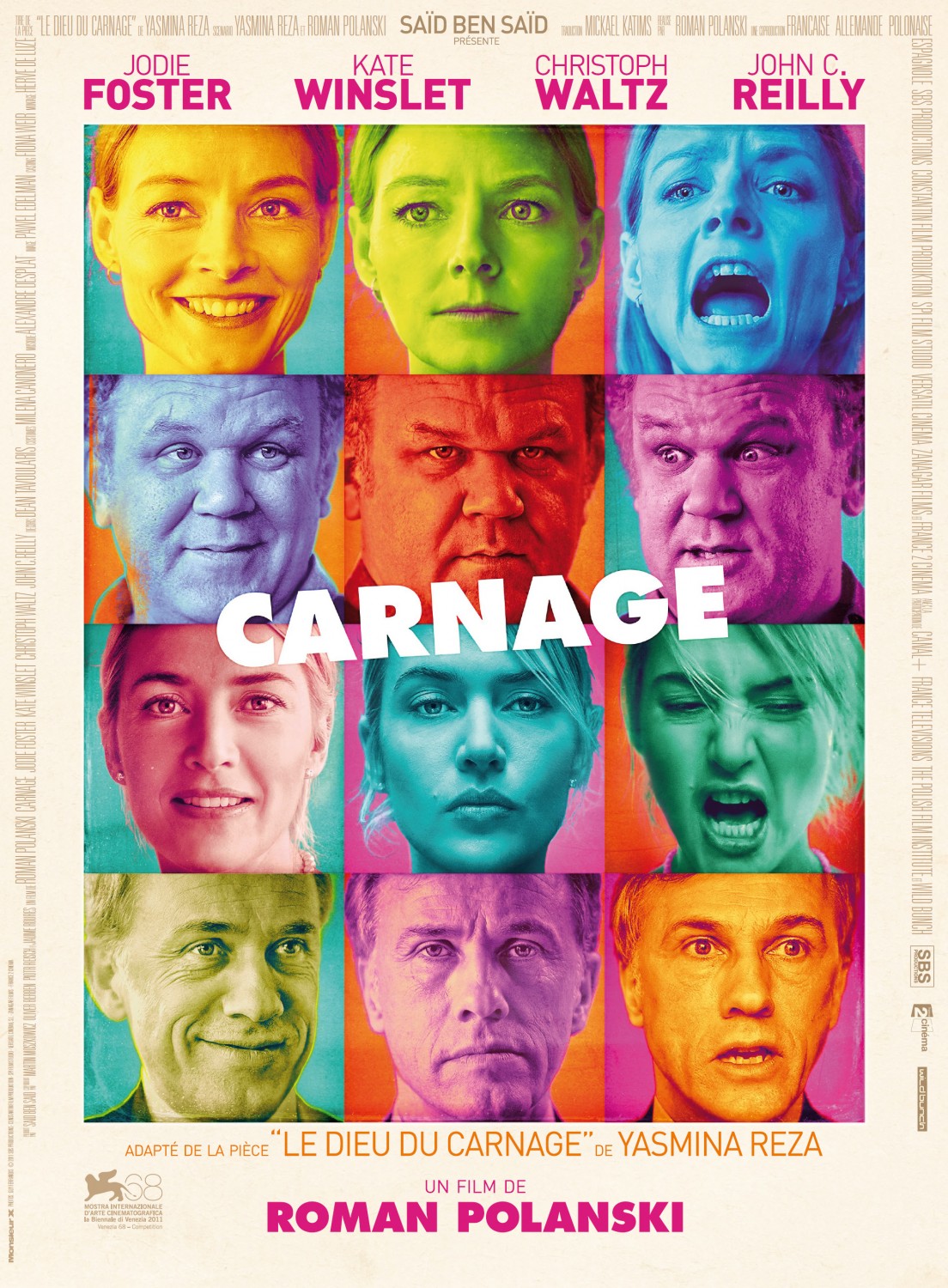 Two pairs of parents (Jodie Foster, Kate Winslet, John C. Reilly, Christoph Waltz) have a cordial meeting after their sons are involved in a fight with each other. But as their time together progresses, and coffee is replaced by whiskey, the veneer of amenity is removed, and the barbs and revelations come out.
Directed by Roman Polanski (Chinatown, Repulsion, Rosemary’s Baby, The Ghost Writer) this is a dark, intellectual and extremely funny film; this viewer was guffawing and snickering throughout. We don’t know exactly what happened between the two sons of the respective couples – it doesn’t really matter as a plot, because this is a showcase for good writing and fine actors to portray four characters in detail. But even as the main characters are well-developed, realistic and interesting, it’s a short film (79 min).
Polanski and his quartet of excellent actors should all be nominated for an Oscar. This is a darkly comic film worth seeing.
 Victoria Jelinek