Filed under: The Baby Diaries | Tags: Boy George, Chamonix, clubbing, Culture Club, DJ's, expats, French Alps, hyperreality, L'Amnesia, motherhood, nightclubs, pop music, teen spirit, The New Romantics
“Forty is the old age of youth; fifty the youth of old age.” Victor Hugo
 A friend invited me to go and see Boy George in Chamonix last Friday night. Yes, that’s right – Boy George of the Culture Club fame, the iconic girlie-man in the pop band of the 1980’s – was in this wee village DJ’ing, or ‘spinning.’ When I remarked on how bizarre it was to have Boy George in town to my husband, he tried to give it the ‘big un’ about how Chamonix is a cosmopolitan place, a destination for many, and that I underestimate its appeal…that Boy George probably saw it as an opportunity to go snowboarding for the weekend, hang out in a “cool French Alpine village,” and do his DJ’ing. Hmmm. I later found out he was paid 15k, which makes more sense. Curious to see what he looks like now, and a little anxious to prove to myself that I’m not only a rapidly aging mother, I agreed to go. Then I found out that he wasn’t scheduled to begin till 1am. If I’m up at 1am these days it’s cause my little tyke has wet or pooped himself, had a ‘night terror,’ is hungry, or has indigestion. Moreover, if I’m up at 1am these days, it means that when my day inevitably begins at the crack of dawn, I’m going to be even more fatigued than usual. Not wanting to disappoint my friend, however, or myself, I decided that on the night of the show, I would go to bed at the same time as my son (shortly after dinner), then wake up at midnight and go to the gig. All went as planned, I got a few hours of sleep, got dressed, made a coffee for myself, took an ibuprofen, (god I’m lame), and set off for the nightclub.
Nightclubs still smell like the teen spirit of my youth – sweat, alcohol, hormones, and the close, stale smell of an interior that never opens its doors for a spring-cleaning. This one is downstairs in a cave-like space below a two-story magazin. I couldn’t help but think that if there were a fire none of we club goers would be able to escape and it’d be a tragedy noted on the AOL homepage. Many of Chamonix’s expat ‘society’ were out for the gig – middle aged, middle class, dressed up in heels and ‘hip’ tennis shoes, already drunk in celebration of being away from their respective hearths-and-homes, in denial of the next morning and the demands of children and the household. Boy George didn’t come on until 3am (he must have been snoozing before his set, too) and he looked good: he had a sequined butterfly flower makeup design on half of his face, eyeliner, white foundation make up, and a pink, glittery fedora, with a simple black suit. Like the rest of us, he’s put on a bit of weight over the years. There was a charisma and energy around him – you could sense him moving through the crowd even before he entered the DJ booth. Immediately there was a tight knot of people around the little booth, which would have made me claustrophobic. Hyper-realistically, cell phones were over the heads of everyone standing around him as they took pictures and made videos. Boy George didn’t do much other than bob around while his partner actually DJ’d, then he, himself, started spinning. He chose ‘poppy’ riffs, which were good, and the music he chose had an energetic, non-aggressive beat, but after awhile, it was repetitious, and, well, boring. I wasn’t the only one to think so either ‘cause the club drained of folks pretty quickly. That said, maybe the crowd left because they were knackered in the small hours of dawn?
Filed under: Published film reviews | Tags: Bill Murray, Bob Balaban, Cate Blanchett, George Clooney, Jean Dujardin, John Goodman, Matt Damon, Nazi, Oceans Eleven, Russian, Second World War, WWII
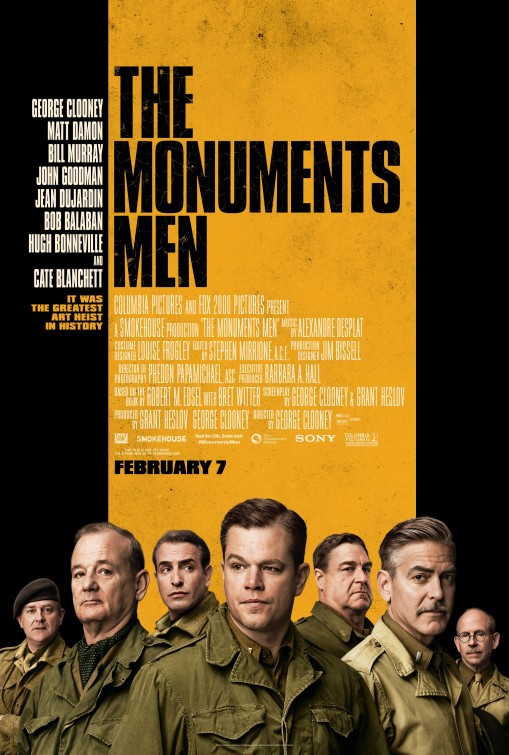 At the end of WWII, Frank Stokes (George Clooney) puts together a crew of art experts willing to brave the front lines in order to rescue continental Europe’s cultural heritage from the Nazi’s obliteration of the pieces, and the Soviets pillaging of them.
I unabashedly like George Clooney, who also directed and co wrote this film. I know he’s arguably “too earnest,” and a bit “too slick,” but I don’t care – I appreciate his efforts. That said, this latest endeavor was disappointing. It’s a handsome film, and the concept is great – art geeks braving the ruthlessness of war to do the right thing and save our collective treasures. But the film is not focused, making the pieces incoherent and episodic. It wants to be an important film, asking (repeatedly) whether a work of art is worth a human life. It also seems to want to be like the daring Nazi-bashing escapades of yore, with its whistling score. It also seems reminiscent of a Danny Ocean orchestrated heist. Not one of these objectives is successfully accomplished, though, due to a poorly constructed story that does not have one unifying’ job’ that brings all the seams together. It’s a shame, too, ‘cause the idea has potential, there are several excellent scenes, and the cast is talented…
Filed under: The Baby Diaries | Tags: Chad, Cote d'Ivoire, equal rights, French Republic, gender equality, human rights, International Women's Day, Iran, Mali, Marianne of France, Mauritania, Morocco, Pakistan, Saudi Arabia, suffrage movement, Syria, WEF, World Economic Forum, Yemen
Before God we are all equally wise – and equally foolish. Albert Einstein
 International Women’s Day is March 8th and it has me thinking about what it means to be a woman in the context of motherhood today. It may be a taboo to write, but I find that the most difficult aspect of motherhood is the fact that I must be less selfish. I think it’s hard enough to be an ambitious woman in this world, much less one who is also a mother.
Having my son has been, by far, the greatest accomplishment of my life. This in the context of surviving divorce, illness, several moves, and a few career incarnations. In the long run, too, it is likely the most interesting thing I’ve ever done. This is in the context of living in a variety of places, working in the film industry and as a writer, traveling everywhere, and being married more than once. But in the daily scheme of things, it’s hard work to be a woman and a mother. I won’t be able to sleep in again until he’s in his teens. I can’t just move to a more desirable locale if the whim or an opportunity exists, as I must defer to my husband and his wishes. I must work towards compromise and contentment in my marriage to the father of my child, even when circumstances are taxing. Living in a provincial small town, I must often sit with the women in the kitchen as we discuss our children and our marital relationships, when I would prefer rhetorical conversations on politics, culture, books, and film. And, when I do have the opportunity for these types of conversations, they are fractured because I must attend to my small child. It’s a lot of personal sacrifice and a lot of work, which has prompted me to go outside of myself and consider what we as women have accomplished over the last century.
Issues typically associated with notions of women’s rights cover, but are not limited to, several points: the right to bodily integrity and autonomy. Yet these rights do not exist for many women in the Middle East or Africa, as evidenced in mutilation exercises, rape, and the covering of the body. The right to vote. This is relatively new – it only became possible for women in the U.S. in 1920 and in the UK in 1928, and it has just became possible for Saudi women in 2011. The right to hold public office. Yet women are not evenly represented with men in public offices throughout the world. The right to fair wages and equal pay. Yet women, on average, earn 44% less than a male counterpart in the same position. The right to own property. Yet in China, male family members are the proprietors of property, and in France, a man’s property goes to his son, first, and if there isn’t a son, the father, and if there isn’t a father, a brother, before it goes to his wife. The right to be educated. Yes, indeed, girls can go to school, but see the aforementioned regarding equal opportunities and wages. Parental and marital rights. In France in a divorce, the children are not automatically put in the guardianship of their mother (not by a long shot) and there is no such thing as an equal division of property (the French republic’s motto is, after all, “Liberte, Eqalite, et Fraternite” even if the French republic’s motto is embodied by the image of a woman, Marianne of France). When there are disparate rights between men and women, institutionalized or supported by law, local custom, or behavior, the argument runs along the lines that women’s rights are different from the broader aspirations of human rights because of inherent historical and traditional bias against females. In essence, a man’s rights trump a woman’s rights because it’s just that way historically and culturally.
I stumbled on an article written in The Washington Post in October entitled “7 Ridiculous Restrictions on Women’s Rights Around the World.” Apparently, road safety laws do not apply to women in India (such as helmets on a motorbike). In Yemen, women are considered half a person when giving testimony (but hey, they can give testimony). Also in Yemen, women can’t leave the house without permission from their husbands (rushing to the aid of ill parents is exempted). In Ecuador, abortion is illegal unless you’re “demented” or an “idiot” (there’s another article on political correctness here). In Saudi Arabia and Morocco, rape victims can be charged with crimes (such as leaving the house without a man in the first place). Also in Saudi Arabia, women can’t drive (but they’re not even the worst – they’re #10 ahead of Mali, Morocco, Iran, Cote d’Ivoire, Mauritania, Syria, Chad, Pakistan and Yemen).
What’s also worrying to me is that many younger women (I can’t believe that I can say this) feel that the battle for equal rights between men and women has been won. Sure, there are more women in the boardroom and in the political arena, as well as greater equality in legislative rights, and there are visible female role models in all aspects of life…but, as mentioned, they are not paid the same as their male counterparts, nor represented in equal numbers in politics or business (ever notice that the heads of all the departments on a film crew are usually male, too, with the exception of hair and makeup, costume, and a few producing roles?) But this prompts me to hope, and, as I explain my hope, reveal my cynicism: my hope is that money will eventually motivate the change necessary to truly make women equal. The World Economic Forum recently wrote that there’s a “strong correlation between a country’s gender gap and its national competitiveness.” Ergo, a nation’s competitive edge in the long term depends on whether it utilizes its women, who comprise one-half of a given country’s “potential talent base.”
When I consider the global situation, I know I should be grateful, not least of all because I have the luxury to consider these things. I’m also married to a Danish man, and all of the Scandinavian and Northern European countries are in the top rankings for gender equality (alongside the Philippines and Nicaragua – who would have thought?). I can vote (but for whom?). I can leave the house of my own volition without fear of arrest. I can drive. I can work and have a family, even if it’s stressful sometimes. And while it sometimes doesn’t seem like it, I do have choices.
Filed under: Published film reviews | Tags: 12 Years a Slave, 1920’s Hollywood, Academy Awards, Afterglow, Alexander Payne, Alfonso Cuaron, American Hustle, Amy Adams, Best Picture, Brad Pitt, Bruce Dern, Captain Phillips, Chiwetel Ejiofor, Christian Bale, Dallas Buyers Club, David O'Russell, Elizabeth, George Clooney, GoodFellas, Gravity, Her, History of Oscars, Jared Leto, Jennifer Garner, Jennifer Lawrence, Joaquim Phoenix, June Squibb, Leonardo di Caprio, Los Angeles, Martin Scorsese, Matthew McConaughey, Michael Fassbender, movie studios, Nebraska, Oscar ceremony, Oscars 2014, Paul Greengrass, Philomena, Plan B Productions, Raging Bull, Roy Woodroof, Sandra Bollock, Shakespeare in Love, Spike Jonze, Steve Corgan, Steve McQueen, Taxi Driver, The Kodak Theater, the Motion Picture Academy, The Wolf of Wall Street, Tom Hanks, Will Fort, William Friedkin, World War Z
 I was told when I worked at a talent and literary agency in Hollywood many years ago that the formation of the Oscar awards was a cynical endeavor. The legend went that there had been a rash of sordid incidents in Hollywood in the 1920’s involving starlets and wannabes who came to Los Angeles from all over the US, and so the Oscars were set up by the big bosses of the day as a way to create a nobler image of Hollywood and garner some good press. I’m not sure this tale is true, but I don’t dismiss its possibility outright. What is certainly true is that because of the prestige and positive exposure of the Academy Awards, studios spend millions of dollars and hire publicists to promote their films during “the Oscar season.” This practice has generated accusations that the Oscars are influenced more by marketing, than by quality. In 2009, William Friedkin, himself an Academy Award winning film director and former producer of the ceremony, described the Oscars as, “the greatest promotion scheme that any industry ever devised for itself.”
Despite its potentially disreputable origins and many criticisms of the event, the Oscars are still a grandiose affair I love. Speaking of grand, I’m going to make my predictions about the Best Picture category, and then wait with bated breath to see if I’m correct. I think that the Oscar will go to 12 Years a Slave or The Wolf of Wall Street. My reasoning is that the Academy will not award Steve McQueen Best Director, given his age and his competition in this category, and unless they award Chiwetel Ejiofor Best Actor, they will not want to appear racist by overlooking this film in the major categories (racism is still a hot subject in the US). Moreover, Brad Pitt’s production company produced it, and there have been some bad press and disappointed expectations regarding his costly movie World War Z, so the industry might want to generate some positive feelings. If it is, indeed, 12 Years a Slave, a movie I found beautiful to look at, but too didactic and self-conscious, it won’t be the first time nepotism and guilt won the day (I remember sitting open mouthed when Shakespeare in Love won Best Picture in 1999). If it’s The Wolf of Wall Street, then it will be in an effort at atonement for the fact that Scorsese has never won the Best Picture award, despite his films Taxi Driver, Raging Bull, and Goodfellas. Best Director, yes, but never Best Picture. Moreover, Leonardo di Caprio has never won an Oscar, so he may get the Best Actor win, but if he doesn’t, there could be the desire to create a balance with the Best Picture. Don’t get me wrong, I loved The Wolf of Wall Street, but I don’t think it deserves Best Picture. I can live with this win, however.
I’ll be gutted if American Hustle wins. Talk about nepotism and a popularity contest. Writer/Director David O’Russell has delivered fine films, such as The Fighter and Silver Linings Playbook, but this isn’t as good as it’s touted to be. Sure, the actors are charismatic and capable, the production design is entertaining, the soundtrack is nostalgic, and there are fun costumes, as well as a lot of time devoted to amusing hairstyles, but there’s little point or suspense to this film.
I’ll also be upset if Philomena wins either Best Picture or Best Adapted Screenplay. Sure, it’s harrowing subject matter (see my thoughts on 12 Years a Slave and the appearance of being sympathetic), the acting is brilliant, the humor is good, but this shouldn’t be confused with the Best Picture or the Best Adapted Screenplay. The Former ‘cause there are more comprehensively great films this year in the category. The second, for the same reason, and because there is a storyline introduced and dropped rather clumsily that should eliminate it from this honor: the scene is the one in which Philomena and Martin meet her son’s adopted sister, who came with him from the convent. Mary (Mare Cunningham) states they did not have a happy childhood, and suggests cruelty on the part of their adopted father, but this is not developed. She claims that Philomena’s son never mentioned or considered their origin, Ireland, or his biological mother, a fact that is later completely discredited. I was left with many questions about Mary’s motives for lying, and the inclusion of this scene in the film, and believe that without developing these provocative storylines introduced here (which the film did not) this scene should have been cut. Its insertion niggled me, and I suspect its inclusion is a clumsy attempt to create a sense of ‘jeopardy” before the third act. But I digress.
Captain Phillips was suspenseful and well shot, but not the Best Picture in my opinion. Nor is Her. Relevant, and a great concept, but not the Best Picture. And I think that despite Spike Jonze’s contacts and cult status in the biz, even the Academy won’t give this film the win. Gravity is beautiful and has lofty existential themes that I find incredibly interesting, but if this wins it will be because the Academy doesn’t want to seem as though it didn’t get it. It’s more likely Alfonso Cuaron will get Best Directing (though I hope Alexander Payne gets it). I’ll be happily surprised if either Dallas Buyer’s Club or Nebraska wins Best Picture (though, as mentioned, I’m fine with the atonement and ‘career honor’ motivations prompting Scorsese’s film to win). If neither Dallas Buyers Club nor Nebraska win the Best Picture, then I hope to god that they win Best Adapted Screenplay and Best Original Screenplay, respectively – they deserve it (see my notes on Philomena), or that one of them gets the Best Actor win.
It would be too lengthy a piece to cover the race for Best Actor and Best Actress, or Best Supporting Actor and Actress. Suffice it to say that the competition is thick (please let it be Matthew McConaughey or Bruce Dern! Please let it be Judi Dench or Cate Blanchett!) But, again, it’s worth remembering that members of the Academy choose the winners – these are fallible folks who work, or have worked, in the industry of movies. Similar to the rest of the big honors, the acting prizes have been criticized for not recognizing superior performances so much as being given for personal popularity, sentimental reasons, atonement for past mistakes, or as a “career honor” in order to recognize a distinguished nominee’s entire cannon of work…watch it all with a grain of salt, and enjoy the fete.
 Victoria Jelinek