Filed under: Published film reviews | Tags: action film, Chris Pine, Reese Witherspoon, romance comedy, Tom Hardy
 Two friends, who also happen to be top CIA operatives, wage battle against each other after discovering they’re dating the same woman (played by Reese Witherspoon, Walk the Line, Election, Legally Blonde).
Sounds like light fare that’s slick Hollywood, and it is, but it also has some entertaining bits. This is largely due to Witherspoon. She manages to walk the line between being fortunate enough to date two handsome men and also appear sympathetic to the audience as she embarks on the lonely and disheartening game of dating, which doesn’t come naturally to her.
That said, this film is not worth the price of a cinema ticket, even as it is worth renting on DVD because it’s easy and pretty. The subplot about a “bad guy” out to get the two CIA operatives as revenge, is gratuitous and concludes abruptly. The romance between the three primary characters is too expedient and easy, as are their feelings of love. The comic relief of the film, Witherspoon’s bawdy confidante, is overdone, though she has her moments. And one can’t help but wonder how these two men became so powerful within their organisation when they are so indiscreet and blatantly misuse their company’s resources. Ultimately, this film has explosions, the smashing up of things, romance, and gorgeous clothes and shoes, suggesting that the filmmakers created a script based on the assumptions about what men and woman want in a movie. They almost got it right in terms of the acting and the concept, but they couldn’t hide the fact that the plot is thin, the circumstances and events too unbelievable (even for those most ‘game’ for it in the audience), and the dialogue is often too embarrassing to listen to, much less funny.
Filed under: Published film reviews | Tags: Aldous Huxley, Donald Sutherland, Dystopia, Gary Ross, George Orwell, Lenny Kravitz, modern life, scary future, Suzanne Collins, William Golding, Woody Harrelson
 Set in the not-so-distant future, The Hunger Games are a televised death match for lottery-picked teens from each of the Capital’s districts. After volunteering to replace her little sister when she’s chosen to take part, Katniss Everdeen must endure the games, where she’s forced to make tough choices in order to survive, all-the-while facing quandaries about love and humanity.
Meant to take place in a Brave New World in which North America has fallen due to droughts, famine, fire and war, the games are a return to the brutality of early empires – part entertainment for the masses, and part intimidation of the masses. Add this context to our heroine’s moral dilemmas throughout her quest to survive the games, and you have a compelling concept for an action film, but it’s not original: reminiscent of the 1982 movie The Running Man, and the goddess Artemis (bow & arrow, prowess in the woods), with elements from the great classic books 1984 (cold, bureaucratic society), Brave New World (desensitized society), and Lord of the Flies (youth turning against each other), what’s worrying is that the book that this film is adapted from is mandatory reading for middle-school teens in the US…are they also reading the great classics (Orwell, Huxley, Golding) that this book is derived from? Are these teens exploring historical references here, too, such as the Aztecs and the Romans, with their human sacrifices? Are they considering the similarities of this book and film to reality TV? I hope so. Without delving too deeply into the implications of the popularity of this book and film, the fact is that it’s had such incredible box office numbers that it seems important to see the phenomena in order to comment on it. And, despite my ambivalence about the film, I found that it is entertaining fare. With cameos by Donald Sutherland, Lenny Kravitz, and Woody Harrelson.
Filed under: Published film reviews | Tags: cult life, Elizabeth Olsen, John Hawkes, Sean Durkin, Sundance Film Institute
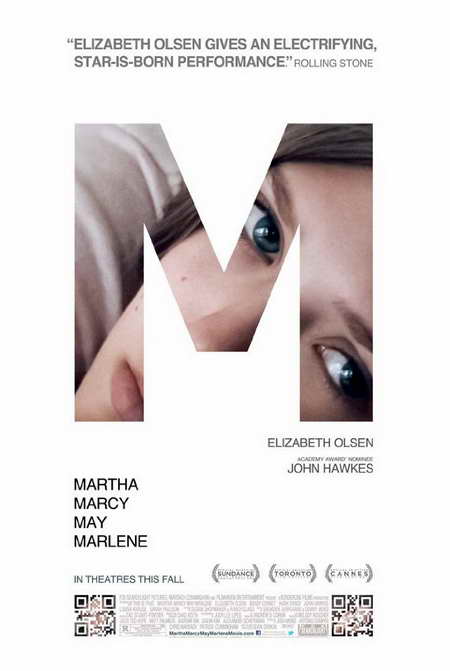 After fleeing a cult, Martha struggles to assimilate with her family and society because she’s haunted by painful memories and increasing paranoia.
Young director and screenwriter Sean Durkin is a new sensation with this movie and for good reason – this is a fine example of the spirit and craft of a great American independent film (the Sundance Institute helped finance it). As a result of his skilful direction, the movie flits between two completely opposing worlds – a backwoods commune and a luxurious lake house – effortlessly, with memories recalled through sound. Patiently, subtlety, Durkin creates an unflinching portrait of cult life that resonates with Martha’s increasingly odd behaviour in the present, creating a suspenseful and vivid portrait of a troubled soul. I was on the edge of my seat for every minute of this film, expecting something horrible to happen. John Hawkes as the cult leader is a believable ‘messiah,’ so gently persuasive with his warped ideas that almost make sense, that you can see how he could win over naïve hearts and minds, even as it raises the hair at the back of your neck (and potentially your ire). However, it’s Elizabeth Olsen as Martha who is particularly fantastic.
That said, “everything” – direction, the entire cast, the script, and the technical value – is stellar. This is absolutely one of the best films I’ve seen in a very long time. And you will remember the unwieldy title after seeing it.
Filed under: Published film reviews | Tags: 9/11, John Goodman, Max Von Sydow, Sandra Bullock, Stephen Daldry, Tom Hanks
 A nine-year-old Francophile, amateur inventor, and pacifist searches Manhattan for the lock that matches a mysterious key left behind by his father, who died in the twin tower bombings on September 11, 2001.
The plot is reminiscent of the film Hugo (an amazing movie by Martin Scorsese, also released this last year), with the great exception that this is about the emotional aftermath of 9/11 through the eyes of a child. Basing a film almost solely on the shoulders of a child actor is very tenuous – the audience will either sympathise with the boy or not. This child, Oskar Schell, is not easy to sympathise with despite his circumstances: he may or may not have Asperger’s; he’s obsessed with puzzle solving, becoming impatient and rude to those who don’t share his obsession; he rattles a tambourine whenever he gets anxious; and he’s often demanding and ‘brattish.’ The cast of actors are capable – Max Von Sydow and John Goodman are especially good, though sorely underused – but fine acting doesn’t save a poorly written script.
Nominated for a Best Picture award at the Oscars this year, this is arguably due to the subject matter, the previous triumphs from director Stephen Daldry, the power of the producer Scott Rudin, and the marketability of Tom Hanks and Sandra Bullock. Because, while some cinemagoers may find this film a universal journey from grief and loss to acceptance and reconciliation, others, like this viewer, will find it manipulative, flat-footed, and just plain boring.
Filed under: Published film reviews | Tags: Abi Morgan, Denis Thatcher, Jim Broadbent, Margaret Thatcher, Meryl Streep, Phyllida Lloyd
 Margaret Thatcher (Meryl Streep), now in her 80’s, is cleaning out her husband Denis’ closet (Jim Broadbent) and thereby putting his ‘ghost’ to rest. While doing so, and with the onset of dementia, she is confronted by memories of her extraordinary and controversial career.
The (side) love story between Maggie and her husband (as a ghost and as her foil) is interesting, humourous, and often touching. One can also almost relate to Maggie’s growing fear about her dementia. However, this film plays like homage to a woman who was divisive and ideologically driven and, as presented here, was this way with some justification. Sure, capitalism in theory is compelling, but once you factor in human nature, it’s incredibly flawed. Sure, she was a grocers daughter and so compared to the upper classes she was working class, but she wasn’t to the great majority. Sure, she went to university on a scholarship, but it was to Oxford. Sure, she was a pioneer by the fact of her being the only woman in Parliament at that time, but this was also a marketing tool for her.
Ultimately, Great Britain is still reeling from her actions – the miners, the unions, the Falklands, and the Poll Tax to name a few things – and, combined with “Reaganomics” in the U.S., her reign is arguably to blame for much of the disparity of wealth today. However, Meryl Streep in the title role is absolutely fantastic, and it’s because of her that one should see this film.
Filed under: Published film reviews | Tags: Carey Mulligan, dysfunctional behavior, Michael Fassbender, sexual addiction, Steve McQueen
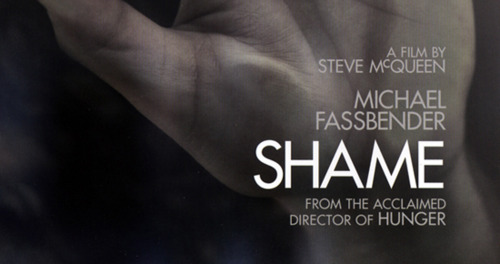 Professional Brandon (Michael Fassbender) lives in New York City and thinks he’s a normal guy with a robust sexual appetite. We see Brandon full of bravado at the beginning of the film, seeking out sexual encounters everywhere and with everyone. However, when his fragile and damaged sister Sissy (Carey Mulligan) arrives unexpectedly for a long stay, he realizes he might have a problem and the façade of his life begins to fall away.
While it’s understood from reviews, taglines, and marketing copy that “Shame” is about the difficult subject of sex addiction, I felt as though I struggled to fill in the themes and a story: is it about the emotional cost (shame) of conforming or not conforming to ‘normalcy’? Certainly I left the cinema feeling sad, lonely and bleak, but did I look for hidden meaning and symbolism that wasn’t there? Other than hurt looks, some non-sequiteur conversations, and some sordid scenes, there was no real story or new insight. Brandon is uncomfortable, at moments tender, and sometimes seemingly remorseful with his sister, but why? She’s first introduced to us taking a shower, he walks in on her, and she continues to let him see her standing there naked – even seems to invite it; at another moment he’s wrestling with her with a towel around him that falls. Did she pin her hopes of sexual understanding, and he his, on each other? Is this the basis for his sexual proclivity? We’re meant to imagine the worst but other than a suggestion by Sissy that they ‘come from a bad place,’ this is never explored or explained – was there incest between them or within their family? Certainly in life story lines and characters aren’t always well-developed or resolved, but this is cinema, sure, cinema verging on an attempt at cinema verite, but it felt very much like a glossy student film, preoccupied with its own agenda rather than any desire to reach anyone else. Perhaps this is the point, that we wrestle with concepts introduced in this film, sans more information, going out feeling unsatisfied, and feeling the self-absorption and isolation that arguably reflects our modern world….
This is director Steve McQueen’s second film, and like his first, the IRA hunger strike drama about Bobby Sands aptly called “Hunger,” it is visually interesting, well-acted and promotes conversation. That said, I felt the same as a fellow filmgoer in front of me who said on his way out of the cinema to his friend “Well, I’ll never get that two hours back.”
Filed under: Published film reviews | Tags: Carl Jung, David Cronenberg, Keira Knightley, Michael Fassbender, Sigmund Freud, Viggo Mortensen
 The plot is described as “a look at the intense relationship between Carl Jung and Sigmund Freud that gives birth to psychoanalysis.” Okay, sounds a bit stuffy, but I studied psychology a bit and heavily relied on Freud’s social insights to write my dissertation, so it sounded intriguing to me. Add Director David Cronenberg (The Fly, Naked Lunch, A History of Violence) and sexy Viggo Mortensen and I’m sold. Going into the cinema I was skeptical about Keira Knightley’s role, but assuaged my worry by telling myself that she’d play a minor character, maybe even just a cameo, and that her name was simply attached to sell the movie.
The plot is not about Jung and Freud. There are minor elements of their relationship as it pertains to psychoanalysis, but they are secondary at best. The focus is primarily on the relationship between Jung (Michael Fassbender) and his patient, played by Keira Knightly, who overacts here to such a degree that it’s painful to watch and who is unfortunately in practically every single frame looking like a palsy victim (and I don’t wish to offend palsy victims by saying this). There is no chemistry between these ‘star- crossed’ lovers, either, despite some manufactured ‘erotic’ scenes. Even Viggo as Freud was dull, a disappointment. That said, no actor could save such a contrived script that is essential boring cliches and little action. But I save my greatest scorn for Cronenberg; I have loved his work in the past and it was his name that drew me to the cinema; but his signature ‘darkness’ (echoing Freud’s theories of the dark and sinister within all of us in society) was false here; there is no sense of direction, as scenes felt meandering and random; and the whole film seems to be lost in costumes and props.
Filed under: Published film reviews | Tags: Christoph Walz, Jodie Foster, John C. Reilly, Kate Winslet, Roman Polanski
 Two pairs of parents (Jodie Foster, Kate Winslet, John C. Reilly, Christoph Waltz) have a cordial meeting after their sons are involved in a fight with each other. But as their time together progresses, and coffee is replaced by whiskey, the veneer of amenity is removed, and the barbs and revelations come out.
Directed by Roman Polanski (Chinatown, Repulsion, Rosemary’s Baby, The Ghost Writer) this is a dark, intellectual and extremely funny film; this viewer was guffawing and snickering throughout. We don’t know exactly what happened between the two sons of the respective couples – it doesn’t really matter as a plot, because this is a showcase for good writing and fine actors to portray four characters in detail. But even as the main characters are well-developed, realistic and interesting, it’s a short film (79 min).
Polanski and his quartet of excellent actors should all be nominated for an Oscar. This is a darkly comic film worth seeing.
Filed under: Published film reviews | Tags: Doug Liman, Naomi Watts, Richard Armitage, Sean Penn, Valerie Plame
 Fair Game is based on Valerie Plame’s memoir in which Plame’s status as a CIA agent was revealed by White House officials allegedly out to discredit her husband after he wrote a 2003 New York Times op-ed piece saying that the Bush administration had manipulated intelligence about weapons of mass destruction to justify the invasion of Iraq.
Plame’s career was essentially ended when Washington Post journalist Robert Novak, with information obtained from Richard Armitage at the US State Department, revealed in his column her identity as a CIA operative. This story is terrifyingly relevant. It is also very frustrating – and this is a credit to the compelling story, the acting, and the direction – to watch as the Bush (2) administration road roughshod over anything, and anyone, in their way.
Starring Naomi Watts (Mulholland Drive, 21 Grams, Eastern Promises) as Valerie Plame, and Sean Penn (Harvey Milk, The Game) as her husband. As mentioned, the story is relevant in its depiction that too much power corrupts, and the direction is well-paced by Doug Liman, who also directed The Bourne trilogy.
Filed under: Published film reviews | Tags: Henry Lee Lucas, Macabre cinema, mockumentary, serial killers
In honour of Halloween and all things spooky, I’ve chosen to review two very scary films, C’est Arrivé Près de Chez Vous (Man Bites Dog) & Henry: Portrait of a Serial Killer: one is Belgian, one is American; both are pseudo documentaries on serial killers (‘mockumentary’ does not seem appropriate here); both take place in small towns; both are well done technically; both are absolutely grisly; and even as both raise the question “why make a film on such morally reprehensible subject matter?” they are also original and memorable films.
C’est Arrivé Près de Chez Vous (Man Bites Dog)
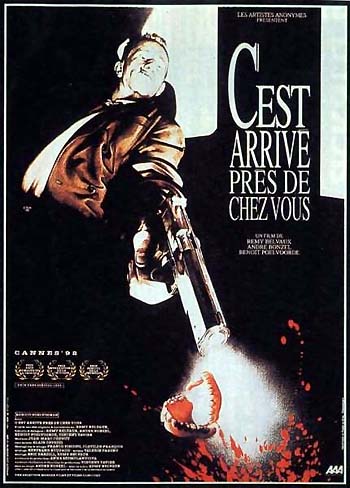 A group of student filmmakers make a ‘fly-on-the-wall’ documentary about a serial killer and are gradually drawn into his perverse world. The serial killer expounds on art, music, nature and society as he kills mailmen, pensioners and other random people.
Written and Directed by Remy Belvaux, who also co-wrote the script with Angre Bonzel and Benoit Poelvoorde, this is arguably one of the most disturbing films ever made. Pitched as a documentary chronicling the exploits of a Belgian serial killer at work, rest and play in his provincial home town, the film’s grainy black-and-white photography, hand-held camerawork and messy murders make for a sick and twisted piece of work that haunts the consciousness long after you’ve finished watching the movie.
While initially the film is a searing black comedy that questions the complicity of the media in its portrayal of violence, it degenerates into a numbing series of increasingly shocking scenes. This is a harrowing and uncompromising feature debut that is definitely not for the squeamish.
Henry: Portrait of a Serial Killer
 Henry, a serial killer, shares an apartment with Otis. When Otis’ sister comes to stay, both sides of Henry’s personality emerge and there are fatal consequences.
Henry seems to be an ‘everyman.’ He’s also an ex-con who drifts from city to city. He’s lodging with an old prison buddy, Otis, when Otis’s sister turns up to stay and she and Henry form a close relationship. Meanwhile, Otis discovers Henry’s dark secret and becomes his willing partner in murder.
The plot (though there really isn’t one, Otis and Henry simply go about their lives with detachment) development of Henry and Otis partnering up defies believability given the solitary nature of a serial killer. The film, inspired by the true case of Henry Lee Lucas who claimed to have murdered over 300 women, is truly shocking and sick. All that said, the script is spare and authentic; it’s a masterful evocation of small town low life; and the acting is performed with brilliant restraint, truth and power.
 Victoria Jelinek