Filed under: Published film reviews | Tags: Iceland banking, Matt Damon, robber barons, UK banking, US banking
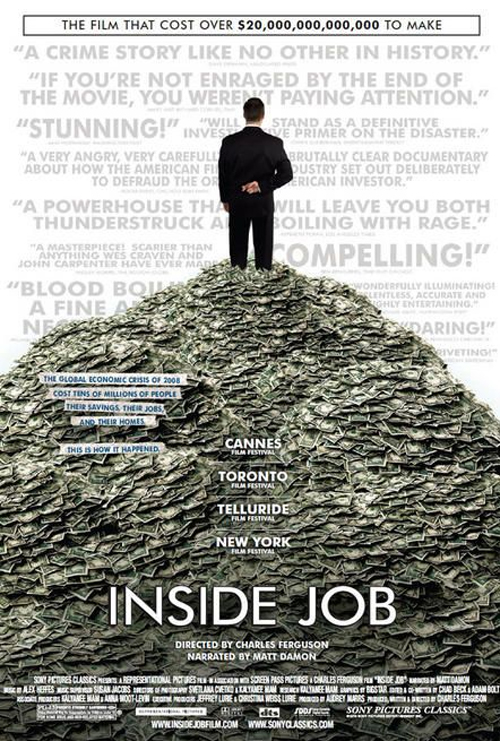 Matt Damon narrates this low-key but shrewd documentary outlining the financial scandal of 2008. Through interviews with economists and politicians, this film reveals how close the USA came to the brink of bankruptcy and why it could so easily happen again.
As a result of a mix of banking deregulation in the US and a bonus culture in the UK, the West entered into an era of casino capitalism. Beginning with the bankruptcy of Iceland, a country once labelled the safest financial bet in the world, the film explains how their banks became greedy, over-expanded, and then fell, bringing the country to its knees. This film strips the layers of mystery that surround the banking world and show us that under laboratory conditions, human brains given money for a task will react similarly to cocaine users.
This documentary isn’t always easy to follow, but that’s part of the fraud: Inside Job tries to show us that the recent crises are not part of an unforeseeable force majeure but the inevitable consequence of a system that manipulates the law at the for the gratification of a few and at the expense of the majority.
Unlike any of Michael Moore’s films that border on the hysterical in their one-sidedness, this is a sharp study of corporate greed in a beautifully restrained attempt to alert us to the robbery that has been, and is, going on in plain sight.
Filed under: Published film reviews | Tags: Alex Garland, Carey Mulligan, Kazuo Ishiguro, Keira Knightley
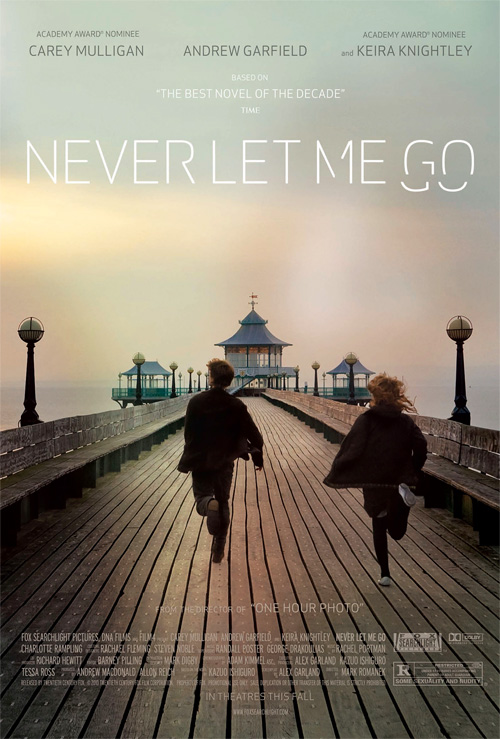 Kathy (Carey Mulligan) is a woman looking back on her childhood days at Hailsham boarding school with best friends Ruth (Keira Knightley) and Tommy (Andrew Garfield). Like the other Hailsham pupils, the three have a destiny that together, they grow to understand, and struggle to accept.
Based on Kazuo Ishiguro’s novel of the same name, the story is, technically, science fiction, even as the film initially feels like a coming-of-age romance. Adapted from the book by Alex Garland, himself an author (28 Days Later, The Beach), we are told immediately of a medical breakthrough in the 1960’s which has dramatically extended human life expectancy, and we see the pupils of the school wearing a wrist band to enter/exit and that they keep through adulthood, so even as we know that we’re not in a ‘normal’ environment, the genre of the film is not revealed quickly.
These characters are entrapped, but they’re not searching for escape. There are deeper, more personal things at stake, which is why this story is so profoundly sad. This is beautifully realised adaptation of intelligent science fiction with very good direction and casting.
Filed under: Published film reviews | Tags: Aron Ralston, Danny Boyle, James Franco, Slumdog Millionaire, Utah climbing
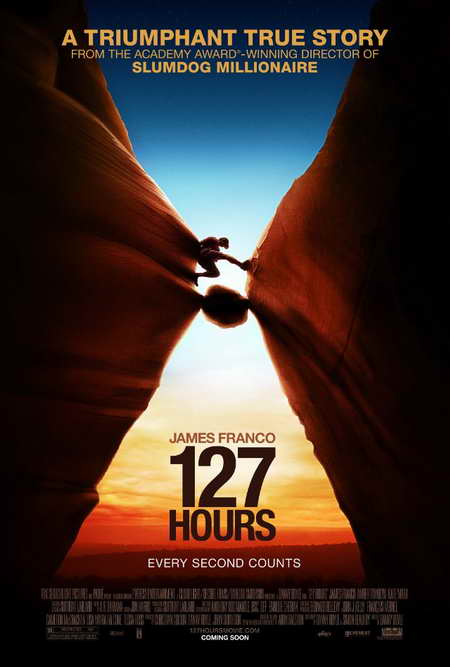 This is the true story of adventurer Aron Ralston (James Franco) who, while hiking in the mountains of Utah, falls into a crevice and a boulder crushes his right arm. Over the next five days, Ralston discovers that he has the wherewithal to extricate himself and to survive by any means necessary.
This is not a story about heroism, its Ralston’s ego that got him into the trouble in the first place. It’s not about hidden reserves of power we find when faced with a crisis because Ralston goes above-and-beyond what most of us would do in any circumstance. It’s a story about optimism –about how a simple guy turns his life around, just as any of us can, and should, in any hemmed-in circumstance we may find ourselves in.
Danny Boyle is no stranger to using dark material to convey optimism and vibrancy. In his film Slumdog Millionaire, we see unimaginable poverty, child beggars having their eyes gauged out to increase begging profits, and girls being forced into prostitution, yet for most critics and audiences alike, it’s ‘the feel good film of the decade.’ In 127 HOURS, Boyle doesn’t linger on the horror of this situation, or the gruesome things Ralston does to free himself, but rather on the liberation that this experience is for him.
That said, this reviewer felt that while it would be interesting to watch a 30 minute documentary on Aron Ralston’s experience, there isn’t enough subject matter to make it an interesting feature film.
Filed under: Published film reviews | Tags: Chamonix, Clint Eastwood, Matt Damon, Peter Morgan
 After a near-death experience during a tsunami, French TV journalist reassesses her life. After a car kills his twin-brother, a London boy is desperate to keep the close connection they had. And in San Francisco, lonely George (Matt Damon) is trying to find a way to live with his ‘gift,’ which is the ability to talk with those who have died. Their lives will intersect and each will be forever changed by what they believe does, or doesn’t, exist in the hereafter.
It’s interesting, and a bit frightening for those of us who are devotees of Director Clint Eastwood’s work, that at 81 years old, he should tackle the question of what happens to us after we die. Scriptwriter Peter Morgan is a master dramatist of major true-life political events and figures as seen in his films “The Queen”, “The Last King of Scotland” and “Frost/Nixon,” but this is a more subdued script that culminates in a gentle film full of warmth.
Eastwood is a man who offers a poetic grace to all that he does and ultimately, it’s the fact that he directed, and did the musical score, that are the reasons one should see this film.
Filed under: Published film reviews | Tags: Alan Rickman, Daniel Radcliffe, Emma Watson, Ralph Fiennes, Rupert Grint
 Part 1 of 2, the ultimate battle between light and darkness draws near. Voldemort and his Death Eaters hatch a plot to kill Harry Potter who not only finds himself on the run, but also with a long list of magical objects to track down.
The cosy trimmings of previous Harry Potter films – trains to school, lessons, quidditch matches – are not evident in this film, which is darker than the rest of the movies. However, there’s too much detail in this films plot making it drag a bit throughout: there’s the main quest to destroy several ‘horcruxes’, objects containing Voldemort’s soul, as well as a sub-quest to find three ‘deathly hollows’, objects that give their owner power over death.
Even as it doesn’t rate as one of the best Harry Potter films, the lead actors are fine and it’s another adventure in the popular series with the familiar characters and there’s enough magic and tension to make you want to see it and to look forward to Part 2.
Filed under: Published film reviews | Tags: Amy Ryan, Bob Glaudini, Daphne Rubin-Vega, John Ortiz, Philip Seymour Hoffman
 A limo driver’s blind date ignites a humorous and poignant tale of love, friendship and betrayal focused around two working-class New York City couples.
Jack (Philip Seymour Hoffman) is a limo driver with vague hopes of getting a job with the Metropolitan Transit Authority (MTA). He has an obsession for reggae that’s inspired him to attempt to grow his hair into dreadlocks, and he spends most of his time hanging out with his best friend and fellow driver Clyde and Clyde’s wife Lucy. Clyde and Lucy introduce him to Connie and they like each other. Being with Connie inspires Jack to learn to cook, to take swimming lessons in order to take Connie on a romantic boat ride, and to pursue a new career. Meanwhile, Lucy and Clyde’s marriage begins to disintegrate.
Hoffman’s directorial debut is a very independently spirited and produced film. Hoffman has made a career doing interesting, indie films such as Magnolia, Boogie Nights, Capote, and The Boat That Rocked among many others. During this career, he’s also been the Artistic Director for an off-Broadway theatre company in NYC for ten years, which is where this play originates. In putting together this film, he has gathered around him some wonderful talent, both on-screen and off-screen, from both theatrical backgrounds and film backgrounds, both indie and studio financed. This film is a small, gently paced, gem.
Filed under: Published film reviews | Tags: Ben Stiller, Dustin Hoffman, Harvey Keitel, Jessica Alba, Robert De Niro
 Ex-CIA agent Jack Byrnes (Robert De Niro) is still concerned that his son-in-law Gaylord Focker (Ben Stiller) isn’t good enough for his daughter (Teri Polo) and suspects he’s cheating on her with a sales rep (Jessica Alba), even as he’s finally ready to trust Gaylord and bestow the position of ‘Godfocker’ on him.
However, like the previous two films, Meet the Parents and Meet the Fockers, as a crowded supporting cast pop in for their cameos, the family begins to have a meltdown. And the cast and cameos in this film are impressive: Harvey Keitel, Dustin Hoffman, Blythe Danner, Barbra Streisand, Laura Dern…one remembers when Keitel, Hoffman, Streisand and De Niro were making amazing films that would go down in the Modern Classics realm.
There will inevitably be some laughs with a cast like this. And if you find the joke about the last name sounding rude, humorous, or an innocent flirtation taken for an affair, or children throwing up on grownups, or a four-year-old surprising his father by giving his grandpa a penile injection to counter the effects of an unwisely-taken erectile dysfunction medication and then drawing a picture of the incident while auditioning for a posh kindergarten, then this is the film for you.
Filed under: Published film reviews | Tags: Coiin Firth, Geoffrey Rush, Guy Pearce, Helena Bonham Carter, King George
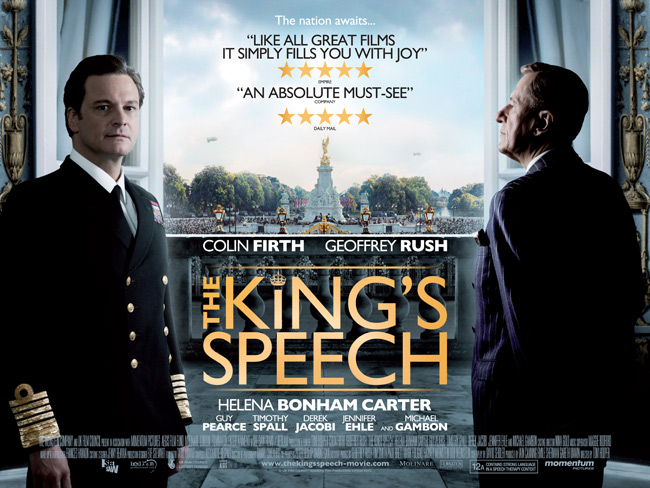 Prince George (Colin Firth) has been afflicted by a debilitating stammer since childhood. When his brother abdicates the throne, and war is looming, he hesitantly turns to Aussie Lionel Logue (Geoffrey Rush), who is a speech therapist with unconventional methods, in order to be able to soothe a frightened nation.
Despite its decent cast and nice costumes, this film was initially low on the radar for greatness. However, after a sneak-peak at a film festival in America, bloggers and Tweeters announced it to be an Oscar favourite and the world opened its eyes to it. But this is not a pretentious film – this is a crowd pleaser. The script transforms history into an approachable form, and it’s dramatic, witty and enlightening. It focuses on the unlikely friendship between the outspoken Aussie and the reluctant-speaking aristocrat. This is a story less about fixing a voice than fixing a mind that has been bullied by his father since boyhood and has not had a childhood in the face of the responsibilities for the throne.
Even as Firth doesn’t have many words to say, he doesn’t stop communicating sadness, yearning, and pain; intelligence and humour demanding an escape; and the self-possession of a man born to privilege. Rush as Logue, is in equally fine form, a brash man with a huge heart. Helena Bonham Carter is a lively Queen Elizabeth, portraying both a teasing wit and a devoted wife. The script, the actors and the loving shots of London make this a film worth watching.
Filed under: Published film reviews | Tags: Barbara Hershey, Darren Aronofsky, Natalie Portman, Vincent Cassel, Winona Ryder
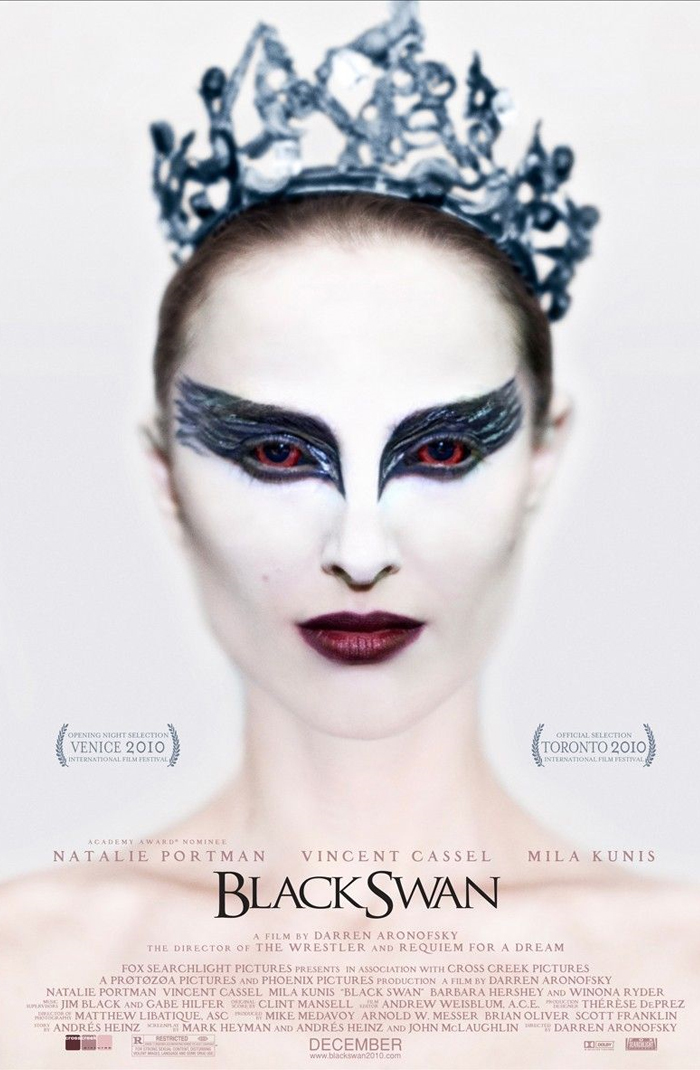 Dancer Nina (Natalie Portman) lives a sheltered, ballet-obsessed life with her over-protective, slightly mad, ex-ballerina mother (Barbara Hershey). When Nina is promoted to prima for a new production of Swan Lake, her director (Vincent Cassel) encourages her to explore her dark side so that she can epitomize the dual role of the Swan Queen and the Black Swan. This exploration, and the claustrophobic life with her mother, combined with her insecurities over the ambitions of a new arrival at the company, pushes Nina towards the snapping point.
Director Darren Aronofsky intends for Black Swan to be the companion piece to his 2008 film The Wrestler. Despite the difference in subject matter, both display a fascination with specialist professions; both have cringe-inducing moments as a result of the potentially crippling physical challenges of these professions; both subtly examine the tension between age and ambition; and both are shot using mostly handheld cameras in order to invade the personal space of the actors/characters.
Black Swan won’t be to everyone’s taste – it’s disturbing and sometimes confusing – but it’s an impressive offering from one of America’s most exciting directing talents.
Filed under: Published film reviews | Tags: Chris Morris, Controversial film, Funny British films
 A radical British Muslim named Omar has formed a terrorist cell with his dim-witted brother Waj, a nervous bomb maker, Fessal, and an angry white convert named Barry who later recruits wannabe-rapper Hassan. After going to Pakistan in a misguided attempt to train in a Mujahedeen training camp, Omar returns to Britain with the plan for a suicide attack on a Western target – any Western target will do.
This sounds like a pretty serious and controversial plot – it’s certainly relevant. However, these terrorists are bumbling, squabbling and inept. That said, Director Chris Morris doesn’t undermine the danger that these types present to themselves and to any civilians who wander into their range. This film doesn’t attempt to answer large questions of why young men who seem to have benefited from living in a multicultural Western nation would want to hurt themselves and random strangers for some mutant notion of Islam. It’s full of silly humour that will cause some to laugh a lot, and did prompt this reviewer to chuckle a few times even as I found the characters and the circumstances and events of their lives tedious and looked at my watch several times throughout the film. Given the concept and its relevance, it could have been a very good film if it’d actually been well-written and incorporated some of the great British humour that’s clever and dry.
What is appreciated about this film is that its not politically correct. It’s likely to offend quite a few people across the political and belief spectrum and in a climate of watered-down opinions and lip-service in the public forum by us all, this is great.
 Victoria Jelinek