Filed under: Book reviews | Tags: American, Americana, heartlands, Kent Haruf, novel, poetry, popular fiction, prose
 A small town community in the ‘heartlands’ is the setting for Plainsong and its rendering of the quintessentially American experience. Kent Haruf interweaves the stories of a lonely teacher, a pair of boys abandoned by their mother, a pregnant high school girl, and a couple of brittle old bachelor farmers as they undergo radical changes over the course of a year. With lyrical, eloquent prose that is richly nuanced, Haruf presents the steadfast courage of decent, troubled people getting on with their lives.
Weather and landscape set the quiet, observant mood of the narrative, while descriptions of rural existence are poetic invocations to the natural world. Haruf steers clear of sentimentality and melodrama, however. His beautifully imagined characters and the vivid depictions of their experiences, makes each of them seem non-fiction, which can evoke both heart-warming and heart-wrenching feelings (respectively) in the reader. Emotions that resonate long after one finishes the novel. This is a contemplative and compelling story about grief, loss, loneliness, and frustration, as well as kindness, love, benevolence, beauty, and what it means to be a family.
Filed under: From the Soap Box | Tags: Chamonix, convert, diet, environment, fads, golden rule, health, meat, pollution, vegan, vegetarian
Addendum to the piece, below
“Only I can change my life, no one can do it for me.” Carol Burnett
I actually began doing research on the environmental effects of eating meat shortly after writing this piece, and in September of 2016 I reduced my eat consumption by 90%. In essence, while I still am hurt and irritated by the people who were combatively proselytizing (& just being plain mean), I have since evolved and changed my ways…
That said, I will keep this post up as evidence of my previous ignorance and petulance on the subject…
To my recently converted vegan eating friends,
 Congratulations on your vegan diet! I’m glad that you’ve found something that you want to do to help the environment and your general health. I’m pleased that you’re contributing to the overall welfare of the collective. Really I am.
But even though I’m super happy for you, I get upset when you talk about your vegan diet and put down meat eaters as barbaric dimwits. I’m a meat eater. But you know that – we’ve had Sunday Roasts together. While it’s arguable that I’m a dimwit, I don’t believe I’m barbaric and cruel. And what about the golden rule? You’re treating animals better than I may, but you’re putting me down in the process of justifying your diet. I might evolve from my place lower than you on the evolutionary chain, but your lectures and accusatory tone may prompt me to crawl right back into the water, leaving my shell on the shore.
Last week alone I suffered three separate people in Chamonix Valley who have recently made this lifestyle change, proselytizing to me about veganism. Each of them explicitly and implicitly told me that if I continue to eat meat I don’t care two shits for the environment, about other living creatures, or my own body. I didn’t engage in argument. I mean, I don’t really care about my own body, and I should given that I’m aging and that’s a horrendous process…I tried to let it ‘roll off of my back’ and not to let my eyes glaze over, attributing their antagonism to early zeal, but the third novitiate made me angry (and hurt, if I’m to be honest): I ran into this friend in the parking lot of the primary school and excitedly mentioned that my husband and I are replacing our very old car with a hybrid. He told me in a flat, contentious voice, “You should become a Vegan if you really want to help the environment.” While I stumbled a bit with a reply, muttering “Oh, gee…um…” he immediately suggested, “You could stop commuting to Geneva for work.” As I scratched my head to figure out a polite way to stop this conversation, he rapid-fire-suggested, “You could stop visiting your family and wasting jet fuel.” I spluttered a “Oh. My. Well now…” Without hesitation, he went on to tell me that the “best” thing I could do (in addition to the aforementioned) was to keep the old car on the road and not cause the industry and subsequent pollution that happens with the creation of a new car. That I wasn’t serious about the environment if I’m unwilling to do the previously stated things. Awkward. I think I said something innocuous and superficial like, “Oh…well…okay. Then I’ll see you around,” and drove off with the belt of my coat stuck in the car door.
These interactions prompt me to write this letter now. I feel that I must justify my existence as a meat eater. And while I risk being a hypocrite ‘cause I’m now exhorting you, the reader, to my cause, and being defensive to boot, I’m also brave for defending my meat-eating ways which may, in the end, just reinforce the idea that I am a selfish, negligent nitwit who would sooner sacrifice kittens than give up something that pleases me.
So here goes:
My name is Victoria. And I’m a meat eater.
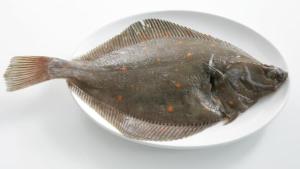
I wasn’t a big meat eater to begin with. We weren’t rich when I was a child and so we ate all kinds of awful meats that I wouldn’t touch, such as plaice, beef tongue, liver and pig’s feet. As a young adult in charge of my own dietary acquisitions, I found that I preferred to spend my money on drugs and entertainment. Granted, I did eat the odd slice of pepperoni pizza, but I can most definitely not be called a savage meat eater through most of the late 80’s and all of the 90’s. As a bona fide adult (meaning I pay my taxes, got married – again – am responsible for raising a child, pay my bills on time and don’t piss off my employers) I do eat more meat. But that’s primarily because I’m eating
three squares (or at least two) and it’s hard not to eat meat whilst still having a relatively diverse diet. Also, my son would never eat if he didn’t eat meat. Or at least he’d only eat starch and carbohydrates. (And don’t say that’s ‘cause we’ve allowed him to eat what he wants. That we’ve spoiled him. That we haven’t starved him enough. Short of tying him up with gaffer tape and administrating vegetables and fruits intravenously, we’ve tried everything).
I’m still making excuses for my addiction, I know, but we don’t consume a lot at home. And what we do eat is locally sourced. I know the animals I eat are still hung upside down, scared, and killed and that’s horrific, but I do spend the money and take the time to buy the meat in which the creature was at least allowed to enjoy their lives to that point. And, hopefully, in their nicer environments they were also spoken to softly and humanely as they were slaughtered. But I don’t think it’s fair to say I’m cruel to living creatures because I eat meat. I sign petitions to stop cruelty to animals. I support The World Wildlife Federation and National Geographic with annual cash donations. I pet wet, smelly dogs, including my own. I’ve taken in the neighborhood stray. But there I go justifying my behavior. The fact is, I like it. Especially the salty ones that originate from pig. Please don’t take this the wrong way, but it sucks to feel judged and admonished about my meat eating ways and I don’t like it one bit. Please let me hit my own ‘bottom’ and reach the decision to stop eating it (and the rest) on my own.
This does not mean I’m not concerned about the state of the world. I’m deeply troubled by the world today, to the extent that it makes it hard for me to be happy at all with the myriad of global problems. My predisposition to neurosis is on overdrive these days, what with Trump, Brexit, Turkey, the Middle East, French strikes, mass shootings, environmental calamity, desertification, unfair wealth distribution, terrorism, human trafficking, the body’s resistance to antibiotics, etc. etc. It keeps me up at night. Seriously. Unless I take a pill (but now they’re prescribed, so that’s okay, right?).
With regard to the environment, I may not be a vegan, but I do many small things throughout every day in an effort to help save our planet:
- We never dry our clothes in a dryer even though I really miss soft towels and jeans.
- We don’t run water while we’re brushing our teeth, and my husband is a total soap dodger, so that’s water saved, too.
- We don’t flush after each pee, adhering to the saying, “if it’s yellow, keep it mellow…”
- We recycle, and flatten all the boxes and bottles.
- We car share to the school most mornings (and we’ve attempted to involve two additional neighborhood families whose children go to the same place at the same time, to no avail, and despite their lamentations about environmental calamity…).
- We don’t use harmful detergents and cleaners, even as I really miss the smell of Ariel.
- As mentioned, our new car is a hybrid, and despite the fact that it’s just weird looking.
- As mentioned, I didn’t eat much of anything through my childhood and into my adult years.
- I spent most of my adult life without being the owner of a car, living in cities with true mass transit capabilities. That counts for something (How many of you can say the same?).
Yes, I’m flawed. I eat meat. I like it. I also eat gluten. And I eat dairy. I suffer a cheese belly due to my penchant for the stuff. I love milk in my coffee. I enjoy omelets and quiche (I’m getting hungry). Even as I’m still adapting and shaping my philosophy of the world, it’s not likely that I will convert to veganism anytime soon. I would like to do more to help. To have a big garden in which my husband grows vegetables and fruit, perhaps he’d even keep a few bees, but he’s busy at the moment earning money to put some kind of food on our table.
These recent conversations with these vegan disciples have left me disturbed and suspicious. Each person’s eye had the shine of a zealot. The imparting of their vegan information the air of proselytizing. The sudden popularity and timely coincidence suggests a fad. Growing up on the West Coast of the USA in the 1970’s, I met all kinds of charlatans who were apostles of Buddhism, Lao Tzu, Pluralism, Karma, Chakras, and astrology, with various accompanying diets, revered stones and/or crystals, yoga practices, and exercise regiments. Later, they became dot-commers and venture capitalists that “do” yoga and Pilates as part of their social role and follow folks on Twitter who practice “mindfulness” and positivity. These recent conversations with these vegan followers here remind me of home and those good old days…
But let’s get back to my central point – what’s up with the preaching and shaming? I have many old friends who are deeply devoted vegetarians. And a couple of vegans are among them. They don’t attempt to persuade me to their ideologies or make me feel bad about my own lifestyle choices. Perhaps they’ve lost their enthusiasm and it’s just a way of life. Perhaps they’ve ascertained that I’m a lost cause. Perhaps it’s ‘cause they know that I’m not a conspicuous consumer. That I’m not one of the bad guys.
Before my dad died, I used to frequently call him up after I’d watch the evening news (from any time zone), crying over the state of the world. In addition to the news, I’d be upset with the broadcasting itself, too, and what it implied about the world and its state of affairs also. My dad, a political activist, would always tell me: “Model the life you’d like. Try to live faithfully to your spirit and your values. Believe that the micro will affect the macro. Remember humor. And live and let live with critical insight, but not fast judgment.”
Filed under: From the Soap Box | Tags: Brexit, Cameron, EEA, England, English, EU, European Union, France, Immigrants, London, refugees, Trump
 My love affair with England began in 1990. I was an undergraduate student in London. I loved the particular energy of the city. The diversity of shoes on display in shop windows and on people’s feet. The apartments over ground floor shops. The double-decker red buses. The black cabs. The deep, smelly, hole-in-the-wall pubs. The trains. The humor – which is everywhere – from the people you meet casually or in passing, to radio and TV broadcasts, to one’s friends. The literature. Oh, the great literature. The libraries. The music. The history. The architecture. The pride. The Indian food. The bacon sandwiches and brown sauce. The pastoral countryside. The rivers. In fact, returning to the USA, I moved to New York City because it was the closest approximation of London that I could find in America. In the years since, I have repeatedly returned to London to live – for graduate school and, later, for work. It’s the only place I’ve lived – of several – which I continually and almost religiously, return to. Livings as I do now in an unnatural habitat for me (and at the risk of sounding dramatic) my regular visits to London are the lifeline that sustains me. Without that vibrant, majestic, complicated, dirty city and my community of friends – honed over 25 years through school and work – I would be bereft.
That said, for the first time my beloved adopted country precariously sits in my heart and mind due to its likely vote to exit Europe. This makes me terribly sad, troubled and confused. Over the course of the last month or so, in London and with the English expatriates who populate the region I currently live and work in, I have been surprised to hear that they mostly favour an exit. Their reasoning? That it’s “better for England.” When I ask exactly how it’s “better for England,” their arguments are thin, though impassioned – “It’s not right that England is ruled by unelected foreign officials!” It’s been “co-opted” by people they can’t see and who are not English. Ultimately, however, it comes down to this: “We are full and can’t accept anymore.” To paraphrase a dear friend who is truly English, the motivation to exit doesn’t seem to be just from fear (tribal basics of ‘in-group’ and ‘out-group’ – see Social Psychology), but from the very real difficulty in getting a GP appointment. From meeting droves of Polish and Asian people waiting in the doctor’s surgery, who are often waiting for translators for their appointment, which is an additional burden on the NHS. The desire to exit is because locals find that their kids are unable to get school places. The parents chat in a multitude of languages in the playground, which promotes fear in the English-speaking parents that their kids are being held back ‘cause they have twenty-four languages in a middle-class white school in Surrey, for example. It’s folks seeing foreign food aisles in supermarkets. British folks looking for a builder and struggling to find one that isn’t Polish, or having carers who can’t speak to them because they’re foreigners without the ability to talk competently in English. It’s black cab drivers that are losing work ‘cause there are flocks of mini cabs being driven by foreigners offering cheaper rates. It’s the fear that unwanted hordes of migrants and refugees will be granted citizenship in France or Germany and then move to England with their fresh passports. The thing is, England needs these workers. Without them, who will do the work that the average English man doesn’t want to do, certainly for a lower wage?
The ‘un-elected foreign officials’ making laws are in Belgium. They’re an amalgamation of Europeans, including the English. Moreover, it’s a miniscule fraction of the laws in England that have their origin in Europe. And likely less so with the recent concessions Cameron has received. On top of that, the laws that have been enacted in England from Europe are about the environment – housing is built to an environmental standard and there are incentives to make one’s homes more environmentally sustainable. The waterways of England have been greatly cleaned up and are protected by EU laws regarding dumping and waste. The EU protects workers rights in an environment of vicious capitalism. For example, the right to ask for overtime pay if your employer requires that you work more than 48 hours a week is protected by an EU law. And if you’re into vicious capitalism (or simply growth and invention), the EU allows English companies to trade and expand more easily, thereby creating jobs and revenue for the country. The EU protects human rights laws –the ability to have a safe place to live subsidized by the state for example. The lack of wars and infighting between countries within the EU has ceased since the 1950’s, when the EU was just a good idea – one that took decades to create and enact and which has consequently ensured peace between the nations of Europe since the (that’s only just over 60 years of peace!). What about the sharing of information? If England secedes, there will not be the same level of cooperation between countries to find a given ‘bad guy’ (and there are already problems given language and bureaucratic realities). Freedom of movement for the English and their children is a product of the EU. The ability to buy houses in warmer countries outside the UK. The ability to work and live out your retirement on the continent with protection for health and welfare as you age, are products of the EU. Low airfares to/from the continent for holidays are a product of the EU. Protection during your package holiday such as travel insurance and charlatan deals are a product of the EU. The ability to buy loads of wine and cheese ‘cheaply’ with a mere crossing of the channel is the result of the EU. The hordes being held on distant shores are the product of the EU – without the EU, the reception will be in Dover, not Calais. Lack of roaming charges on mobile phones is a EU invention (and hasn’t even gone into effect yet). If England exits, it will be the end to the welfare state most English people know. Certainly those under fifty years of age. And one still won’t get a school place or go to a GP appointment without incident or have more material possibilities outside the EU because it’s lack of good management and long term planning that are the problem as well as inequitable distribution of wealth.
I do understand those desiring a frustrated exit from the EU, even as I disagree. I, too, worry about practical and material possibilities for my child in the future. I worry about the influx of migrants – the Trojan horse theory that there will be ‘bad ones’ mixed in with the ‘good ones’ simply seeking a safe haven for their families has entered my construct of reality, too. I am troubled by the prospective entry of Turkey into the EU. I appreciate the country, its beauty, history and music, but it’s not a culture that shares the same values as other European nations – which includes England – about gender roles, education, religion, marriage, work, freedom of speech, and penalties to criminal offenders. Why then would they be a part of the EU? Well, that’s a larger argument about global tactics, side deals, and corruption. The Brexiters are right to complain about the EU’s endless hassles, choices, and its bureaucratic administration, but one does not change things from without. One changes them from within.
Referring to the primal fear in England that the country is losing its national identity, it begs the following questions: despite being a country of immigrants, when you think of Americans, do they not share a common identity in your mind? (For better or for worse). In an increasingly global world, where increased knowledge of other cultures – namely languages – is a practical benefit, why would one want to eliminate that exposure for your children? (Also, look at the neuroscience regarding bilingual abilities and the positive effect on a child’s brain). Does it make sense to break the bonds with your neighbours in such troubled times?
In my opinion, the finest qualities of the English are their language, their humour, their resourceful stoicism, and their generosity. Would not the best way to ‘fight’ the feeling of losing one’s identity be to uphold these values despite the seemingly fierce opposition to them? Figure out ways to teach foreigners the native language and bring ‘em over to the English POV. Find the ways to solve the real problems of mismanagement, poor bureaucratic processes, and lack of material possibilities and wealth (starting with the NHS, the Inland Revenue, namely tax evaders, and foreign home ownership would be a good start). Dearest England, despite your fears and frustration, act in solidarity for what is essentially a good idea for everyone, including you. The European Union is a positive force, not a negative one. Personally, I fear that I’m going to lose friends over this vote…I might find it hard to look those opposed to the EU in the eye because to me a vote to exit is on par with a vote for Trump (who supports Brexit btw) — it’s yielding to the lowest common denominator in each of us.
A few resources for information on Brexit:
http://www.telegraph.co.uk/travel/comment/what-would-brexit-mean-for-travellers/
http://www.bbc.com/news/uk-politics-32810887
Filed under: Uncategorized
The roots of education are bitter, but the fruit is sweet. Aristotle
I attended a series of educational lectures on purposeful thinking this weekend. During my school holidays. Very purposeful of me. Or stupid, depending on how you think about it.
For the second day we were instructed to bring something for a potluck lunch. I thought this was a good idea. As I was staying in a hotel and didn’t think that looted crisps and pretzels from the bar were appropriate, I woke up extra early and drove 35 minutes out of my way to find a bakery that was open. I bought a pear tarte because it’s rather innocuous and it looked elegant. At the break, we went into the room where everyone’s offerings had been stored, and collectively began unwrapping and arranging it all on a large table. I thought the offerings were gorgeous. But then so was my tarte.
Then, a woman in the group – an ‘earth mama’ type, married to an investment banker – announced to everyone that the pear tarte had nuts in it. One must be ever conscious of prospective nut allergies. I looked closely at the tarte and replied, “…oh! But there don’t seem to be any nuts on it…” to which she said authoritatively, “Oh there are. I cook pear tartes and there are nuts in them.” As I hadn’t asked the baker, nor do I cook pear tartes, I said nothing more. And no one touched my tarte for the whole weekend. Not then, nor at the frequent tea breaks. Except me. Rather poignant. And, I thought, rather wasteful. I mean, are we sure the tarte had nuts in it? If you don’t, or can’t, eat nuts, then don’t eat it. Which made me think that she had been rude. Which got me thinking about what is ‘okay’ to say-and-do these days and what is ‘not okay’ to say-and-do these days, and how these social mores often don’t seem logical. It’s okay to respond to a person’s food offering at a potluck dismissively if it might have gluten, nuts, or dairy in it? Yet we talk about being sensitive to others. And much of the meat in supermarkets has steroids, antibiotics, or growth hormones in it. And industrial farming is hurting the earth. But my apologies – I’m off subject about the danger of nuts.
Then I started thinking about the nature of political correctness these days. It’s ubiquitous. It’s no longer okay to be self-deprecating. It suggests fallibility. Imagine. Yet it’s okay not to respond to emails and prompt the person sending them to feel as though they aren’t worth your time and effort. It’s no longer okay to be critical of a person if they’re not Caucasian. Even if their art, music, work, or point could use a critical eye. It’s inappropriate to talk about unfair distribution of wealth in real terms if wealthy people are present. Yet it’s okay that there are children who go to school hungry each day in the 1st world and don’t have safe places to live. It’s not okay to mention that you’re feeling badly when someone asks you “how are you?” Yet, pills for depression and suicide rates are at an all-time high throughout the 1st world. I could, of course, go on.
One attends lectures with educators of present and future generations on critical thinking and there is no discussion about what people really think about societal values and actions. Economic disparity grows daily. Public educational systems produce dolts and disillusioned teachers. Teenage depression and suicide rates rise. There is increasing infringement on women’s rights throughout the world. The flimsy, disposable architecture mass-constructed today at the same time we’re talking about the importance of our personal ‘habitat’ and the environment in general is at odds. What do these things reflect about our modern humanity? Am I being nostalgic about what creates substance in education and culture? Or is this all truly ironic?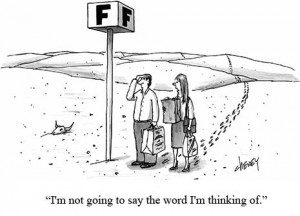
I don’t have the answers, and I’m sure they’re complex and, arguably, much conversation is rhetoric (my Danish husband would likely say so). But I do know that it would buoy me to observe and participate in thoughtful and authentic conversations at a workshop with other educators. Perhaps there’s never enough time (another issue). Perhaps people are too afraid to have an opinion. Perhaps, perhaps…. I do know that I felt like that pear tarte. Not gorgeous mind you, but misunderstood. And I do know that I’m likely to see assertive statements about gluten, nuts, and dairy as signs of a culture gone mad.
Filed under: Film reviews | Tags: Adam McKay, Anchorman, banking, Brad Pitt, Charles Randolph, Christian Bale, Ryan Gosling, Steve Carrell
 Four outsiders foresaw the global collapse of the economy years before 2008. Something big banks, the media, and governments refused to consider. So these four made a bold investment – The Big Short – that led to huge profits for each of them even as they had to negotiate the dark underbelly of modern banking in order to get the boon.
There are three things that made me skeptical about watching this film: the lingo, the bizarre identifying traits for each of the main characters, and the concern that those who watch this film are those who already know about the perverse exploitation that constitutes modern banking.
The lingo is hard to understand for those of us outside of the banking world. However, Director McKay breaks the fourth wall down and introduces celebrity cameos to directly address the audience with colorful and cogent explanations of terms, which does help and also amuses.
McKay is best known for comedic fare, such as Anchorman and The Campaign, but one can see that even in the silly humor of these films, there’s a sly intelligence underling and animating them. And he infuses the script for The Big Short with a profanely witty dialogue.
While arguably he creates the character’s bizarre defining traits to show the types of brazen personalities that thrive in this environment, I believe it’s more evidence of his humor in the midst of sobering material. Bale lacks any social grace, rocks out to heavy metal music to get his brain up to speed, and sports a glass eye. Gosling is a typical douchebag banker, spray tanned, arrogant, and slick. Pitt is the former banker gone rogue, all shaggy, bearded, talking about intestinal health and the need to prepare for the end of the world. These are humorous elements that make these men characters, but don’t be fooled for a minute that any of it’s silly or distracting. There is committed and accomplished acting going on. These performances are what make The Big Short especially enjoyable. Carrell, however, is the heart of the film, delivering another impressive turn after surprising audiences and critics alike with his performance in last year’s Foxcatcher.
The ensemble cast superbly conveys the angry, pessimistic conviction driving this film, which is the argument that major banks all engaged in fraudulent, criminal activity leading to the 2008 collapse, and governments bailed them out at the expense of “the average Joe.” And there’s no reason big banks wouldn’t do it again – why shouldn’t they? We’re the assholes who let them get away with financial murder. Which brings me to the third concern I had before watching The Big Short. That those attracted to watching this movie will already be those who understand the situation. It won’t reach the folks who refuse to see what went on and continues to go on in large banking and global politics. Well, so be it. At least there are smart films created by thoughtful and critical people, for some of us to enjoy.
Filed under: Film reviews | Tags: Boston, Boston Globe, Catholic, John Slattery, Liev Schreiber, Mark Ruffalo, Michael Keaton, Pulitzer, Rachel McAdams, Stanley Tucci, Tom McCarthy
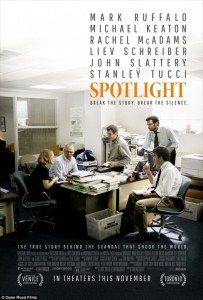 A small group of journalists from The Boston Globe reveal the Catholic Church’s role in systematically covering up the sexual abuse of children by priests.
Michael Keaton, Liev Schreiber, Rachel McAdams, Mark Ruffalo, and John Slattery play the Pulitzer Prize-winning reporters. Through them, Director Tom McCarthy demonstrates (again) his incredibly understated ‘touch’ with actors. This ensemble cast is a model of low-key greatness – as is the film itself. There are no ghoulish rape flashbacks or sensationalistic cutaways to a menacing clerical conspiracy behind closed doors. There is just the absolute confidence that the audience will be enthralled as the reporters quietly and quickly go through journalistic procedures, slowly and steadily gathering information, and painstakingly corroborating leads and hunches. Like so many films absorbed with the minutia of daily journalism, Spotlight is a terrifically nerdy process movie.
What I especially liked about this film is its incredibly perceptive sense of how inextricably the Church is woven into the fabric of Boston life. The Church concealed its corruption for so long by applying pressure to the city’s legal, political, and journalistic institutions. As Spotlight sifts through the appalling pile of evidence to reveal the Church’s horrific cycles of abuse and concealment, we understand that the most galling crime is that it has used its uniquely privileged position in society to exploit its victims (whom they are meant to serve). We also understand that many of us are complicit in allowing this type of oppression to flourish because we don’t do anything about it when we see it. Jamey Sheridan and Paul Guilfoyle are two Church-connected friends who try to convince editor Robinson (Keaton) not to publish, and we recognize these characters immediately — they are the members of our decent yet compromised humanity, the proverbial good men who do nothing and therefore allow evil to grow and to thrive.
Sobering, yes, but a very good film with a strong narrative and a fine cast.
Filed under: Published film reviews | Tags: Alan Arkin, Albuquerque, Amy Adams, Crime, dvd, film review, Hanway Films, New Mexico
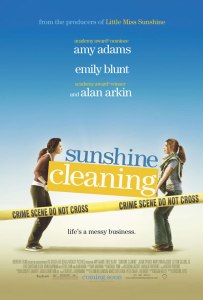 The heroine, Rose, is a single mom in need of a regular income who starts a business cleaning up crime scenes. The circumstances that prompt her need are multi-faceted. She’s poor. She’s trapped in an affair with her high-school sweetheart, who fathered her son but then married someone else. Her son is perpetually in trouble at school. Her mother is dead. Her father is a ‘chancer,’ whose moneymaking ideas almost never come off. And her sister, Norah, is a hard-living numskull.
Rose is a good mom. She ‘gets’ her son, and he seems like a nice boy, but the teachers and administrators accuse him of misbehaving and she can’t afford to send him to “a good school.” It’s Mac, the faithless love that abandoned her in the first place, that tips her off to the idea of a new business venture. He’s a cop who notices people get paid well for cleaning up after gruesome murders, and so Sunshine Cleaning is born. By the very nature of the work, Rose and Norah (who helps Rose with the business), witness the aftermath of lives irrevocably interrupted.
Does this sound sunny to you? It’s hard to make a feel-good film about murder scene clean- ups and broken lives. While the material has promise as a black comedy, Sunshine Cleaning’s attempt to keep a smiling face throughout is artificial. That said, it is a watchable film due to its cast. Amy Adams as Rose, and Emily Blunt as Norah, are effortlessly charming. As is Alan Arkin, who plays their father, perpetually hatching get-poor-quick schemes, and whose rapport with Rose’s son is heart-warming. If you’re in the mood for good acting, high production value, and can overlook the excessive cheerfulness of the script, despite the circumstances and events of the plot, then this is a movie worth watching.
Filed under: Book reviews | Tags: Anne Tyler, characterisation, characterization, John Updike, Nick Horby, popular fiction, prose, stories with bank robbers, stories with obese people
 For thirty-five-year-old Charlotte Emory, leaving her husband is the only way out from the humdrum of her days and the banality of life’s earthly possessions. She goes to the bank to withdraw what money she has, but finds her getaway is not at all what she expected when a young bank robber takes her hostage and they head south for Florida in a stolen car.
I don’t read the “blurbs” on the back of books anymore, relying, instead, on its reviews. John Updike, Nick Hornby, The Times on Sunday, and The Observer all write that Ann Tyler is “wickedly good.” So I dug in. While I appreciate Tyler’s prose and her astute eye for the “ordinary” detail that’s telling about a person, circumstance, or context, I didn’t rush to bed at the end of the day to read the book, nor drag it everywhere I went in case I found a moment to read a page or two.
That said, the book remained with me after I finished it. I found myself lingering on elements of it, particularly the characterization. Our heroine, seemingly mousy in all ways, from her looks to her actions. The obese mother who told her own daughter she was a changeling. The husband, who seemed so romantic and moody. The bank robber who appears to be a greasy loser. It was only upon reflection that I understood how expertly Tyler had developed these characters and given them a wholeness that wasn’t immediately apparent. They are at once repellent and utterly sympathetic. There’s a line in the book that reads, “I never did have the knack to realize when I was happy.” This sentiment remains with me because of its message, and also its subtlety, truthfulness, and its poignancy — three words that encapsulate Anne Tyler’s book Earthly Possessions.
Filed under: Published film reviews | Tags: Bill Murray, Chevy Chase, Christmas movies, Elf, Frank Capra, James Caan, Jimmy Stewart, Jon Favreau, Lenny Bruce, National Lampoon, Saturday Night Live, Valley of the Dolls, Will Ferrell

Growing up, my family’s Christmas viewing was the films Valley of the Dolls and Lenny Bruce. While these remain staples in my holiday diet, in the years since I’ve lived at home my Christmas movie watch list has expanded.
Of course It’s a Wonderful Life, directed by Frank Capra, is a Christmas classic. The plot is about an angel who shows a man what life would have been like had he never existed. It’s from 1946, so the black-and-white coloring may turn some people off, but it’s worth watching not only ‘cause it’s a great film that any self-respecting cinephile has watched, but because it’s dealing with disillusionment, depression, and the prospect of suicide– avant-garde themes to put on the big screen at the time.
For a bright, silly, funny film with a gracious helping of insight into elfin mores, Elf tops my list. Directed by Jon Favreau with Will Ferrell, it’s the story of a human raised in the North Pole who goes to New York City to find his biological father, played by James Caan. Mishaps and misunderstandings that appeal to all ages and personality types ensue as the two cultures meet.
A Christmas Story is a close second to Elf. Filmed in the 1980’s, it’s circa 1940’s and all Ralphie wants for Christmas is a Red Ryder B.B. gun. In the days that lead up to Christmas, we get to know Ralphie’s family – his father’s penchant for swearing, his mother’s desire to placate, his little brother’s atrocious eating habits, his aunt’s namby-pamby gifts, and the trials and tribulations of playground politics. This is a movie full of warmth that will have you and your family laughing out loud in recognition of its characters, and the circumstances and events of their lives.
While Bad Santa may have made the watch list in my family had it been produced while I was still a tot, it’s not general family viewing. Billy Bob Thornton plays a con man that dresses up as Santa for Christmas in order to earn a bit of dosh, and he simply doesn’t give a fuck about others’ expectations of him once he dons the Claus outfit. Humorous and downright rude, this movie entertains by taking the idea about what a naughty Santa would look like to its extreme.
As a caveat to my final recommendation for Christmas movie fare, know that I grew up with Chevy Chase on Saturday Night Live and am a fan of the cult classic film CaddyShack, so I forgive Chevy his later career transgressions. National Lampoon’s Christmas Vacation is funny ‘cause the Griswold’s family’s mishaps at Christmas could be our own – obnoxious family guests for one thing…
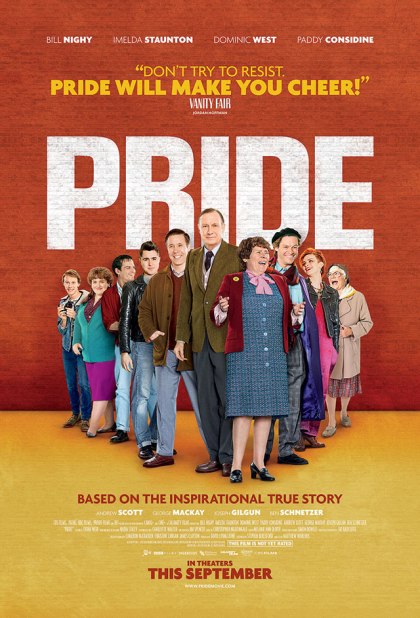
Filed under: Published film reviews | Tags: Bill Nighy, coal miners, Dominic West, George Mackay, Imelda Staunton, Margaret Thatcher, Paddy Considine, strikes, unions, Wales
Realizing that they share a common enemy in Margaret Thatcher, the police, and the conservative press, London-based gays and lesbians give support to striking coal miners in 1984 Wales.
PRIDE is exactly the kind of film British filmmakers do best: a focused local story based on hard facts and blended with sentimental fiction. It’s poignant and humorous at the same time. Add a stellar ensemble cast and a nostalgic soundtrack, and you’ve got yourself a film worth loving. I found myself literally sitting on the edge of my seat, my spine tingling in response to this film’s charm. I laughed. I cried. And in lieu of my inability to join their ranks and raise a fist in solidarity, I clapped with joy (and relief) that such artful and engaging films are being made.
 Victoria Jelinek