Filed under: Published film reviews | Tags: Cruel Intentions, Dangerous Liaisons, Glenn Close, John Malkovich, Michelle Pfeifffer, Perre Choderlos de Laclos, Reese Witherspoon, Sarah Michelle Gellar
Because the characters in Pierre Choderlos de Laclos’ novel Les Liaisons Dangereuses (Dangerous Liaisons) are very French and not ‘august’, I’ve chosen to profile two very different film adaptations from this book for this month. The author, Choderlos de Laclos, was a Brigadier General in Napoleon’s army. His novel was condemned as ‘revolting immortality’ when it was first published in Paris in 1782, but that didn’t stop it from being voraciously read over the next two hundred years!
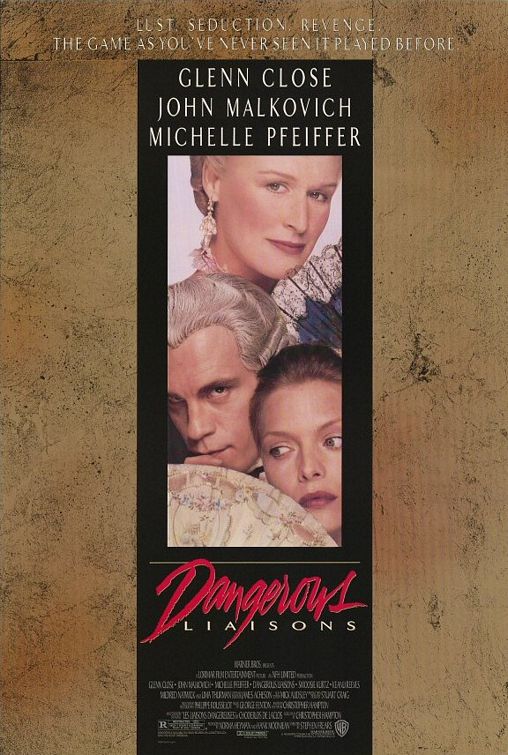 DANGEROUS LIAISONS (Les Liaisons Dangereuses)
Vicomte de Valmont (John Malkovich) and the Marquise de Merteille (Glenn Close) enjoy a close, although not sexual, relationship based on desire and disdain. They are perpetually trying to outdo each other in their morally reprehensible acts, which generally involve the deflowering of young socialites. When she asks him to seduce Cecile to humiliate her prospective husband (the Marquises’ ex), he initially refuses because he’s trying to bed the highly moralled Mme de Tourvel (Michelle Pfeiffer) just for fun. When Valmont locks horns with Cecile’s protective mother, he decides that bedding her, in defiance of the mother, may be a good idea after all. Meanwhile, the ‘bet’ between the Marquise and Valmont is that he cannot bed Mme de Tourvel, and if he does, he must provide written proof and then he will actually get to sleep with the Marquise.
The film could so easily have fallen apart due the sheer ludicrousness of the plot, but the wonderful acting by the leads, Close, Malkovich and Pfeiffer, makes the story not only possible, but plausible; they’re operating on the idea that everybody concerned is absolutely mad as only the fabulously wealthy can be. This is a devilishly seductive black comedy.
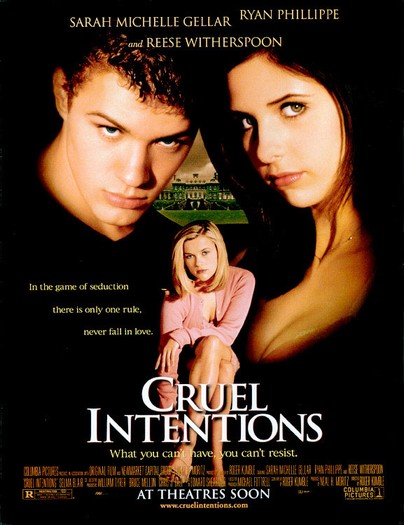 CRUEL INTENTIONS
Kathryn (Sarah Michelle Gellar) and Sebastian Valmont (Ryan Phillippe) are amoral step–siblings in modern day Manhattan. Both of them spend their time shagging around the Upper East Side, but Kathryn has a great reputation among the upper-class society they are both a part of, whereas Sebastian is a notorious sleaze. In an effort to satisfy their lust for each other, Kathryn bets Sebastian that he can’t bed the virginal Annette (Reese Witherspoon), the headmaster’s daughter at their posh school, who has sworn celibacy before marriage. If Sebastian fails to bed Annette, then Kathryn gets his vintage Jaguar. If he succeeds, he gets Kathryn for the night.
Cue saucy shenanigans and a subplot regarding defrocking the innocent pawn Cecile as revenge for Kathryn’s being dumped by Cecille’s current boyfriend. As added vengeance, Kathryn also sleeps with Cecile’s ‘true love’ even as she tells Cecile that she is helping them to get together away from the vigilante eye of Cecile’s overbearing mother.
With its over-the-top performances and preposterous climactic ‘tragedy’, this is the kind of movie purists dismiss as a mockery of both the original film ‘The Dangerous Liaisons’ and of the book. However, if you don’t focus on the roots that it has shamelessly mangled, this film is a lot of fun that will entertain you.
Filed under: Published film reviews | Tags: Abbie Cornish, Bradley Cooper, Robert DeNiro
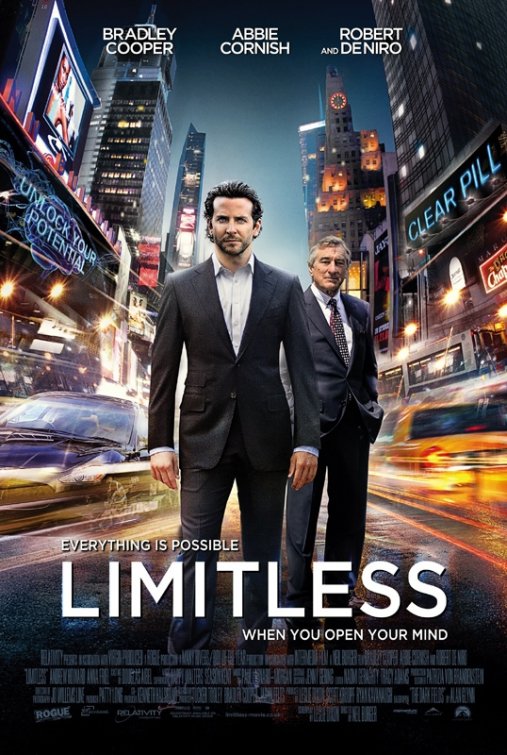 Wannabe writer Eddie (Bradley Cooper) is out of money, heart broken, and has writer’s block until he discovers a top-secret drug with brain-enhancing qualities, which gives him a four-digit IQ. Robert De Niro plays a billionaire on the trail of Eddie’s secret and Abbie Cornish plays our hero’s skeptical girlfriend. Soon, Eddie finds himself haunted by blackouts and hunted by bad guys.
This is silly material, sure, and very high concept, but the actors – particularly Bradley Cooper and Robert De Niro (both in form in their respective roles) have a lot of fun in this film, which does not take itself seriously. This is a smart, stylish and hugely entertaining movie that makes you wonder “what if?”.
Filed under: Published film reviews | Tags: Christopher Plummer, Ewan McGregor, Mike Mills
 Oliver (Ewan McGregor) is graphic artist grieving for his father, Hal (Christopher Plummer) who has terminal cancer and who Oliver’s just discovered is gay. Oliver then embarks on a love affair with a French actress.
Mike Mills is a very hip US Director connected in a big way to cool bands (Air, Beastie Boys), edgy movies (Thumbsucker), and who’s married to an indie-scene ‘goddess,’ so it’s no surprise that this film has an offbeat sense of humour and is quirky in general. However, this film doesn’t know whether it wants to be a romance – see our hero embarking on a love affair with pretty and ‘kooky’ French actress – or whether it’s a family drama – see our hero discovering something huge about his father just as he’s dying – resulting in the film not going into too much depth in either area.
That said, the acting and the characters are very well done: Ewan McGregor is likeable and witty as Oliver; and Christopher Plummer as Hal, is great as the kindly, outspoken and stubborn dad. The flashbacks of their visits together in the hospital, where Hal openly embraces his sexuality, to the surprise of his son, are well-observed and poignant, and remind one of the importance of living life to the fullest.
Filed under: Published film reviews | Tags: Bangkok, Bradley Cooper, Hangover, Very Bad Trip
 Like its predecessor, one of the guys is set to wed a non-mail order Thai bride, so the gang are reunited and set loose in Bangkok (last time Las Vegas) where they wake up in another hotel room, unable to remember what’s happened to them. This time their trail of mayhem involves monks, monkeys and a slew of ‘lady boys.’
The original Very Bad Trip (Hangover) was a cleverly structured dumb comedy about the day after a stag night, piecing together the specifics of a debauchery. This follow-up sticks so closely to its predecessor’s blueprint that it plays more like a remake, and unlike the first film, it’s not very funny. That said, if you’ve had a few beers, want to have a ‘lite’ evening at the cinema, and are interested in looking at the seedier side of Bangkok, then this is the film for you.
Filed under: Published film reviews | Tags: Badlands, Brad Pitt, Days of Heaven, Sean Penn, Terrence Malick
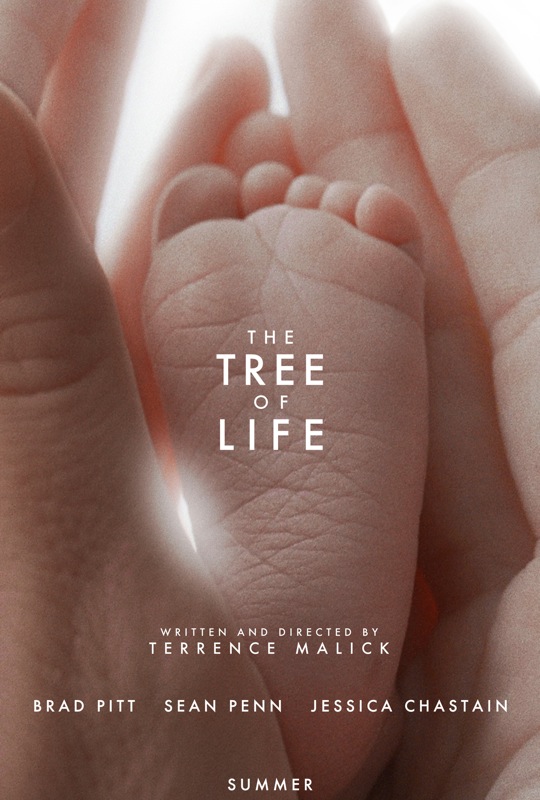 This is a film about three boys growing up in the 1950’s with their mother, a free spirit, and their father, a ‘hard ass’ who is alternately affectionate (played by Brad Pitt). The story considers the origins and meaning of life, and death, in general and as it pertains to the boys’ lives and experiences.
The film premiered in competition at the 2011 Cannes Film Festival, where it won a Palme d’Or, and was met with rave reviews from critics but was actually booed at the screening (a tough reaction particularly as the filmmakers and actors are present). Depending on who you speak to, the sci-fi meets surrealist themes and imagery were seen as either imaginative and independently minded, or pretentious and boring. This reviewer finds that the fragmented and non-linear narrative actually is how memories are remembered, and as it’s a story told in the present about the past, this seems appropriate and interesting. That said, there is an argument for its being indulgent and meandering. However, in a world of films that appeal to the lowest common denominator and rely on frenetic images and action, this nicely paced, philosophically-light film is refreshing.
Malick has taken his time with his films, working on this one for decades and ‘only’ having made seven films in a 35-year career, but his films Badlands and Days of Heaven are two of the most beautifully filmed movies of all time and this one is gorgeous, too. Lightly existential, this is a great film to watch when you’re in the mood to consider your life, your family, and the world you live in without delving too deeply into any of it.
Filed under: Published film reviews | Tags: Audrey Tautou, Carla Bruni, Jean-Pierre Jeunet, Michael Sheen, Owen Wilson, Paris, Rachel McAdams, Woody Allen
Picking up from last month’s The French Paper interview with Woody Allen at the Cannes Film Festival, I’ve reviewed his latest film Minuit a Paris (Midnight in Paris) currently in cinemas. Because Allen’s film celebrates Paris as the city of light, the city of romance, and the city of beauty and possibility, I have chosen another film that honours Paris’ ‘heart’, too.
MIDNIGHT IN PARIS
 Director Woody Allen’s latest film, which premiered in Cannes this year, is a romantic comedy about a family travelling to Paris for business, including a young engaged couple. Our hero, one half of the couple, is unhappy, but not entirely sure how to amend his malcontent. During his rambling evening walks, our hero finds that he is transported to 1920’s Paris every night at midnight when he stands at a certain place in the city. In this other age he meets many of his heroes, such as Hemingway, Fitzgerald, Dali, Bunuel, Picasso, Man Ray and Gertrude Stein. During these visits, our hero is forced to confront his illusion that a life different from his own is better, even as he also finds that some elements of his dreams are worth pursuing in his ‘real’ life.
This film is not one of Allen’s greats – Manhattan or Annie Hall or even The Mighty Aphrodite – but it is the best of recent years and absolutely worth watching. That said, it’s not a film for everyone because of its literary and artistic references as well as its subtext of existentialism, but that’s not to say that it’s ‘high brow’ or overly intellectual at all. Ultimately, Woody Allen’s film is an homage to creativity and dreams as a reality rather than as an illusion. This reviewer left the cinema after watching this film feeling that “all things are possible.”
AMELIE
 Amelie secretly sorts out the sad little problems in her friends’ lives, bringing joy to them without being happy herself. But when she finds a photo album belonging to a stranger called Nino, she realises that she’s in love from afar, a problem of her own she has to deal with, among other problems, one of which is that as a child she was isolated from her peers and withdrew into a private world of her own. Luckily, however, this gives her a great imagination and gives Director Jean-Pierre Jeunet the opportunity to filter the film through some of Amelie’s gently bizarre observations.
As in Director Jeunet’s other film Delicatessen, the affectionately eccentric and grotesque characters are essentially lonely people who share their geography. Unlike Delicatessen, there is the positive force of Amelie, played charmingly by Audrey Tautou, who brightens their lives and fills them, and us, with hope and happiness.
This colossal French box office hit has an irresistible charm that will eliminate the storm clouds hanging over the heads of even the most desolate misanthrope. With its wonderful soundtrack, Amelie leaves the viewer feeling revitalized and dreamy.
Filed under: Published travel writing | Tags: Cannes, Cannes Film Festival, film festival, French film festival, May in France
 It’s an amazing party like nothing you’ll see anywhere – not Sundance, Toronto, Berlin, Venice, nowhere. It’s everyone in World Cinema and the European industry combined with everyone in the US industry, combined with super super stars, combined with international wealth that one doesn’t usually see (arms dealers, for example), with huge yachts on the harbour, sparkling at night along the Croisette, and folks decked out in Chanel, Dior, Gucci for the premieres (black tie only, and its very cool as you walk down the red carpet and it all seems so celebratory! For film!). The main gig is along the Croisette (the main road, bordering the water) with Old Town providing the places for nice, relaxed dinners, and the beaches farther along the harbour for those who want some ‘peace.’ And most of the action that’s not private happens behind the “Grand Hotel”. It’s a lot of fun and it’s gorgeous. I enjoyed the work and the partying, but it was exhausting. I felt like I had Rose wine streaming through my veins by the time I left all times. However, it is impossible to get into parties, on the beach, in the villas up in the hills, on the boats, anywhere, without being on guest lists, and it’s near impossible to get into most films without a pass, and absolutely impossible to attend a premiere unless you know a distributor who can give you an invite, or you go with an A-list star. The villas, the parties on the beach, all heavily guarded, as are the premieres, where even if you do have a ticket, you may not get in and it’s a real mess (see A-list bringing an entourage and over-issuing to insure packed houses). It’s gorgeous, blue sparkling, French Riviera, and its silver-coloured sea with the sparkling lights at night… However, even when you are working, or are with an ‘important’ person, or are ‘beloved’ by those you’re around, everyone is always looking over your shoulder as they talk to you, and around the room, to see who else is there, eager to make that next important contact, that next big impression. Overall, it’s exhilarating in the setting of the silver, sparkling sea, and all the commotion about film when you are a lover of film, even as it’s also heartbreaking.
Filed under: Published film reviews | Tags: Iceland banking, Matt Damon, robber barons, UK banking, US banking
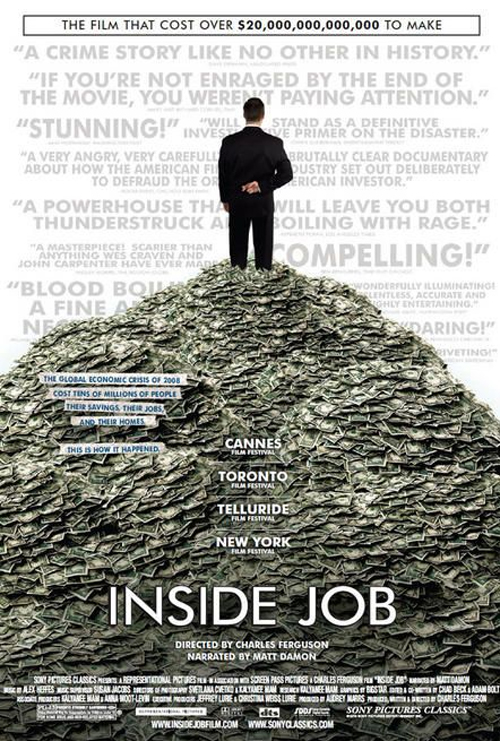 Matt Damon narrates this low-key but shrewd documentary outlining the financial scandal of 2008. Through interviews with economists and politicians, this film reveals how close the USA came to the brink of bankruptcy and why it could so easily happen again.
As a result of a mix of banking deregulation in the US and a bonus culture in the UK, the West entered into an era of casino capitalism. Beginning with the bankruptcy of Iceland, a country once labelled the safest financial bet in the world, the film explains how their banks became greedy, over-expanded, and then fell, bringing the country to its knees. This film strips the layers of mystery that surround the banking world and show us that under laboratory conditions, human brains given money for a task will react similarly to cocaine users.
This documentary isn’t always easy to follow, but that’s part of the fraud: Inside Job tries to show us that the recent crises are not part of an unforeseeable force majeure but the inevitable consequence of a system that manipulates the law at the for the gratification of a few and at the expense of the majority.
Unlike any of Michael Moore’s films that border on the hysterical in their one-sidedness, this is a sharp study of corporate greed in a beautifully restrained attempt to alert us to the robbery that has been, and is, going on in plain sight.
Filed under: Published film reviews | Tags: Alex Garland, Carey Mulligan, Kazuo Ishiguro, Keira Knightley
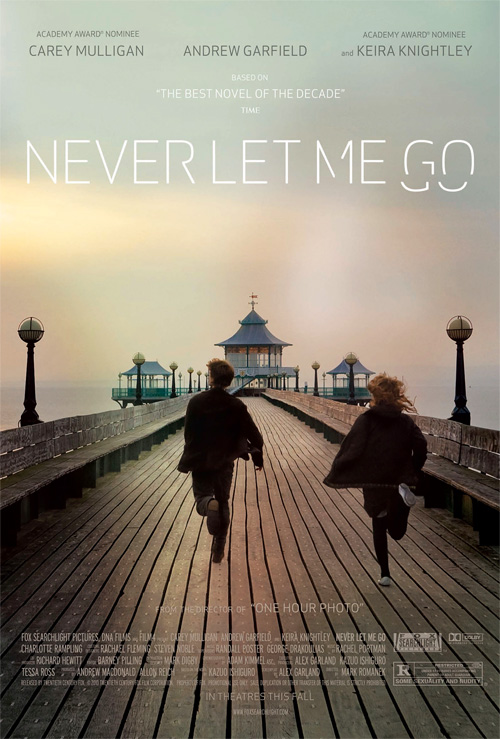 Kathy (Carey Mulligan) is a woman looking back on her childhood days at Hailsham boarding school with best friends Ruth (Keira Knightley) and Tommy (Andrew Garfield). Like the other Hailsham pupils, the three have a destiny that together, they grow to understand, and struggle to accept.
Based on Kazuo Ishiguro’s novel of the same name, the story is, technically, science fiction, even as the film initially feels like a coming-of-age romance. Adapted from the book by Alex Garland, himself an author (28 Days Later, The Beach), we are told immediately of a medical breakthrough in the 1960’s which has dramatically extended human life expectancy, and we see the pupils of the school wearing a wrist band to enter/exit and that they keep through adulthood, so even as we know that we’re not in a ‘normal’ environment, the genre of the film is not revealed quickly.
These characters are entrapped, but they’re not searching for escape. There are deeper, more personal things at stake, which is why this story is so profoundly sad. This is beautifully realised adaptation of intelligent science fiction with very good direction and casting.
Filed under: Published film reviews | Tags: Aron Ralston, Danny Boyle, James Franco, Slumdog Millionaire, Utah climbing
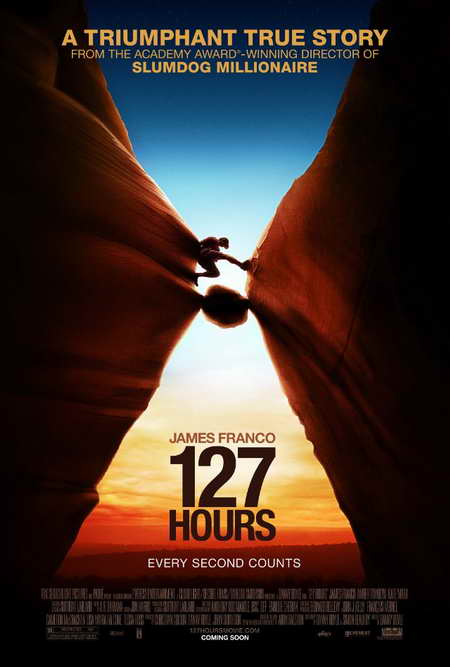 This is the true story of adventurer Aron Ralston (James Franco) who, while hiking in the mountains of Utah, falls into a crevice and a boulder crushes his right arm. Over the next five days, Ralston discovers that he has the wherewithal to extricate himself and to survive by any means necessary.
This is not a story about heroism, its Ralston’s ego that got him into the trouble in the first place. It’s not about hidden reserves of power we find when faced with a crisis because Ralston goes above-and-beyond what most of us would do in any circumstance. It’s a story about optimism –about how a simple guy turns his life around, just as any of us can, and should, in any hemmed-in circumstance we may find ourselves in.
Danny Boyle is no stranger to using dark material to convey optimism and vibrancy. In his film Slumdog Millionaire, we see unimaginable poverty, child beggars having their eyes gauged out to increase begging profits, and girls being forced into prostitution, yet for most critics and audiences alike, it’s ‘the feel good film of the decade.’ In 127 HOURS, Boyle doesn’t linger on the horror of this situation, or the gruesome things Ralston does to free himself, but rather on the liberation that this experience is for him.
That said, this reviewer felt that while it would be interesting to watch a 30 minute documentary on Aron Ralston’s experience, there isn’t enough subject matter to make it an interesting feature film.
 Victoria Jelinek