Filed under: Published film reviews | Tags: film review, Michael Sheen, Robert Pattinson, Stephenie Meyer, Twilight
 For those of you who are aware of the craze that the Harry Potter series was, you may also know that the Twilight books and films have surpassed them in terms of popularity.
And if you haven’t seen the Twilight films because you don’t want to be part of a teenage cult phenomena, I advise you to release any intellectual or ‘adult-like’ reservations you may have about this film, buy into the central story, which is all-encompassing love against the odds, and go see it. With the additional bonus of werewolves and the traditional vampire Volturi – led by Michael Sheen (Underworld, Blood Diamond) – in this sequel, it’s a must see on the big screen.
But let me first establish my credibility as a fellow sceptic: a friend loaned me the first book for a flight I was about to take. Shortly after I landed at my destination, I bought the rest of the books and stayed up practically all night that week to finish these tomes. Sure, I was, and am, a bit embarrassed that I like what is ultimately a clever testament to the merit of abstinence written by a Mormon, and what’s popular with 13-year-old’s around the world. However, I rationalise, this is an epic and entertaining story, and the films are fun, and well shot (on digital, btw, not celluloid) to boot.
On Bella’s (Kristen Stewart) 18th birthday, there’s an unfortunate near-death incident at vampire Edward’s (Robert Pattinson) house, and he leaves his true love for her own good (so it seems to him) and disappears from her life. Bella is absolutely devastated. Estranged from her pals and a virtual zombie at home, it’s her friend Jacob Black (Taylor Lautner) who helps her through. But Jacob is dealing with issues of his own, such as a searing crush on our heroine. Unfortunately, however, it turns out that that’s not the only thing Jacob’s afflicted with…
In the middle of this masculine acting out, Bella pulls herself out of the trance of depression and fights to keep both men in her life.
In the same way that many superhero sequels are about our hero trying to give up their cape, New Moon is about the heartbreak that almost inevitably follows the unthinking passion that was conveyed in the first movie. This is an escapist movie at its best.
Filed under: Published film reviews | Tags: Armando Iannucci, film review, James Gandolfini
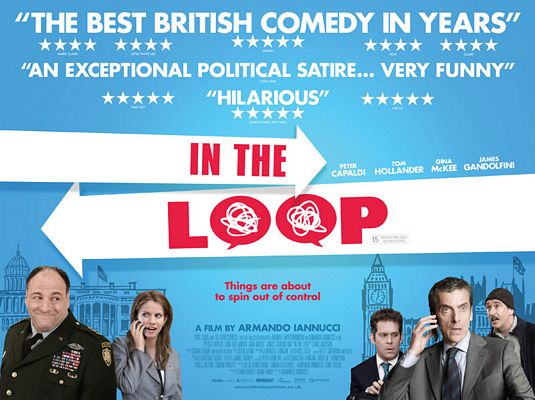 In The Loop is a satirical demolition of Whitehall and Washington: politically astute, absolutely funny and terrifyingly real.
As cinematic subgenres go, political satire doesn’t generally beat blockbuster, but In The Loop not only received ecstatic critical reviews when it was released in the UK and stateside, it managed to get bums-on-seats everywhere it screened.
It doesn’t matter if you’re politically in the know: most of us have met people like the bullies, opportunists and passive-aggressive backstabbers on display here. And it doesn’t matter if you’ve seen Director Armando Iannucci’s BAFTA-winning series, The Thick Of It.
In In The Loop, incompetent minister Simon Foster, played by Tom Hollander (Valkyrie, Pirates of the Caribbean) is sent to Washington after making contradictory comments about possible war in the Middle East. Foster is a hapless minister whose senseless pronouncements about potential war (in the Middle East) are latched onto by vying political factions. Hollander is utterly brilliant as a man so far out of his depth he needs armbands.
The set-up loosely shadows the drive for the invasion of Iraq, with various avatars for real-life politicos: James Gandolfini (The Sopranos) is a peace-pushing general reminiscent of Colin Powell; Peter Capaldi (The Thick of It, Doctor Who) is a foul-mouthed Scottish spin-doctor who bears relation to Alastair Campbell; and David Rasche (United 93, Flags of Our Fathers) hideously resembles former Secretary of Defense, Donald Rumsfeld.
Okay, sure. Many people think politics are dull or that it’s transitory, so it’s considered to be the domain of TV, which can react pretty instantly to breaking news (and doesn’t cost a cinema ticket!). But Iraq is not named at any point in this film because Director Iannucci is savvy enough to understand that ambition, idiocy, and fundamentalism play a role in any conflict, in any age, in any nation. Politics isn’t transitory; it’s timeless. And so is great satire, which this is. There’s also a good deal of improvisation by the actors here, feeding the intimate documentary style and aligning it worryingly to ‘real-life.’ But, hey – if we can’t laugh at ourselves, what’s the point? Finally, it’s worthwhile to support films that are not appealing to the lowest common denominator. I highly recommend In The Loop.
Filed under: Published film reviews | Tags: Allison Janny, Away We Go, film review, John Krasinski, Maya Rudolph, Sam Mendes
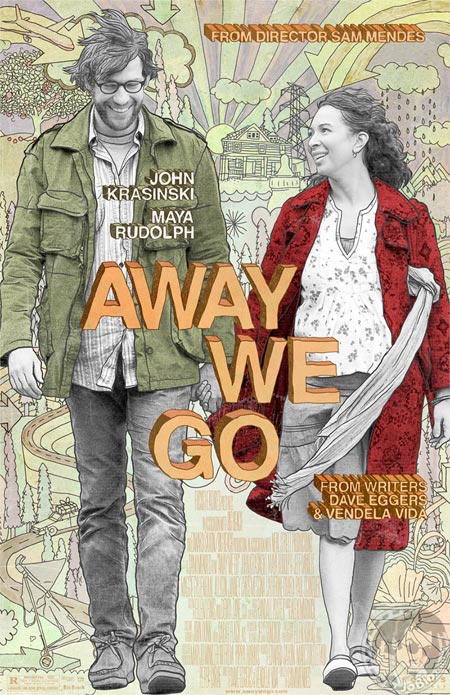 Away We Go wanders happily between comedy road trip and thirty-something coming-of-middle-age-drama. This film belongs to that branch of the road movie in which characters examine their pasts to confront present dilemmas.
Directed by Sam Mendes, who also directed American Beauty (Kevin Spacey, Annette Bening), Jarhead (Jake Gyllenhaal), Revolutionary Road, (Kate Winslet, Leonardo DiCaprio), and Road to Perdition, (Paul Newman, Tom Hanks), Away We Go does not stray from the themes of Mendes’ previous films, as it, too, is about seemingly ordinary people coming to terms with their lives.
The lead actors in Away We Go are not A-lister’s (a nod to independent filmmaking) but have done good work on TV and small film roles. Verona – played by Maya Rudolph – is hilarious in a deadpan, understated manner. Bespectacled college dropout Burt – played by John Krasinski – is charmingly idiosyncratic.
Burt and Verona are expecting their first baby. When Burt’s parents, the couple’s sole reason for moving to their current dreary town they call The Place We Live At the Moment, decide to leave the US, the couple go on a trip cross-country to find somewhere else to raise their child, beginning a disillusioning odyssey pretty much visiting any friend who has ever reproduced. During a particularly fraught, affecting visit, Verona has an epiphany about her own childhood which clarifies their lives: everywhere they’ve learnt lessons from those they meet about how not to raise children – apparently, the answer to their problems is that they don’t have to depend on the support of friends or the kindness of strangers.
Bravely, this film posits a relationship in which the couple are completely and happily in love, without underlying secrets waiting to ruin everything. Happiness is a difficult narrative concept to maintain, being, by definition, free of dramatic incident, but the lead couple are so charismatically and likeably written and played that even an uneventful trip on a train becomes high comedy. Arguably, those they meet along the way are cliché, but they’re balanced by the completely believable leads who seem themselves unable to believe these people are quite real.
I believe this is a film worth seeing because it’s simply a poignant and funny film. Also, I believe that if you’ve liked even one film from a given director (and I’ve liked all of Sam Mendes’ films), then you should give all of their work a ‘look-see.” Finally, the film works through striking scenes and splendid moments, rather than as a continuous whole, and, thanks to the cinematographer and production designer’s efforts, there is a distinctive regional look to each episode.
 Victoria Jelinek