Filed under: Uncategorized | Tags: Christopher Nolan, Epic, film review, greek mythology, Homer, IMAX, Matt Damon, movies, the odyssey
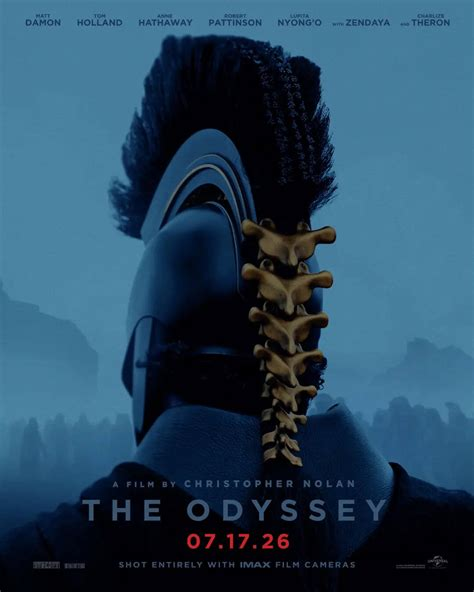
The Odyssey is the epitome of an epic by any definition. Homer’s 8th century BC poem has 12,000-lines and 24 books. The 3000-year old piece of literature, essentially about a man trying to get home after being at war, is a masterpiece of Greek mythology. Spanning many years, it’s a voyage of monsters and gods, across seas and islands, over warring lands and into the underworld itself.
A difficult text to adapt to the screen, but Christopher Nolan is not a stranger to ambition. From the opening title card, set in a “time of apparent magic,” the audience goes headlong into a world of realism and fantasy and a story dense with detail and plot. But, it is as economical and elegant an adaptation as is possible to make of such a lengthy tome, and you don’t need an English degree to understand it. While there may be purists who chafe at the script’s omissions and the loss of dactylic hexameter, Nolan’s film makes up for these sacrifices with the film’s structural and visual poetry. Beautifully shot and edited, using flashback and nesting narratives, this film might only be truly appreciated through repeat viewings. In addition to the extraordinary artfulness of the script, the set pieces are a seamless blend of puppetry, stunt performers, and special effects, which make this mythical world look and feel real (Especially if viewed on IMAX, the scope it was shot on)
Nolan’s The Odyssey is filmmaking at a magnitude only a few modern directors could imagine, much less execute. But it is not clangorous. There are quiet moments. As with the original text, the heroes of the film are full of foibles: Calypso is lonely and just wants a companion. Athena appears in flashes as if some kind of traumatic response. Zeus and Poseidon manifest as the elements. Circe is furious and saddened by the baseness of men.
When, in the final act, Odysseus finally makes it back to Ithaca, heartbroken at the state of the world and his part in its downfall, the film, and Nolan’s purpose, comes into focus. Greece is spoken of as “the greatest civilisation the world has ever seen.” A diminished empire, Nolan embraces its parallels with American exceptionalism and Manifest Destiny. It is here, at the journey’s end, that Nolan rages against the pointlessness of war and the follies and failures of mankind.
Filed under: Film reviews | Tags: AIDS, biopic, Film, Freddie Mercury, movies, music, Queen
 The movie begins in 1970 when Freddie Mercury (Rami Malek), an audacious youth with a mouth full of too many teeth, works as a baggage handler at Heathrow and lives at home with his parents. One night, he meets, and then joins, the college rock band, Smile, and together they become Queen, one of the biggest bands in rock history. The film chronicles their rise to fame and ends with Queen’s performance at Live Aid in 1985.
Critical reviews have been lukewarm. In the interest of being judicious, I’ll cover primary complaints. Changing direction midway through production – from Bryan Singer to Dexter Fletcher – results in the subject of Queen and Freddie Mercury being realized in a safe, by-the-numbers manner, even as it’s depicting a man and a band who were anything but ‘safe’ and predictable. Queen’s ‘path to glory’ is fundamentally free of any road bumps, progressing smoothly from student gigs to sold-out stadiums within a few years. The film’s focus on Freddie’s relationship to Mary Austin, rather than any real time on a happy, gay relationship, undermines who he was. This part of his identity is further injured by the discovery of his HIV status being revealed in a quiet montage. Finally, ending the film at Live Aid in 1985, rather than covering the story of Freddie’s last six years, undermines the work he did during this time.
There is reason to these assertions, but the film couldn’t cover it all, despite its tagline, without seeming underdeveloped. Yes, Freddie Mercury is an utterly fascinating and deeply moving subject, and Rami Malek, who plays Freddie, is absolutely spectacular – he’s a strutting, bodacious peacock who’s also incredibly affecting, providing visual excitement on screen at every turn, just as the charismatic Freddie once did. However, I feel this is more about the story of Queen than its frontman, so perhaps a criticism could be that the script didn’t fully realize its stated goal? And, it’s not about their, or Freddie’s, struggle to fame, it’s about their struggle to remain true to themselves, and each other, and relevant to their fans. I realized while watching the film how unwittingly omnipresent the band had been throughout my youth (and I sang Bohemian Rhapsody to my infant son as a lullaby), but I had stupidly not realized how collaborative they essentially were. From the moment the film starts, we see the set up for a large concert, from the roadies, to the technicians, to the ticket sellers, to the artists, setting the stage – literally – for the film, which accentuates the mechanics of creating the music. In my opinion, this isn’t a light journey through the hits that some declare, or the story of Mercury’s complicated life, but, rather, some insight into how those hits were created and developed by the band. Their relationship, for better and for worse. It’s compelling material. On top of that, one revisits one’s own youth through the music they created together. Ending the film on the Live Aid show simply creates a focused arc, a ‘bookend,’ if you will, that provides dramatic tension. As for not focusing on Freddie’s homosexuality, I think that’s tripe. The entire story arc for his character is about realizing his ‘true’ identity, who he is ‘meant to be,’ as he struggles with the role he has within his family, his sexual propensities, and the effects of fame. Mary Austin wasn’t an aside or an act of curiosity – she embraced Freddie’s flamboyance before anyone else did and was a consistent friend and lover for years (he left his entire estate to her) despite the fact that she was not male and consequently does not fit into the general assessment of who he was. If one is to be truly liberal, one should account for the possibilities inherent in human sexuality, and not be so dogmatic about how one “usually” fits into a category or not.
In fact, this film illustrates that things are not always what they seem, through its minor exploration of Freddie’s sexual awakening and consequent proclivities, yes, but also in its insight into the band’s marriage, if you will, and Freddie’s realization of his power as a performer. Ultimately, I found the film interesting, joyful, humorous, and poignant–fantastic entertainment that made me forget everything else whilst watching it.

