Filed under: The Baby Diaries | Tags: 19th century America, 20th century America, A Tree Grows in Brooklyn, Anna Quindlen, Betty Smith, classic American novels, injustice, memoirs, poverty, soft-hearted, tenement living
Sometimes the strength of motherhood is greater than natural laws. Barbara Kingsolver
 I recently read a book in which there was a passage that greatly affected me. While I have always been a person who becomes emotionally and intellectually involved with compelling characters in books I read, and have even been known to mourn them when they die, I am surprised by my reaction to this particular passage, described below in a note to my mother. My guess is that I feel particularly connected to the young mother in the story as I now have a child, and I’m particularly vulnerable to the world around me and to his experience within it–I can feel the woman in the story’s love and protectiveness, her hurt and her rejection. And I am aware of my connection with my own mother, who responds to my note with understanding, sympathy, and a hint of how to handle these very tender feelings. Thus is information passed from one mother (a literary creation) to another (me, the newish mother), to my own mother…it’s an empathetic, comforting connection which illustrates “the strength of motherhood, passed through generations.”
Dear Mom,
At my book club meeting the other day (it’s really a book swap for a group of expatriates in the valley who want to read English language books, and not pay for them), I borrowed a book called A Tree Grows in Brooklyn. Now, courage is a quality I admire most in people, and value greatly in myself, but I fear I can’t finish this book because it’s so sad: the story is told from the perspective of a little girl, a poor, tenement child growing up in turn–of-the-century Brooklyn. She’s precocious, an avid reader, but usually hungry – it hurts me to think of hungry children. Her mother works hard as a washer- woman, and her father is a sweet, but rather useless dreamer. Anyway, there was a passage last night that made me cry and cry and I could not get the image out of my head, and as I write this note to you, tears are coming to my eyes…
In the chapter, a pretty young woman, Joanna, who lives on our narrator’s block, has an infant son. She works in the factory during the week and Joanna’s mother takes care of the baby while Joanna is at work, but she never takes the baby outdoors because the child is a bastard and it’s “unseemly” to take him out of doors. This fact starts to tug on my heart as I think of the poor baby that has shame cast upon him, and they’re so impressionable and sensitive, through no fault of his own. One day, young Joanna takes her baby out for a walk (on the street of the tenements), as it’s a gorgeous spring day. The carriage is clean, the baby is dressed in clean white (uncommon among these “great unwashed”), evidence of Joanne’s love and conscientiousness, and the baby and she are smiling and happy to be enjoying the spring day together. But the women in the neighborhood, angry at their own circumstances, their savage husbands and loveless marriages, whatever, are cruel to her. At one point, they say to her that she has no right to be on the street and needs to go indoors. Again, my heart constricts with this notion, the meanness, and tears well up in my eyes. Joanna responds defiantly, crying, “It’s a free country!” The women start to throw stones and manure at her. One of the stones accidentally hits the baby in the forehead and a thin line of blood starts to run down his face. He starts to whimper, seemingly afraid to cry, as though he knows that he has no ‘right’ to cry out loud (this is where I started sobbing), and quietly holds his arms up to be picked up. The women are ashamed, but don’t apologize, just go away. Joanna takes the baby into her arms, comforting him, she’s covered in manure and now disheveled, and returns home. She abandons the carriage in the street. Our little narrator sees Joanna and the baby in the vestibule outside Joanna’s house, the baby touching Joanna’s face tenderly, and Joanna softly speaking to him, but they are never seen on a walk again.
I can’t reconcile myself to this today, can’t make my heart hurt less, it’s such a vivid scene and it has hurt me to the quick for that poor baby and his sweet, pretty, hard working mother (the father was a coward), and I’m so distracted that I’m finding it hard to focus on anything…do you have any salve for my soul?
Dearest Tori,
I understand. Tears are in my eyes as I read the retelling of this part of the story. There is so much unfairness in the world. I tear up both at sad stories in the daily newspaper (usually about a child) and touchingly reassuring stories of kindness, of sympathy, of generosity, and I try to be a person of kindness and generosity. I can’t avoid my “soft-heartedness,” nor do I really wish to do so. My sadness reaffirms my intention to be caring, but I then have to wipe my tears away and return to my more common, daily world and tasks, or else I, too, will be one of the broken ones unable to act to free oneself from meanness or purposelessness or lack of hope.
One cannot forgive or forget the sad things, but one puts it away in one’s “heart” and goes on. Think, too, how the author of that story was able to convey the picture of people in a slum–in which there are, as I recall, Aunt (Cissy?) brassy and funny, and–the little, brave tree which grows amidst the stones and sidewalks and dead-end, unhappy, mean people.
Finish your guide for *. You’re helping to make kids lucky enough to be studying that play aware of things such as rejection and unfairness and also feisty rejuvenation and wisdom and some created happiness, instead.
Love, Mom
Filed under: Book reviews | Tags: 18th century, Big Endians, classic novels, Colonialism, English colonialism, French colonialism, Gulliver's Travels, Jack Black, Jonathan Swift, Lilliputians, parody, satire, satirical literature, Small Endians
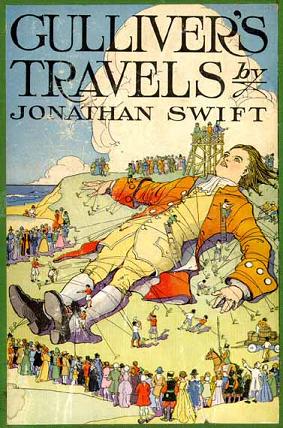 Author Jonathan Swift wrote that the purpose of his writing, “is to vex the world rather than divert it.” Throughout Gulliver’s Travels, Swift satirizes scientists, academics, snobs, politicians, lawyers, doctors, and – unfairly – women. Swift further parodies travel writers’ preoccupation with appearing to be “experts” in everything they write.
Lemuel Gulliver, a sea-loving surgeon and “everyman” travels to four lands and has numerous adventures. The imaginary worlds, fantastic characters, and exaggerated stories of Gulliver’s strange and exotic adventures, draw the reader into the narrative (and inspire film adaptations). Gulliver begins the journey larger than life in the land of the tiny Lilliputians, and after observing mankind’s tendency toward greed and selfishness, he finds himself most contented in a land of horses governed by reason. The moral of the novel suggests that the only ideal world is one in which humans do not rule.
“Satire,” Swift wrote, “is a sort of glass, wherein beholders do generally discover everybody’s face but their own.” The staying power of Gulliver’s Travels lies in the fact that the more things seem to change, they really don’t: mankind has been, and continues to be, motivated by avarice and folly. The practice of economically exploiting other countries was the policy of English and French colonial governments during Swift’s time, just as modern world powers go into underdeveloped cultures and consume their resources. Conflicts of religious ideology, as observed in the battle of the “Big Endians” and the “Small Endians,” are still apparent, as evidenced by the discord throughout the Middle East. Even the feuds between the “High Heels” and the “Low Heels” in the novel continue between and among current political parties.
Despite Swift’s critique of humanity and its institutions, however, he seems to have felt passionately enough about mankind to hope that those who read the book would reconsider themselves and the world around them in order to help make it a better place – “vex” readers into thinking, rather than “diverting” them into switching their thoughtfulness off.
Filed under: Published film reviews | Tags: apocalypse, big budget movies, Brad Pitt, Marc Forster, Max Brooks, Mel Brooks, Paramount, Philadelphia, summer blockbuster, World War Z, zombies
 An unexpected outbreak of a zombie plague leaves the world in shreds. Former UN worker Gerry Lane (Brad Pitt) and his family receive refuge on a governmental ship safely anchored at sea in exchange for Gerry traveling around the globe to find a cure.
Adapted from the grim book written by Max Brooks (son of Mel), we journey around the globe with Gerry, a family man who once ran operations for the UN in countries were most mortals wouldn’t survive a day. With governmental and military infrastructures in disarray, and entire countries experiencing radio silence, Gerry, alone, must trace the origin of the outbreak. Most apocalyptic blockbusters open by teasing the audience about what’s to come, but this one hits the ground running, with an entire city (Philadelphia) being overrun before you’ve settled comfortably in your seat. The opening scene – in which Director Marc Forster keeps the monsters practically unseen, creating an unnerving sense of the chaos — also sets the pace for the rest of the film, in which millions of people die, but scarcely a drop of blood is seen. Horror fans longing for large scale carnage will likely come away unsatisfied, but I appreciated the lack of gore. And the film is scary due to horrifying imagery, such as when the zombies go after prey, swarming like angry locust, screeching and chomping their teeth.
I watched this movie because I’d read about the development and production debacle involved in its making, and was curious to see how it ended up. Granted, it’s arguably bland, few of the characters are memorable, and the ending feels abrupt and flat-footed, but it’s also slick, taut, and holds together nicely. It’s certainly not the disaster many predicted it would be during its distressing birthing. In fact, despite costing an enormous amount of money for Paramount to make (a purported 230 million), it doubled this expenditure in worldwide box office sales alone…
Filed under: The Baby Diaries | Tags: Boy George, Chamonix, clubbing, Culture Club, DJ's, expats, French Alps, hyperreality, L'Amnesia, motherhood, nightclubs, pop music, teen spirit, The New Romantics
“Forty is the old age of youth; fifty the youth of old age.” Victor Hugo
 A friend invited me to go and see Boy George in Chamonix last Friday night. Yes, that’s right – Boy George of the Culture Club fame, the iconic girlie-man in the pop band of the 1980’s – was in this wee village DJ’ing, or ‘spinning.’ When I remarked on how bizarre it was to have Boy George in town to my husband, he tried to give it the ‘big un’ about how Chamonix is a cosmopolitan place, a destination for many, and that I underestimate its appeal…that Boy George probably saw it as an opportunity to go snowboarding for the weekend, hang out in a “cool French Alpine village,” and do his DJ’ing. Hmmm. I later found out he was paid 15k, which makes more sense. Curious to see what he looks like now, and a little anxious to prove to myself that I’m not only a rapidly aging mother, I agreed to go. Then I found out that he wasn’t scheduled to begin till 1am. If I’m up at 1am these days it’s cause my little tyke has wet or pooped himself, had a ‘night terror,’ is hungry, or has indigestion. Moreover, if I’m up at 1am these days, it means that when my day inevitably begins at the crack of dawn, I’m going to be even more fatigued than usual. Not wanting to disappoint my friend, however, or myself, I decided that on the night of the show, I would go to bed at the same time as my son (shortly after dinner), then wake up at midnight and go to the gig. All went as planned, I got a few hours of sleep, got dressed, made a coffee for myself, took an ibuprofen, (god I’m lame), and set off for the nightclub.
Nightclubs still smell like the teen spirit of my youth – sweat, alcohol, hormones, and the close, stale smell of an interior that never opens its doors for a spring-cleaning. This one is downstairs in a cave-like space below a two-story magazin. I couldn’t help but think that if there were a fire none of we club goers would be able to escape and it’d be a tragedy noted on the AOL homepage. Many of Chamonix’s expat ‘society’ were out for the gig – middle aged, middle class, dressed up in heels and ‘hip’ tennis shoes, already drunk in celebration of being away from their respective hearths-and-homes, in denial of the next morning and the demands of children and the household. Boy George didn’t come on until 3am (he must have been snoozing before his set, too) and he looked good: he had a sequined butterfly flower makeup design on half of his face, eyeliner, white foundation make up, and a pink, glittery fedora, with a simple black suit. Like the rest of us, he’s put on a bit of weight over the years. There was a charisma and energy around him – you could sense him moving through the crowd even before he entered the DJ booth. Immediately there was a tight knot of people around the little booth, which would have made me claustrophobic. Hyper-realistically, cell phones were over the heads of everyone standing around him as they took pictures and made videos. Boy George didn’t do much other than bob around while his partner actually DJ’d, then he, himself, started spinning. He chose ‘poppy’ riffs, which were good, and the music he chose had an energetic, non-aggressive beat, but after awhile, it was repetitious, and, well, boring. I wasn’t the only one to think so either ‘cause the club drained of folks pretty quickly. That said, maybe the crowd left because they were knackered in the small hours of dawn?
Filed under: Published film reviews | Tags: Bill Murray, Bob Balaban, Cate Blanchett, George Clooney, Jean Dujardin, John Goodman, Matt Damon, Nazi, Oceans Eleven, Russian, Second World War, WWII
 At the end of WWII, Frank Stokes (George Clooney) puts together a crew of art experts willing to brave the front lines in order to rescue continental Europe’s cultural heritage from the Nazi’s obliteration of the pieces, and the Soviets pillaging of them.
I unabashedly like George Clooney, who also directed and co wrote this film. I know he’s arguably “too earnest,” and a bit “too slick,” but I don’t care – I appreciate his efforts. That said, this latest endeavor was disappointing. It’s a handsome film, and the concept is great – art geeks braving the ruthlessness of war to do the right thing and save our collective treasures. But the film is not focused, making the pieces incoherent and episodic. It wants to be an important film, asking (repeatedly) whether a work of art is worth a human life. It also seems to want to be like the daring Nazi-bashing escapades of yore, with its whistling score. It also seems reminiscent of a Danny Ocean orchestrated heist. Not one of these objectives is successfully accomplished, though, due to a poorly constructed story that does not have one unifying’ job’ that brings all the seams together. It’s a shame, too, ‘cause the idea has potential, there are several excellent scenes, and the cast is talented…
Filed under: The Baby Diaries | Tags: Chad, Cote d'Ivoire, equal rights, French Republic, gender equality, human rights, International Women's Day, Iran, Mali, Marianne of France, Mauritania, Morocco, Pakistan, Saudi Arabia, suffrage movement, Syria, WEF, World Economic Forum, Yemen
Before God we are all equally wise – and equally foolish. Albert Einstein
 International Women’s Day is March 8th and it has me thinking about what it means to be a woman in the context of motherhood today. It may be a taboo to write, but I find that the most difficult aspect of motherhood is the fact that I must be less selfish. I think it’s hard enough to be an ambitious woman in this world, much less one who is also a mother.
Having my son has been, by far, the greatest accomplishment of my life. This in the context of surviving divorce, illness, several moves, and a few career incarnations. In the long run, too, it is likely the most interesting thing I’ve ever done. This is in the context of living in a variety of places, working in the film industry and as a writer, traveling everywhere, and being married more than once. But in the daily scheme of things, it’s hard work to be a woman and a mother. I won’t be able to sleep in again until he’s in his teens. I can’t just move to a more desirable locale if the whim or an opportunity exists, as I must defer to my husband and his wishes. I must work towards compromise and contentment in my marriage to the father of my child, even when circumstances are taxing. Living in a provincial small town, I must often sit with the women in the kitchen as we discuss our children and our marital relationships, when I would prefer rhetorical conversations on politics, culture, books, and film. And, when I do have the opportunity for these types of conversations, they are fractured because I must attend to my small child. It’s a lot of personal sacrifice and a lot of work, which has prompted me to go outside of myself and consider what we as women have accomplished over the last century.
Issues typically associated with notions of women’s rights cover, but are not limited to, several points: the right to bodily integrity and autonomy. Yet these rights do not exist for many women in the Middle East or Africa, as evidenced in mutilation exercises, rape, and the covering of the body. The right to vote. This is relatively new – it only became possible for women in the U.S. in 1920 and in the UK in 1928, and it has just became possible for Saudi women in 2011. The right to hold public office. Yet women are not evenly represented with men in public offices throughout the world. The right to fair wages and equal pay. Yet women, on average, earn 44% less than a male counterpart in the same position. The right to own property. Yet in China, male family members are the proprietors of property, and in France, a man’s property goes to his son, first, and if there isn’t a son, the father, and if there isn’t a father, a brother, before it goes to his wife. The right to be educated. Yes, indeed, girls can go to school, but see the aforementioned regarding equal opportunities and wages. Parental and marital rights. In France in a divorce, the children are not automatically put in the guardianship of their mother (not by a long shot) and there is no such thing as an equal division of property (the French republic’s motto is, after all, “Liberte, Eqalite, et Fraternite” even if the French republic’s motto is embodied by the image of a woman, Marianne of France). When there are disparate rights between men and women, institutionalized or supported by law, local custom, or behavior, the argument runs along the lines that women’s rights are different from the broader aspirations of human rights because of inherent historical and traditional bias against females. In essence, a man’s rights trump a woman’s rights because it’s just that way historically and culturally.
I stumbled on an article written in The Washington Post in October entitled “7 Ridiculous Restrictions on Women’s Rights Around the World.” Apparently, road safety laws do not apply to women in India (such as helmets on a motorbike). In Yemen, women are considered half a person when giving testimony (but hey, they can give testimony). Also in Yemen, women can’t leave the house without permission from their husbands (rushing to the aid of ill parents is exempted). In Ecuador, abortion is illegal unless you’re “demented” or an “idiot” (there’s another article on political correctness here). In Saudi Arabia and Morocco, rape victims can be charged with crimes (such as leaving the house without a man in the first place). Also in Saudi Arabia, women can’t drive (but they’re not even the worst – they’re #10 ahead of Mali, Morocco, Iran, Cote d’Ivoire, Mauritania, Syria, Chad, Pakistan and Yemen).
What’s also worrying to me is that many younger women (I can’t believe that I can say this) feel that the battle for equal rights between men and women has been won. Sure, there are more women in the boardroom and in the political arena, as well as greater equality in legislative rights, and there are visible female role models in all aspects of life…but, as mentioned, they are not paid the same as their male counterparts, nor represented in equal numbers in politics or business (ever notice that the heads of all the departments on a film crew are usually male, too, with the exception of hair and makeup, costume, and a few producing roles?) But this prompts me to hope, and, as I explain my hope, reveal my cynicism: my hope is that money will eventually motivate the change necessary to truly make women equal. The World Economic Forum recently wrote that there’s a “strong correlation between a country’s gender gap and its national competitiveness.” Ergo, a nation’s competitive edge in the long term depends on whether it utilizes its women, who comprise one-half of a given country’s “potential talent base.”
When I consider the global situation, I know I should be grateful, not least of all because I have the luxury to consider these things. I’m also married to a Danish man, and all of the Scandinavian and Northern European countries are in the top rankings for gender equality (alongside the Philippines and Nicaragua – who would have thought?). I can vote (but for whom?). I can leave the house of my own volition without fear of arrest. I can drive. I can work and have a family, even if it’s stressful sometimes. And while it sometimes doesn’t seem like it, I do have choices.
Filed under: Published film reviews | Tags: 12 Years a Slave, 1920’s Hollywood, Academy Awards, Afterglow, Alexander Payne, Alfonso Cuaron, American Hustle, Amy Adams, Best Picture, Brad Pitt, Bruce Dern, Captain Phillips, Chiwetel Ejiofor, Christian Bale, Dallas Buyers Club, David O'Russell, Elizabeth, George Clooney, GoodFellas, Gravity, Her, History of Oscars, Jared Leto, Jennifer Garner, Jennifer Lawrence, Joaquim Phoenix, June Squibb, Leonardo di Caprio, Los Angeles, Martin Scorsese, Matthew McConaughey, Michael Fassbender, movie studios, Nebraska, Oscar ceremony, Oscars 2014, Paul Greengrass, Philomena, Plan B Productions, Raging Bull, Roy Woodroof, Sandra Bollock, Shakespeare in Love, Spike Jonze, Steve Corgan, Steve McQueen, Taxi Driver, The Kodak Theater, the Motion Picture Academy, The Wolf of Wall Street, Tom Hanks, Will Fort, William Friedkin, World War Z
 I was told when I worked at a talent and literary agency in Hollywood many years ago that the formation of the Oscar awards was a cynical endeavor. The legend went that there had been a rash of sordid incidents in Hollywood in the 1920’s involving starlets and wannabes who came to Los Angeles from all over the US, and so the Oscars were set up by the big bosses of the day as a way to create a nobler image of Hollywood and garner some good press. I’m not sure this tale is true, but I don’t dismiss its possibility outright. What is certainly true is that because of the prestige and positive exposure of the Academy Awards, studios spend millions of dollars and hire publicists to promote their films during “the Oscar season.” This practice has generated accusations that the Oscars are influenced more by marketing, than by quality. In 2009, William Friedkin, himself an Academy Award winning film director and former producer of the ceremony, described the Oscars as, “the greatest promotion scheme that any industry ever devised for itself.”
Despite its potentially disreputable origins and many criticisms of the event, the Oscars are still a grandiose affair I love. Speaking of grand, I’m going to make my predictions about the Best Picture category, and then wait with bated breath to see if I’m correct. I think that the Oscar will go to 12 Years a Slave or The Wolf of Wall Street. My reasoning is that the Academy will not award Steve McQueen Best Director, given his age and his competition in this category, and unless they award Chiwetel Ejiofor Best Actor, they will not want to appear racist by overlooking this film in the major categories (racism is still a hot subject in the US). Moreover, Brad Pitt’s production company produced it, and there have been some bad press and disappointed expectations regarding his costly movie World War Z, so the industry might want to generate some positive feelings. If it is, indeed, 12 Years a Slave, a movie I found beautiful to look at, but too didactic and self-conscious, it won’t be the first time nepotism and guilt won the day (I remember sitting open mouthed when Shakespeare in Love won Best Picture in 1999). If it’s The Wolf of Wall Street, then it will be in an effort at atonement for the fact that Scorsese has never won the Best Picture award, despite his films Taxi Driver, Raging Bull, and Goodfellas. Best Director, yes, but never Best Picture. Moreover, Leonardo di Caprio has never won an Oscar, so he may get the Best Actor win, but if he doesn’t, there could be the desire to create a balance with the Best Picture. Don’t get me wrong, I loved The Wolf of Wall Street, but I don’t think it deserves Best Picture. I can live with this win, however.
I’ll be gutted if American Hustle wins. Talk about nepotism and a popularity contest. Writer/Director David O’Russell has delivered fine films, such as The Fighter and Silver Linings Playbook, but this isn’t as good as it’s touted to be. Sure, the actors are charismatic and capable, the production design is entertaining, the soundtrack is nostalgic, and there are fun costumes, as well as a lot of time devoted to amusing hairstyles, but there’s little point or suspense to this film.
I’ll also be upset if Philomena wins either Best Picture or Best Adapted Screenplay. Sure, it’s harrowing subject matter (see my thoughts on 12 Years a Slave and the appearance of being sympathetic), the acting is brilliant, the humor is good, but this shouldn’t be confused with the Best Picture or the Best Adapted Screenplay. The Former ‘cause there are more comprehensively great films this year in the category. The second, for the same reason, and because there is a storyline introduced and dropped rather clumsily that should eliminate it from this honor: the scene is the one in which Philomena and Martin meet her son’s adopted sister, who came with him from the convent. Mary (Mare Cunningham) states they did not have a happy childhood, and suggests cruelty on the part of their adopted father, but this is not developed. She claims that Philomena’s son never mentioned or considered their origin, Ireland, or his biological mother, a fact that is later completely discredited. I was left with many questions about Mary’s motives for lying, and the inclusion of this scene in the film, and believe that without developing these provocative storylines introduced here (which the film did not) this scene should have been cut. Its insertion niggled me, and I suspect its inclusion is a clumsy attempt to create a sense of ‘jeopardy” before the third act. But I digress.
Captain Phillips was suspenseful and well shot, but not the Best Picture in my opinion. Nor is Her. Relevant, and a great concept, but not the Best Picture. And I think that despite Spike Jonze’s contacts and cult status in the biz, even the Academy won’t give this film the win. Gravity is beautiful and has lofty existential themes that I find incredibly interesting, but if this wins it will be because the Academy doesn’t want to seem as though it didn’t get it. It’s more likely Alfonso Cuaron will get Best Directing (though I hope Alexander Payne gets it). I’ll be happily surprised if either Dallas Buyer’s Club or Nebraska wins Best Picture (though, as mentioned, I’m fine with the atonement and ‘career honor’ motivations prompting Scorsese’s film to win). If neither Dallas Buyers Club nor Nebraska win the Best Picture, then I hope to god that they win Best Adapted Screenplay and Best Original Screenplay, respectively – they deserve it (see my notes on Philomena), or that one of them gets the Best Actor win.
It would be too lengthy a piece to cover the race for Best Actor and Best Actress, or Best Supporting Actor and Actress. Suffice it to say that the competition is thick (please let it be Matthew McConaughey or Bruce Dern! Please let it be Judi Dench or Cate Blanchett!) But, again, it’s worth remembering that members of the Academy choose the winners – these are fallible folks who work, or have worked, in the industry of movies. Similar to the rest of the big honors, the acting prizes have been criticized for not recognizing superior performances so much as being given for personal popularity, sentimental reasons, atonement for past mistakes, or as a “career honor” in order to recognize a distinguished nominee’s entire cannon of work…watch it all with a grain of salt, and enjoy the fete.
Filed under: Published film reviews | Tags: About Schmidt, Alexander Payne, Bob Odenkirk, Bruce Dern, Election, June Squibb, Nebraska, road movie, rural America, Sideways, Stacey Keach, Will Forte
 Aging, booze-addled, and confused Montana resident Woody Grant (Bruce Dern) repeatedly tries to make his way on foot to Lincoln, Nebraska in order to claim a $1 million Mega Sweepstakes marketing prize. To keep him from harm, Woody’s son David (Will Forte) drives the old man there, stopping for a visit in his father’s hometown of Hawthorne, Nebraska to break up the journey.
Woody’s old stomping ground is a boundless rural plain, punctuated by barns, pick up trucks, rusting farm equipment, and churches. Shortly after arriving, Woody and David are joined by Woody’s wife Kate (June Squibb) and their other son Ross (Bob Odenkirk) for a reunion with Woody’s family. Before long, ancient grudges rise to the surface, prompted by the prospect of money. Over the course of the film, David begins to learn more about his mom and dad, and, therefore, himself. And we, the audience, are prompted to contemplate the nature of family, our origins, our dynamics, our choices, and our movements.
Director Alexander Payne has already demonstrated that he is a talented filmmaker, as evidenced by his films Election, Sideways, and About Schmidt. Like these other films, this film is heavily nuanced, subtly comedic, and incredibly observant. The performances are affecting, the cinematography is beautiful (shot in black & white), and the screenplay is seemingly effortless.
Filed under: Published film reviews | Tags: AIDS, alternative therapy, Dallas, HIV, Jared Leto, Jean-Marc Vallee, Jennifer Garner, Killer Joe, Magic Mike, Matthew McConaughey, Mud, Oscars 2014, Ron Woodroof, The Lincoln Lawyer
 The true story of Ron Woodroof (Matthew McConaughey), a promiscuous straight man who finds out he’s HIV positive in Texas of 1985. When doctors tell him he has days to live, he turns to black market medicine and becomes an unlikely hero.
Woodroof is Texas trailer-trash, working as an oil company electrician and screwing former rodeo glories while off his head on booze and lousy coke. He doesn’t pay attention to his declining health till a work accident lands him in the hospital. Woodroof initially refuses his diagnosis, and then he defies it. Abandoned by his redneck friends and fired from his job, Woodroof does not despair and, instead, hazards into Mexico for unsanctioned drugs and alternative treatments in an effort to stall the disease. We discover that Woodroof possesses a nimble mind, as he realizes an opportunity for a swift buck and quickly deciphers baffling medical science and pierces through hospital bureaucracy and governmental bluster. He creates the club of the title, a shrewd legal dodge in which desperate sufferers of AIDS don’t buy illegal medicine, but pay a monthly membership fee in which drugs are a perk. To navigate the marketplace, Woodroof gains an unlikely guide in the form of transsexual Rayon (Jared Leto), another AIDS victim refusing to be victimized.
But this isn’t a hackneyed Hollywood offering about a journey of self-discovery. Nor is it a vulgar sentimental film. Woodruff does not become a different person – he remains a scheming asshole and lowlife, and it’s his offensive personality that gives him the elixir for survival. Matthew McConaughey’s latest film is yet another indication that he has left fake tans, bulging biceps, and silly flicks, and is actually an exciting and talented actor, as evidenced in his most recent films, such as Mud, Magic Mike, Killer Joe, and The Lincoln Lawyer. McConaughey has turned the victim narrative on its head with a completely convincing portrayal of a hostile, but unbreakable spirit. This is a truly remarkable film with an independent spirit, full of characters that are both romantic and fallible.
Filed under: The Baby Diaries | Tags: air pollution, ATMB France, environment, France, Francoise Hollande, La Route Blanche, La Vallee de l'Arve, mont blanc, mont blanc tunnel, pollution, SITMB Italy, The White Highway
“It isn’t pollution that’s harming the environment. It’s the impurities in the our air and water that are doing it.” Dan Quayle
 La Vallee de l’Arve, which is the region that encompasses the village I live in, has very polluted air. I believe that Paris and Marseille are the only other French places that have worse air (and they have a few more people). This is ironic, given that the area became a tourist destination – its primary source of income – in the late 19th century when the Victorians would come here for ‘the mountain cure’ of fresh air. The problem is primarily the result of transit through the Mont Blanc Tunnel, home heating (bad wood, fireplaces and chimneys that aren’t energy efficient), and the fact that the valley is so deep that it traps the air in it. All the expats complain about the air and attest that this will be the reason they leave the valley, ‘Poor little Junior can’t breathe and always has a cough.’ It’s true. My infant son often has a cough and after several visits to the doctor because of it, we’ve been told ‘C’est comme ca…c’est le Chamonix toux…” (It’s like that…it’s the Chamonix cough…). I, myself, am always congested here, and I find it odd when I return to London that my nose becomes clear again.
Recently, my husband and I received a letter home from the crèche (nursery) letting us know that they would no longer be going outdoors with the kids on days in which the pollution index was too high. Mon Dieu. Then, almost all of the doctors in the region signed a petition addressed to President Francois Hollande, stating that the air pollution in La Vallee de l’Arve is a health issue, particularly for the vulnerable, such as infants, children, and the elderly. I signed and sent this petition to everyone I know globally in the hope that by having folks of other nations sign it, maybe the powers-that-be would think that the tourist money will dry up if they don’t do something (god forbid they do it for the inhabitants).
Now there’s the proposal for a second Mont Blanc Tunnel, or, alternatively, the expansion of the current one, to increase the amount of transit and goods through the tunnel. As an aside, those that own the tunnel – a 50/50 partnership between ATMB France and SITMB Italy–pay for its upkeep and all of the overhead/salaries associated with the running of the tunnel, in the first six days of every month, so the rest of the month is pure profit. A second tunnel, or the widening of the existing tunnel, would be dire in terms of air quality. Ten years ago there was fierce opposition by local residents against plans to widen the tunnel, but it seems it’s back on the table again. The Swiss are busy building tunnels for trains through their country in the hope of increasing efficiency and not destroying the environment. But the French, and Italians on the other side, are extremely reluctant and claim it will cost too much money.
So, this last weekend there was a demonstration in Chamonix against the pollution, in which the highway, La Route Blanche (The White Highway), leading up to the Mont Blanc Tunnel, was closed so that protestors could walk it. I sent emails and text messages to all the expats in the valley I know (not many, granted, but a couple of dozen), many of whom are regularly complaining about this situation. But on the day, there were five expats I recognized there. The rest of the crowd of, perhaps, 150-200 people, were French, and included Chamonix’s mayor and various council folks. A disappointing turnout for the valley of 10,000 regular inhabitants and 90,000 saissonaires, but, then again, it was a good snow day. I did receive numerous text messages from my pals with various excuses about why they couldn’t participate, but they reflected their hypocrisy. At the march, I carried a HUGE sign with about 13 other people for the entire demonstration. It was very heavy and awkward to carry, but the spirit of the crowd was one of camaraderie, and the line of us carrying the sign joked together, often as a result of the French ‘lovey’ next to me calling out to folks passing in cars or on foot ‘cause she seemed to know everyone and was really charming. We marched down the highway and into town, then to the Mayor’s office where there were a bunch of speeches (of course). Yesterday, the Mayor travelled down to Paris to meet with someone in Hollande’s cabinet about the situation. I look forward to discovering what’s next. I’m still hopeful, despite my instinct telling me that apathy and commerce will rule the day…
 Victoria Jelinek