Filed under: Travel pieces | Tags: California, Death Valley, New Year, travel piece, Zabriskie Point
 The Solaris soundtrack, miles of sand, ice like formations of salt, flower beds, craters of different color/strata that looked like the moon, Cubist Joshua trees and cactus, huge camper vans with folks travelling from Nebraska and Wisconsin to Death Valley, the salt sea with just dead bones, rusted, abandoned cars, wooden frames left from houses and hotels of ‘the boom era.’
A little bar, dinner of steak and potato, and then countdown, staying at the one-story motel attached. Rather lacklustre, half-hearted feeling, folks drinking beer quickly. Went out to the road, a dark night with starry skies, headlights on the horizon from miles away, and danced…could still hear the local band’s music.
Filed under: Published film reviews | Tags: film review, Michael Sheen, Robert Pattinson, Stephenie Meyer, Twilight
 For those of you who are aware of the craze that the Harry Potter series was, you may also know that the Twilight books and films have surpassed them in terms of popularity.
And if you haven’t seen the Twilight films because you don’t want to be part of a teenage cult phenomena, I advise you to release any intellectual or ‘adult-like’ reservations you may have about this film, buy into the central story, which is all-encompassing love against the odds, and go see it. With the additional bonus of werewolves and the traditional vampire Volturi – led by Michael Sheen (Underworld, Blood Diamond) – in this sequel, it’s a must see on the big screen.
But let me first establish my credibility as a fellow sceptic: a friend loaned me the first book for a flight I was about to take. Shortly after I landed at my destination, I bought the rest of the books and stayed up practically all night that week to finish these tomes. Sure, I was, and am, a bit embarrassed that I like what is ultimately a clever testament to the merit of abstinence written by a Mormon, and what’s popular with 13-year-old’s around the world. However, I rationalise, this is an epic and entertaining story, and the films are fun, and well shot (on digital, btw, not celluloid) to boot.
On Bella’s (Kristen Stewart) 18th birthday, there’s an unfortunate near-death incident at vampire Edward’s (Robert Pattinson) house, and he leaves his true love for her own good (so it seems to him) and disappears from her life. Bella is absolutely devastated. Estranged from her pals and a virtual zombie at home, it’s her friend Jacob Black (Taylor Lautner) who helps her through. But Jacob is dealing with issues of his own, such as a searing crush on our heroine. Unfortunately, however, it turns out that that’s not the only thing Jacob’s afflicted with…
In the middle of this masculine acting out, Bella pulls herself out of the trance of depression and fights to keep both men in her life.
In the same way that many superhero sequels are about our hero trying to give up their cape, New Moon is about the heartbreak that almost inevitably follows the unthinking passion that was conveyed in the first movie. This is an escapist movie at its best.
Filed under: Published film reviews | Tags: Armando Iannucci, film review, James Gandolfini
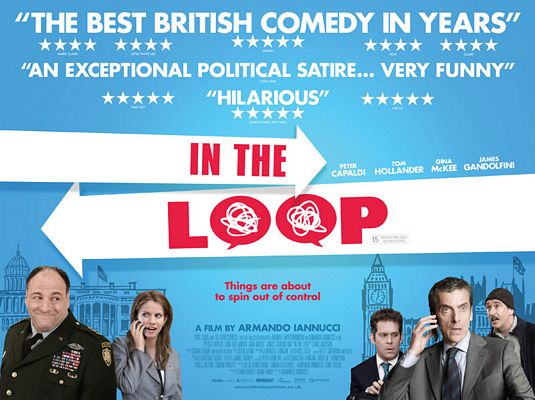 In The Loop is a satirical demolition of Whitehall and Washington: politically astute, absolutely funny and terrifyingly real.
As cinematic subgenres go, political satire doesn’t generally beat blockbuster, but In The Loop not only received ecstatic critical reviews when it was released in the UK and stateside, it managed to get bums-on-seats everywhere it screened.
It doesn’t matter if you’re politically in the know: most of us have met people like the bullies, opportunists and passive-aggressive backstabbers on display here. And it doesn’t matter if you’ve seen Director Armando Iannucci’s BAFTA-winning series, The Thick Of It.
In In The Loop, incompetent minister Simon Foster, played by Tom Hollander (Valkyrie, Pirates of the Caribbean) is sent to Washington after making contradictory comments about possible war in the Middle East. Foster is a hapless minister whose senseless pronouncements about potential war (in the Middle East) are latched onto by vying political factions. Hollander is utterly brilliant as a man so far out of his depth he needs armbands.
The set-up loosely shadows the drive for the invasion of Iraq, with various avatars for real-life politicos: James Gandolfini (The Sopranos) is a peace-pushing general reminiscent of Colin Powell; Peter Capaldi (The Thick of It, Doctor Who) is a foul-mouthed Scottish spin-doctor who bears relation to Alastair Campbell; and David Rasche (United 93, Flags of Our Fathers) hideously resembles former Secretary of Defense, Donald Rumsfeld.
Okay, sure. Many people think politics are dull or that it’s transitory, so it’s considered to be the domain of TV, which can react pretty instantly to breaking news (and doesn’t cost a cinema ticket!). But Iraq is not named at any point in this film because Director Iannucci is savvy enough to understand that ambition, idiocy, and fundamentalism play a role in any conflict, in any age, in any nation. Politics isn’t transitory; it’s timeless. And so is great satire, which this is. There’s also a good deal of improvisation by the actors here, feeding the intimate documentary style and aligning it worryingly to ‘real-life.’ But, hey – if we can’t laugh at ourselves, what’s the point? Finally, it’s worthwhile to support films that are not appealing to the lowest common denominator. I highly recommend In The Loop.
Filed under: Published film reviews | Tags: Allison Janny, Away We Go, film review, John Krasinski, Maya Rudolph, Sam Mendes
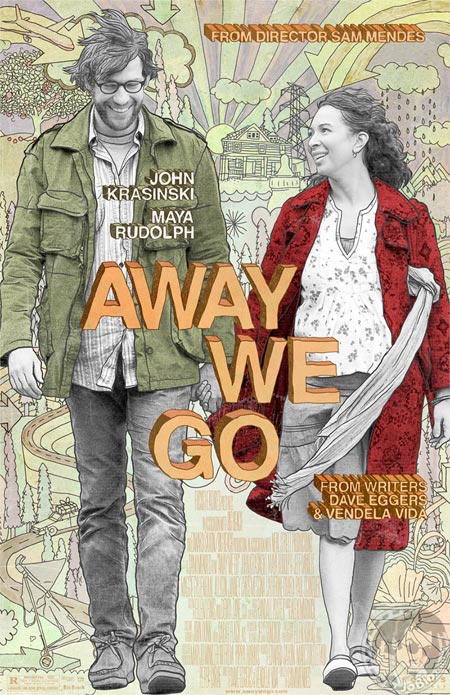 Away We Go wanders happily between comedy road trip and thirty-something coming-of-middle-age-drama. This film belongs to that branch of the road movie in which characters examine their pasts to confront present dilemmas.
Directed by Sam Mendes, who also directed American Beauty (Kevin Spacey, Annette Bening), Jarhead (Jake Gyllenhaal), Revolutionary Road, (Kate Winslet, Leonardo DiCaprio), and Road to Perdition, (Paul Newman, Tom Hanks), Away We Go does not stray from the themes of Mendes’ previous films, as it, too, is about seemingly ordinary people coming to terms with their lives.
The lead actors in Away We Go are not A-lister’s (a nod to independent filmmaking) but have done good work on TV and small film roles. Verona – played by Maya Rudolph – is hilarious in a deadpan, understated manner. Bespectacled college dropout Burt – played by John Krasinski – is charmingly idiosyncratic.
Burt and Verona are expecting their first baby. When Burt’s parents, the couple’s sole reason for moving to their current dreary town they call The Place We Live At the Moment, decide to leave the US, the couple go on a trip cross-country to find somewhere else to raise their child, beginning a disillusioning odyssey pretty much visiting any friend who has ever reproduced. During a particularly fraught, affecting visit, Verona has an epiphany about her own childhood which clarifies their lives: everywhere they’ve learnt lessons from those they meet about how not to raise children – apparently, the answer to their problems is that they don’t have to depend on the support of friends or the kindness of strangers.
Bravely, this film posits a relationship in which the couple are completely and happily in love, without underlying secrets waiting to ruin everything. Happiness is a difficult narrative concept to maintain, being, by definition, free of dramatic incident, but the lead couple are so charismatically and likeably written and played that even an uneventful trip on a train becomes high comedy. Arguably, those they meet along the way are cliché, but they’re balanced by the completely believable leads who seem themselves unable to believe these people are quite real.
I believe this is a film worth seeing because it’s simply a poignant and funny film. Also, I believe that if you’ve liked even one film from a given director (and I’ve liked all of Sam Mendes’ films), then you should give all of their work a ‘look-see.” Finally, the film works through striking scenes and splendid moments, rather than as a continuous whole, and, thanks to the cinematographer and production designer’s efforts, there is a distinctive regional look to each episode.
Filed under: Press releases | Tags: Bellingham, Karl Abramovic, Mural, Pacific Northwest

 Who’s the Monkey?
California artist Karl Abramovic has arrived in Bellingham to create its newest mural for the soon-to-be opened State Street Depot Bar & Grill, located at 1327 N. State St.
Raised in Oregon by conscientious educators before moving as an adult to California, Abramovic’s artwork incorporates western American themes and eastern European motifs in an expressive, surreal and farcical style. A prolific artist, Abramovic has won much recognition and numerous awards for his murals, oil paintings, pastels and drawings.
The State Street Depot Bar & Grill’s mural is inspired by the fact that the location was home to the town’s Greyhound Bus Depot in the 1930’s. Abramovic’s design evokes the nostalgia created by this era, its transience and its hope, its hardship and its glamour. These poignant tensions are treated in a whimsical fashion by Abramovic.
Ben Gilmer, owner of Bellingham’s newest night spot, plans to use the vintage bus depot theme to create an exciting environment that suggests a small town’s reclusive location in the middle of dense Pacific Northwest forests, yet its worldly contact with numerous travelers passing through it to and from Canada, and up and down the West Coast.
For information about Karl Abramovic and his work, please visit http://www.americansurreal.com
Filed under: Travel pieces | Tags: Africa, Cape Buffalo, Elephants, travel article, Zimbabwe
 While on safari in Zimbabwe at the Imire Game Reserve in July of 1995, we came across this elephant who has established herself as a female ruler of the Cape Buffalo herd. Anna thinks she is a Cape Buffalo. At least she’s preferred the company of the buffalo to her own kind for twenty years. Anna was brought to the game reserve at the age of eighteen months with one of her siblings. The sibling died shortly thereafter, and Anna did’nt identify with the other elephants. Instead, she attached herself to a Cape Buffalo herd on the reserve. Anna grew large eventually, and the buffalo realized that she was’nt one of them. At this point, the lead bull challenged her, and Anna, realizing instinctively that she outweighed him by at least a ton, literally squashed him.
This killing was the first of many in the years to come. She had established a matriarchy. A decade ago, the game keepers came to the conclusion that something had to be done to save the bulls and increase the herd! Anna was eventually going to make it impossible to mate because of her defeats and deaths to the bulls who challenged her power.The gamekeepers responded to this crisis by removing the bulls from the herd and taking the females to them singly to mate, so as not to arouse Anna’s suspicions. Later, the fledgling bulls would be taken from their mothers so as not to be at risk, and another herd, with a few select cows, would be created.
Within the last decade, nature itself has compensated for the herd’s losses by producing four male to every one female birth. Nature is incredibly self sustaining, and in the case of Anna and her herd of Cape Buffalo, freakish. To my question of why the Cape Buffalo don’t just ostracize her collectively and take the risk for the greater gain, Paul Ritson, game keep, said, “If you had a loaded gun to your head, would you risk escape?”
Filed under: Published travel writing | Tags: fashion article, London Shoes, London Shopping, shoes article
 I revisited London this past summer for the first time in years. In a pensive mood one day, I walked among the crowds in order to sort out my thoughts, head bent looking mostly at the ground, down at Oxford Street. Suddenly I noticed what a wonderful array of footwear!
Plastics with cotton…linens with leather…canvas with metal…and of course wonderful variations on leather shoes from sandals to thigh-high boots; I saw all of the different textures, fabrics and style that are so splendidly unique.
Londoners don’t wear splashy outfits to match these spectacular shoes, either: a wonderfully bowed, glass-like slipper in a bright fuchsia can be seen with a plain skirt and t-shirt. Multi-colored boots that zip up the side are put with a pair of jeans and a sweatshirt; linen with leather sandals that have a wedgie cork sole can be worn with the most casual of shorts; and fabulous, stiletto-heeled, elaborately woven leather shoes are a contrast to conservative business suits.
What a sense of style the Londoners have! I ducked into a shoe shop and bought a pair of shoes. Later, as I stood waiting for the train and the inevitable breeze through the tunnel that signals its coming, looking at my feet and new shoes, I felt satisfied, and no longer a bit melancholy. All I had needed was a great, new pair of shoes, and they are: ruddy brown leather sandals, with a strap around the ankle, and a modest heel about two inches high, convey the subtlety, individuality and the great sense of style that I so appreciate in London.
Filed under: Published travel writing | Tags: Fanelli's Cafe, New York City cafes, restaurant review
 It’s owned and operated by a guy that boxed against Joe Lewis. It was featured in State of Grace with Gary Oldman and Ed Harris. But for some reason, many New Yorker’s don’t know about Fanelli’s, even though it’s on the corner of Prince and Mercer in the middle of Soho, and it’s always full.
There’s a tiny little neon sign over the place. Inside, there are small tables with traditional red-checked clothes crowded into a long, narrow space. Black and white photos of boxing matches cover the wall. Across from the tables is a long bar, with stools filled with old timers, who might be Teamsters, or Mafia, polished, young executives, a few hipsters and the odd foreigner. Smoke floats to the ceiling.
This is home to the best Bloody Mary in New York—not too spicy but it has a bite. Not too strong, but enough to relax you. The burgers rival any burger in the city and are cooked at medium rare—whether you like it or not.
Their best food is a dieter’s nightmare—chicken wings and cheese sticks—and the drinks flow even more heavily. If you’re looking for something immaculate and minimalist, this ain’t it. It’s a place that you go to because it’s easy to get to. It’s got that sense of time when cabbies in NY knew the city like the back of their hand. This is one of the places they’d tell you to go eat. It’s charming. It’s not trendy, but it sure is hip.
Filed under: Press releases
 Manifesto for Creative London North
‘True compassion is more than flinging a coin to a beggar; the compassionate come to know that an edifice which produces beggars needs restructuring.’ Martin Luther King
- Creative London North realizes that even as we do not operate in a feudal society anymore, modern society has created new conditions of oppression, new forms of struggle to take the place of old ones and this needs to change now.
- Creative London North will not be another short-term initiative whose funding dries up as soon as it begins to work.
- Creative London North is not developed by disenfranchised bureaucrats, but those who have lived and operated in the world of creative commerce.
- Creative London North operates as a practical approach to the creative industries, even as it understands some need more support than others and therefore has a variety of programs for all levels through a vast network of partner organizations.
- Creative London North functions on the premise that it takes time to hone your craft and build a career.
- Creative London North is committed to those that are committed to helping themselves and taking responsibility for themselves. It does not reinforce the soft bigotry of low expectations.
- Creative London North is the opportunity for like-minded individuals, from beginners to those farther along in the process and needing introduction to the industry, to receive guidance, feedback and real help to produce something tangible.
- Creative London North is adaptive and responsive with those it works services, which means that it is not a one-way ‘conversation’ of programs and administrators, but a perpetual ‘tweaking’ of the programs in order to deliver what is relevant.
- Creative London North understands that the pseudo feudal system for the creative industries, in which production is monopolized by a few closed guilds and organizations, now no longer suffices for the growing wants and abilities of the global market.
 Victoria Jelinek