Filed under: Book reviews | Tags: book, Book of Dust, books, Confinement, Corona virus, Covid-19, Fantasy, Fantasy adventure, Golden Compass, Harry Potter, His Dark Materials, J.K. Rowling, Lyra, Philip Pullman, reading
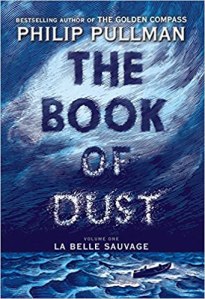 Many years ago, I remember working at a film school and talking to a colleague about the wonderful J.K. Rowling’s Harry Potter series. My then-colleague said, “You’ve not read Philip Pullman, then, have you?” I hadn’t. Later that day, I found my way to a bookstore and bought the His Dark Materials trilogy (written by Pullman) and gulped them down. Once read, I realized there was no comparison: His Dark Materials is, in my opinion (as well as my respected colleague’s), the better series. It’s complex and imaginative as it combines magical creatures and alternative worlds in an uncompromising story about religion, authority, and individual freedom. Topical themes in any age, really.
It has been nearly two decades since Philip Pullman completed his renowned trilogy. In its first installment, The Northern Lights (or The Golden Compass, depending on where you’re geographically located in the world), he introduces readers to Lyra Belacqua, a girl from a parallel world, who sets off on an epic mission to rescue a missing friend. In the His Dark Materials trilogy, Pullman depicts a world ruled by an oppressive church, known as the Magisterium, that dictates the rules and mores of society. The worlds created in both His Dark Materials and his latest series, The Book of Dust, are almost like our own world, but just slightly changed. A primary difference is that every human is linked to their own daemon, an animal-shaped manifestation of their soul. (I love this idea!).
In Pullman’s long-awaited follow up, The Book of Dust, and its first volume, La Belle Sauvage, we’re introduced to the prequel (to the original trilogy) set ten years before the first adventure, when Lyra is just an infant in need of protection from the burgeoning powers of the Magisterium. In Lyra’s place as ‘hero’ is Malcolm Polstead. He’s a bright, curious, and capable eleven-year-old who helps his parents at their Oxford pub and also spends a lot of time helping out the nuns at a local priory. In his free time, he’s out on the river in his canoe, which he named “La Belle Sauvage.” One day at the pub, he overhears the news that the local nuns have taken in an infant – Lyra – who is the daughter of two powerful figures — a man named Lord Asriel and a woman named Marisa Coulter. At around the same time, he sees a man arrested by agents of the Magisterium, and later discovers that the man has mysteriously drowned in the river. Going over the area where he first saw the now-deceased man, he finds an item that the man lost — a brass acorn with a hidden message inside. He discovers that the acorn is used as a means to covertly deliver messages to a local scholar who belongs to a secret anti-Magisterium society, and who has access to an alethiometer, which is a truth-divining tool that figured prominently in Pullman’s original trilogy. When a massive flood overtakes Oxford, Malcolm and a teenager, Alice, spirit Lyra away in Malcolm’s canoe in order to avoid a murderous scientist and agents of the Magisterium who are keenly interested in kidnapping the infant.
As this is a prequel to the original trilogy, the Magisterium has not yet established its oppressive control on society, but it’s well on its way to this kind of power. In The Book of Dust-La Belle Sauvage, Pullman illustrates how the Magisterium is infiltrating the very core of society and tightening its grip on every aspect of daily life. Its security force assassinates, assaults, and makes dissidents vanish, while it introduces a youth-oriented group to Malcolm’s school that encourages his classmates to report to the Magisterium the “heretical actions” of their peers, teachers, and parents. Teachers who object are reprimanded or fired. Tension and suspicion escalate. This League and its fascistic movements are similar to the Inquisitorial Squad in Harry Potter and the Order of the Phoenix, but the anxiety and fear that Pullman creates with the onset and actions of this League, believably conveys the insidious and hypocritical rot fascist tendencies have on democracy.
In the interest of being judicious, there are a couple of storylines presented and dropped, and the concept of “dust” is really underdeveloped. However, the character of Malcolm holds the narrative together. He’s different from Lyra as the central hero, but he’s vibrant and compelling in his own right. Throughout the course of the novel, he transforms from a quiet, stout child to a hero willing to take radical steps to keep Lyra safe in the name of justice.
Ultimately, Pullman is a master storyteller, and La Belle Sauvage is worth the 17-year wait. Moreover, a tale about battling a rising tide of fascism as authoritarian ‘strongmen’ claim political power and alt-right groups spring up across the world, is timely. This is a tense, thrilling, and magical book that feels like a natural part of the saga that began with His Dark Materials.
Filed under: Film reviews | Tags: betrayal, Boogie Nights, Capote, Confinement, Corona virus, Covid-19, drama, Film, films, friendship, independent, Little Miss Sunshine, love, Magnolia, New York, New York City, Philip Seymour Hoffman, The Boat that Rocked
(Rendez-vous l’été prochain)
 A limo driver’s blind date ignites a humorous and poignant tale of love, friendship and betrayal focused around two working-class New York City couples.
Jack (the late, great, Philip Seymour Hoffman) is a limo driver with vague hopes of getting a job with the Metropolitan Transit Authority (MTA). He has an obsession for reggae that has inspired him to attempt to grow his hair into dreadlocks, and he spends most of his time hanging out with his best friend and fellow driver Clyde and Clyde’s wife, Lucy. Clyde and Lucy introduce him to Connie and they like each other. Being with Connie inspires Jack to learn to cook, to take swimming lessons in order to take Connie on a romantic boat ride, and to pursue a new career. Meanwhile, Lucy and Clyde’s marriage begins to disintegrate.
Hoffman’s directorial debut is a very independently spirited and produced film. Hoffman made a career doing interesting, indie films such as Magnolia, Boogie Nights, Capote, and The Boat That Rocked, among many others. During his career, he was the Artistic Director for an off-Broadway theatre company in NYC for ten years, which is where this play originated. In putting together this film, he gathered around him wonderful talent, both on-screen and off-screen, from both the theatrical and the cinematic world, both independently financed and studio financed. And, the result is a small, gently paced, gem of a film, perfect viewing during our days of confinement.
Filed under: Film reviews | Tags: Chalie Kaufman, construct, Corona virus, Covid-19, Film, films, individual, Jim Carrey, Kate Winslet, Mark Ruffalo, Memories, memory, person, Thought
 I recently read an article in Aeon Magazine, which investigates the scientific possibilities and implications of purging one’s “bad” memories.* Haunted by news stories and terrible images during this pandemic, and as a teacher to too many troubled adolescents, I find my opinion is conflicted: memories construct who we are, for-better- or-for-worse, but there are such horrible things that happen…
Hungry for more insight into the subject (and a film buff) I decided to re-watch the 2004 film Eternal Sunshine of the Spotless Mind. In it, introvert Joel Barish (Jim Carrey) meets outgoing Clementine (Kate Winslet) and they start a tumultuous relationship. Then one day, Clementine doesn’t recognize Joel and he finds out that she had all of her memories of him removed. Angry and hurt, Joel decides to undergo the same procedure, but in the process of it he finds that he has second thoughts.
Screenwriter Charlie Kaufman is ingenious. His films Being John Malkovich and Adaptation are also high concept ideas that explore neurosis and the possibilities of the mind scientifically and perceptually. The movie begins slowly, as we experience the confusion Joel feels because his girlfriend suddenly doesn’t know him, with him. However, once Joel discovers she has had her memories of him wiped out and decides to have the same procedure done on himself, the bulk of the action takes place over one night in his rapidly disintegrating memory. When Joel’s subconscious decides that the procedure is a bad idea and he enlists the ‘memory’ of Clementine to help him escape, the film moves at a rapid pace. Here, director Michel Gondry showcases true visual verve (and most of the effects are created in camera!) as we delve into repressed memories, teenage humiliation, and childhood helplessness. But then a miracle happens — just as Joel’s situation seems most hopeless, the tone of the film becomes more hopeful. We travel through Joel’s mind back to those initial, profoundly romantic first days with Clementine, and we are able to view both the beginning and the end of a relationship at the exact same time. It’s poignant and beautiful. At this moment, Kaufman’s objective comes into sharp focus, and we, the viewer, are left to ponder what we’ve just seen, and to consider whether we would, indeed, purge our minds of painful memories if given the chance. Eternal Sunshine of the Spotless Mind is a relevant and weird and wonderful film with genuine heart and a thoughtful mind.
*Aeon Magazine, Aug. 1, 2016, Would You Purge Bad Memories From Your Brain If you Could by Lauren Gravitz. https://aeon.co/essays/would-you-purge-bad-memories-from-your-brain-if-you-could
Filed under: Film reviews | Tags: Americana, Coen brothers, Corona virus, Covid-19, drama, Film, films, Michale Stuhlbarg, mystery, USA
A potential film to watch while in confinement…
 Did you like The Big Lebowski? Fargo? Raising Arizona? Oh Brother Where Art Thou? No Country for Old Men? Then you should watch A SERIOUS MAN by The Coen Brothers if you haven’t watched it already.
The setting is 1967 Americana suburbia: Larry Gopnik’s (Michael Stuhlbarg) life is beginning to unravel -his wife wants a divorce because his incompetent brother is sleeping on the couch and his son owes the school bully $20 for a bag of marijuana – and he just wants to know how it all went wrong and what he can do about it.
The Coen Brothers have made some great films and this one is marvellous – a suburban dysfunctional family drama meets metaphysical mystery that stands out as their most human and relatable film yet.
Filed under: TV reviews | Tags: American, British, Confinement, Corona virus, Covid-19, drama, entertainment, humor, Perspective, poverty, series, Shameless, Television, TV, William H. Macy
 Shameless USA is a family drama based on the UK’s long-running hit of the same name. William H. Macy leads the cast as the working class patriarch of an unconventional Chicago clan of six kids who, helmed by their eldest sibling, Fiona, keep their ramshackle home afloat while their dad is out getting blindingly drunk each day.
While the original series, set in Manchester, is grimmer, grittier, and, arguably, more shameless than the USA based series, the American version is still good. Yes, even as the actors in the US version are more attractive, their teeth are good, and their home is larger and prettier than the British version (prompting the question of whether Americans are comfortable with the ugliness of poverty), their circumstances and behavior are similarly outrageous and touching. Sure, Americans don’t ‘do’ subtlety as well as the British, so much of the action is obvious and flat-footed (such as when young Debbie puts the pillow under the head of her passed out father, thereby showing us the acceptance and love that the family feel for him, rather than permitting the audience to discern that via observation), they are still an audacious, criminally-inclined family trying to survive without resources other than their wits and each other.
I came late to these series, which have both been running since 2004 and 2011*, respectively, but it’s never too late to watch entertaining television – particularly during confinement. Moreover, I have found that by watching these fictional families, which in many ways reflect the truth of poverty in that the people make perpetual sacrifices in order to meet the minimum needs of life, have to get by on practically nothing, and whose permitted aspirations are often little more than surviving, I have gained perspective about my own life’s desires and expectations. As I’m entertained watching this series, I’m also inspired and resolved to be more modest in general. And, at this terrible moment in our shared global history, that’s a good thing to learn and to remember as we face our collectively uncertain future.
*Ending in UK in 2013 and in USA in 2021.
Filed under: Corona 2020 | Tags: corona, Covid-19, creativity, Education, empathy, family, kindness, leadership, literacy, modesty, nature, Perspective, quarantine, reading, school, students, teachers, thinkers
The following came to me, a teacher, from my mother, who is a retired teacher, and she received it from another teacher. It’s not written very well, but the concept is wonderful!
Just maybe this could happen because of our crisis…
 WHAT IF
If they cancel the rest of the school year, students would miss 2.5 months of education. Many people are concerned about students falling behind because of this. Yes, they may fall behind when it comes to classroom education…
But what if…
What if instead of falling “behind,” this group of kids are AHEAD because of this?
What if they have more empathy, perspective, enjoy family connection, can be more creative and entertain themselves, love to read, love to express themselves in writing?
What if they enjoy the simple things, like their own backyard and sitting near a window in the quiet?
What if they notice the birds and the different flowers emerge, and the calming renewal of a gentle rain shower?
What if this generation is the one to learn to cook, organize their space, do their laundry, and keep a well-run home?
What if they learn to stretch a dollar and to live with less?
What if they learn the value of eating together as a family and finding the good to share in the small delights of the everyday?
What if they are the ones to place great value on our teachers and educational professionals, librarians, public servants and the previously invisible essential support workers like truck drivers, grocers, cashiers, custodians, logistics, and health care workers and their supporting staff, just to name a few of the millions taking care of us right now while we are sheltered in place?
What if among these children, a great leader emerges who had the benefit of a slower pace and a simpler life to truly learn what really matters in this life?
What if they are…”AHEAD?”
*image courtesy of UNICAF.ORG
Filed under: Corona 2020 | Tags: avarice, billionaires, Capitalism, carpenters, collectivism, Corona virus, Covid-19, economic inequality, farmers, garbage, greed, grocery, healthcare, individualism, millionaires, plumbers, purpose, society, teachers, truckers, workers
I think I could turn and live with animals, they’re so placid and self-contain’d,
I stand and look at them long and long,
They do not sweat and whine about their condition,
They do not like awake in the dark and weep for their sins,
They do not make me sick discussing their duty to God,
Not one is dissatisfied, not one is demented with the mania of owning things,
Not one kneels to another, nor to his kind that lived thousands of years ago,
Not one is respectable or unhappy over the whole earth.
Walt Whitman
At this time (medical professionals goes without saying) it’s the low paid workers – street sweepers, refuse collectors, supermarket workers, delivery drivers, and farmers that are keeping the country going, not big businesses, over paid footballers, you tubers, etc.
I would love to believe people will change their perspective a little when this is over, but I doubt it. Given the conversations I have with adolescents I teach and know, and from what I see from those around me who have huge houses and fancy cars they work all of the time to pay for, I think most people still see “success” as material, and most adolescents want to be big corporate executives or celebrities of some sort (sports, you tubers, those new online “change makers” or “it” folks). With little effort to boot.
Such a shame. There is great integrity in those listed above, and those who can do a trade (carpenters, plumbers, electricians, hairdressers, teachers, artists, sowers, farmers). The world needs people who are educated, absolutely, but who are also modest. Kindness, usefulness, collectivism should be promoted by our societies, not individualism, competition, and avarice. My guess is that if these alternative ideas were promoted, you would find that the grave numbers of loneliness, depression, and suicide would be vastly reduced. Purposefulness and a sense of “other” are reasons to be and give one self confidence.
Bertrand Russell wrote in his book “The Conquest of Happiness,” that the most direct path to true contentment is altruism.

(image courtesy of The Borgen Project)
Filed under: Corona 2020 | Tags: Allemagne, Confinement, Corona virus, Covid-19, Emmanuel Macron, Europe, France, Germany, Iceland, Island, lockdown, Macron, Regles, Sante, Suisse, Switzerland, Taiwan, Vietnam

Cher Monsieur President Macron,
J’étais fier et soulagé quand la France a commencé rapidement et avec fermeté le 16 mars. J’ai félicité le gouvernement français à chaque occasion de «prendre de l’avance» sur la courbe. Je me sentais protégé. Depuis, j’ai changé incommensurablement «mon air».
Hier, je suis sorti (dans la voiture) chercher des cigarettes. C’était la première fois que je conduisais en trois semaines ou parcourais plus d’un kilomètre. À mon grand étonnement, les gens étaient rassemblés en groupes dans les coins, le long des routes, à bicyclette, profitant de la journée ensoleillée et se tenant proche de l’autre, parlant en groupes et en groupes. Comme s’il n’y avait pas de virus infectant les deux chiffres en France seulement. De plus, au cours de la dernière semaine, j’ai remarqué depuis notre véranda arrière, qui surplombe une petite route, des groupes de personnes qui n’ont pas l’air liées (sont en fait similaires en âge) à faire du jogging, de la marche et du vélo ensemble.
C’est très inquiétant. Au magasin de cigarettes, l’homme derrière le comptoir ne portait pas de masque ni de gants, et ne m’a pas simplement fait effectuer un paiement «tactile», mais a pris ma carte et saisi les informations manuellement, et a pris chacun des magazines que j’achetais et les scanné chacun manuellement, comme il l’a également fait avec chaque paquet de cigarettes. Il a touché chacun de mes objets à fond. J’étais mortifié. Je lui ai demandé pourquoi il n’avait aucune protection pour lui-même et pour les autres, comme un masque ou des gants, et il a bêtement répondu: “Je me sens bien.” Mes voisins partent chaque jour, avec leur famille et leurs chiens, deux ou trois heures à la fois, puis reviennent, puis repartent encore deux ou trois heures, tout au long de la journée, chaque jour. J’ai deux amis qui m’ont demandé séparément de les rencontrer pour boire un verre chez eux, me disant qu’ils le font avec d’autres amis.
Pas étonnant que la France soit si riche en infections et en décès consécutifs. Le confinement DOIT être appliqué ou il n’a tout simplement aucun.
Hier, j’ai regardé un extrait de nouvelles (étrangère) expliquant pourquoi il y a des endroits dans le monde qui ont le virus corona, mais qui ne voient PAS les infections rapides OU les décès, comme en France, en Italie et en Espagne. En Islande, ils testent activement la population, puis ils ont des DETECTIVES, des forces de police, trouvant TOUTES les personnes possibles avec lesquelles une personne infectée a été en contact au cours des deux semaines précédentes, puis les mettant en quarantaine pour une obligation deux semaines, souvent trois. Coûteux? Est-ce moins cher d’avoir un confinement dans un pays où les gens le traitent avec une attitude cavalière?
Au Vietnam, en Corée du Sud et à Taïwan (juste en face d’un petit canal en provenance de Chine), ils ont maintenu la propagation en vérifiant les personnes qui arrivent par avion pour la fièvre, puis en les ramenant chez eux dans une voiture gouvernementale (seule!) Et en les mettant en quarantaine. Encore une fois, ils effectuent des tests massifs sur la population, mettent en quarantaine ceux qui sont positifs, puis recherchent activement leurs contacts potentiels au cours des deux semaines précédentes. De plus, ils publient qui est infecté afin que les gens puissent voir s’ils ont été en contact avec la personne infectée. De cette façon, tout le monde AILLEURS n’est pas en lock-out et le pays n’est pas fermé et souffre d’une catastrophe financière ET le virus ne se propage pas. Est-ce une violation des libertés civiles? Est-ce moins le cas pour nous dire que nous devons avoir un morceau de papier justifiant pourquoi nous sommes à l’extérieur, ainsi que notre carte d’identité, ne devrait être à l’extérieur que pendant une heure, et la création d’une situation dans laquelle les voisins s’espionnent les uns les autres avec suspicion et la colère dans leur cœur?
L’Organisation mondiale de la santé a déclaré dès le début que le moyen le plus efficace de lutter contre la nature infectieuse du virus Corona est de procéder à des tests massifs de la population, d’isoler les personnes atteintes de la maladie, puis de rechercher «de manière agressive» toutes les personnes dans lesquelles elles se trouvaient. Les contacter et les isoler également. Oui, cela coûte cher et cela nécessite un grand effort coordonné, mais est-ce plus cher que de fermer l’économie pour «endiguer le flux» de patients vers les hôpitaux?
En parcourant le nombre de personnes infectées par pays et par État sur le site Web de l’Université John Hopkins, je note que même si certains États des États-Unis, la Suède, la Suisse, par exemple, N’ONT PAS de confinement en vigueur, ils ONT instillé des mesures de sécurité ( pas de place dans les restaurants, tous assis à six pieds de distance, nombre limité dans une réunion, travail à domicile si vous le pouvez, fermetures d’écoles, etc.), qui SONT appliquées et qui sont par conséquent respectées par les gens, et le virus ne se propage pas! Pourquoi y a-t-il beaucoup moins de cas d’infection dans ces États des États-Unis, en Suède, au Luxembourg, en Suisse, en Belgique, etc. qu’en France (ou en Italie ou en Espagne) et même moins de décès, alors que la France, l’Italie et l’Espagne sont confinement total?
Quel est le but de paralyser l’économie et de faire en sorte que CERTAINS d’entre nous adhèrent au confinement, alors qu’il y a évidemment BEAUCOUP de personnes qui ne respectent pas les règles? Dans l’état actuel des choses, les gens voient évidemment l’amende potentielle de 135e pour ne pas avoir adhéré aux mesures de confinement comme une menace vide. Alors que je remplis chaque jour le journal pour moi et ma famille avec notre raison de sortir, je n’ai pas vu un seul officier de police, même une fois depuis que nous nous sommes isolés le 14 mars.
Je suis sceptique que mon pays fera ce qui est dans le meilleur intérêt de la nation. En fait, je crains que la France ne mette un terme au confinement – pour tout ce qu’il vaut – trop tôt en raison de l’adhésion aux arguments «économiques» des mêmes personnes à courte vue et égoïstes qui n’adhèrent pas au confinement, renvoient nos enfants à l’école (mettre en danger parce qu’il y aura eu beaucoup de divergences dans la façon dont les familles respectives se sont «auto-isolées») et puis il y aura encore une nouvelle augmentation terrible des infections et des décès, et un autre confinement inefficace, et ainsi de suite.
Le gouvernement français a bien commencé – de manière décisive et rapide – puis a échoué par la désorganisation. Pour remédier à cela, veuillez soit appliquer activement le confinement, OU tester la population, mettre en quarantaine les personnes malades et rechercher activement celles avec lesquelles elles ont été en contact (ou publier les données publiquement), et les isoler également.
Merci pour votre considération.
Sincères amitiés,
Filed under: Corona 2020 | Tags: Corona virus, Covid-19, Emmanuel Macron, Europe, European, European Union, France, health, healthcare, Macron, security, society
President Macron addresses the nation for the second time in a week
To my family,
 We allowed S to watch the address too. This virus is a huge thing…the first of its kind in a century (Spanish Flu 1918), and President Macron notes this (like the Humanities and Classics man he is).
It was a beautiful and sad speech. He candidly says that it is the beginning of the “onslaught” of this virus, that it will accelerate in the coming weeks and months, with a “second wave” that will effect younger people.
He calls on us to prepare for this. He calls for solidarity. He calls for “brotherhood” (the whole “liberté, egalite, fraternité” reference to the French Revolution that is noted on the side of every mayor’s office in every village and city throughout France)
He says that we must trust the experts who are guiding the decision for a lockdown – scientists and healthcare professionals who are on the front line of this crisis.
However, he notes, despite this context and the seriousness of the threat, the protocol to help first responders (healthcare professionals, police) by slowing down the spread of this disease enacted last Thursday, the public has not respected the guidelines. So, 100k army and extra police will be deployed across the country to enforce the ban on our movement as of tomorrow at midday. From then, we must have a written explanation downloaded from the government’s site (or handwritten for those without printers) explaining why we are out. We are only allowed to get food, medicine…to exercise, walk our dog, but not to meet with friends and extended family, “in the streets” or in our homes, or we will be fined 38e and “there will be repercussions.” I’m not clear what the repercussions would be. Perhaps it’s the 38e? (it was in French after all).
Borders across Europe/the Schengen Area have now collectively been closed to all foreign nationals for 30 days as of midday tomorrow also, with extension after that if needed. There seems to be some lenience with UK citizens, though I’m not sure exactly how this works given that they are now out of the EU, but it’s, perhaps, because it’s a recent ‘divorce’ that there is this allowance? I’m not clear on this to be honest…
President Macron referred to what French citizens must now face as “life in slow-motion,” but he called on us to spend this time “reading, reflecting on what is essential,” and said the nation would “prevail” in this “war.”
(I hope Netflix and our internet doesn’t somehow go down. That would TRULY leave me desperate).
There are many measures to help businesses and the economically vulnerable, and there is (subsidized by the government as usual) childcare for those who are first responders and necessary governmental workers.
He called for solidarity and courage.
He closed his address with the classical, “Vive la France. Vive la République.”
Which S kept saying afterwards to himself as he was brushing his teeth and getting ready for bed. After he went to bed, I heard him ask his father, who was was sitting with him, “Daddy, what will happen if you or mommy get the virus?” To which M said, “We’ll be fine honey…we’re strong.” He then asked why we have to stay indoors and not see friends if we’re not sick. To which M said, “To protect others, honey…to protect those that aren’t so strong…to make sure that we help the nurses and doctors who are dealing with this each day by not spreading the disease further…” It was quiet after that. He was probably asleep after that long winded response (as you might be now with my long missive – I type quickly. Perhaps, M, you can use it for your morning ‘private time’ reading?).
Gods hope all of us we will be protected and fine. Particularly as we can’t get to one another easily if there is a personal crisis.
We have been and will continue to, respect the guidelines. But, I have been appalled by the numbers who have not (the weather has been extraordinary, but it’s rather surreal to see so many over the last three days not taking this seriously despite national directives). I’ve also been perplexed and hurt by friends who have castigated me for self isolating: “I wouldn’t have thought YOU would be like this!” and “It’s a bit mad, don’t you think, to just stay at home when the weather is so gorgeous?!” and, “Drop by for a coffee – don’t be like that.” And, “I feel as though you’re judging me for continuing to live my life!” And, “It’s hysterical behavior if you ask me.” And, “It’s no worse than a really bad flu for most of us, stop being such a worry wart,” sorts-of-things. (The fact that I am a worry wart isn’t the point).
I suppose crisis brings out a variety of responses in people. I, too, didn’t take it seriously till last Thursday and had been mystified, incredulous, and somewhat disdainful when a couple of my friends were ‘banging the drum’ that it was time to lockdown everywhere asap. Then it hit me. I read something the other day about coming to terms with this virus socially is akin to the six stages of grief, so, perhaps, we are at different stages in this, just like the outbreak is in different stages of development in different countries?
I know for us, like many, we are worried about the future for our son. As M once said, “Having a child is like having your heart outside your body.” I love that. It’s so true. And mine beats heavily now…
And, like many, we are worried about money. Unlike the huge amount of money that is being put out there in France to alleviate the stress on businesses (the French government is paying salaries for workers while businesses are closed, rents and mortgages for those that are “poor” are being paid by the government, taxis, hotels, childcare for first responders, subsidies to hospitals and army tents to be set up in the hardest hit areas in order to support hospitals, all courtesy of our government). We freelancers, however, receive little or nothing. And, we won’t receive regular assistance because we have a bunch of money in our bank account from the sale of our previous house that will be used to build our new house. But, it doesn’t look as though our new house will be built this summer because if things remain, the wood/build will not get here and the workers can’t build it/be on site, and then we’ll be stuck paying our exorbitant rent! But, we’ll see how this all goes.
Things are changing daily.
There are so many in worse positions of course. I was told by a friend who had lived in Nigeria for 15 years, that most people in Africa live with this type of fear and uncertainty all of the time. You ‘just’ learn to cope.
Though, thankfully, in France, our poorest are given help with food, housing, and health, so there are not these types of desperate situations for the most part. Isolation is an issue.
And, of course, we could be ill. The impotence and fear of S’s recent illness is still fresh in our minds (the 40+ fever for five days in which he couldn’t eat and it would not go down! I’m so glad I insisted his blood was tested or I’d have thought it was Covid-19!).
And President Macron suggests that instead of visiting our elderly family members and neighbors, we offer to support these people in our communities by offering to get groceries and do errands for them (he actually said this! Makes me chuckle how he considers everything), and, of course, we would have “justification” for doing this (but we must fill in the form for transit! Goodness knows the French LOVE their paperwork).
Trying, terrible times. My dear friend E (S’s “nou nou” from three months old to three-years-old) who is now a neighbour, and who is normally a stoic, humorous, Welsh woman who regularly chides me to “take off my ‘big girl’s blouse’ and just get on with things,” texted me after the televised address and said she was despondent, that “The future seems bleak.” Rather alarmed, but figuring immediately that it made sense that it’d take something of this magnitude to shake her up, I suggested she bundle up warmly – it gets cold at night here – come over in ten minutes and meets me on the back porch – that I’d make us both very large whisky sours (washing my hands first of course) and, adhering to the security restrictions, we’d sit outside in lawn chairs two meters apart and talk. It was poignant as we sat on our respective sides of the porch quietly talking. The sky was bright with stars. There was a rock slide on the mountain that was SO loud it sounded as though Thor was smashing rocks together. We heard the sound of an owl and foxes (perhaps the owl was caught by the fox?). J chased a big deer away (which I soundly – though softly – scolded her for).
Oh my. What a world we live in.
So, it seems we have no choice but to spend this time at home, “reading and reflecting on what is essential,” as le president advises.
Though tomorrow I start teaching online classes. I’m advised that it’s “very important” that we “model peace and serenity” for the students.
Sleep is best for that.
Bon courage a tout.
Please keep in touch virtually. How lucky we are to have email and cell phones! (They wouldn’t have had those things during the last pandemic!).
Keep safe.
Love, Tori
Photo is courtesy of the link below (via friend) on Reddit and someone with the handle u/krinosh:
 Victoria Jelinek