Filed under: Book reviews | Tags: book, Book of Dust, books, Confinement, Corona virus, Covid-19, Fantasy, Fantasy adventure, Golden Compass, Harry Potter, His Dark Materials, J.K. Rowling, Lyra, Philip Pullman, reading
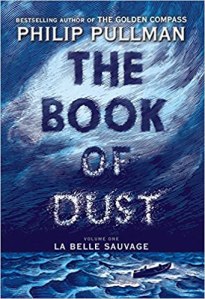 Many years ago, I remember working at a film school and talking to a colleague about the wonderful J.K. Rowling’s Harry Potter series. My then-colleague said, “You’ve not read Philip Pullman, then, have you?” I hadn’t. Later that day, I found my way to a bookstore and bought the His Dark Materials trilogy (written by Pullman) and gulped them down. Once read, I realized there was no comparison: His Dark Materials is, in my opinion (as well as my respected colleague’s), the better series. It’s complex and imaginative as it combines magical creatures and alternative worlds in an uncompromising story about religion, authority, and individual freedom. Topical themes in any age, really.
It has been nearly two decades since Philip Pullman completed his renowned trilogy. In its first installment, The Northern Lights (or The Golden Compass, depending on where you’re geographically located in the world), he introduces readers to Lyra Belacqua, a girl from a parallel world, who sets off on an epic mission to rescue a missing friend. In the His Dark Materials trilogy, Pullman depicts a world ruled by an oppressive church, known as the Magisterium, that dictates the rules and mores of society. The worlds created in both His Dark Materials and his latest series, The Book of Dust, are almost like our own world, but just slightly changed. A primary difference is that every human is linked to their own daemon, an animal-shaped manifestation of their soul. (I love this idea!).
In Pullman’s long-awaited follow up, The Book of Dust, and its first volume, La Belle Sauvage, we’re introduced to the prequel (to the original trilogy) set ten years before the first adventure, when Lyra is just an infant in need of protection from the burgeoning powers of the Magisterium. In Lyra’s place as ‘hero’ is Malcolm Polstead. He’s a bright, curious, and capable eleven-year-old who helps his parents at their Oxford pub and also spends a lot of time helping out the nuns at a local priory. In his free time, he’s out on the river in his canoe, which he named “La Belle Sauvage.” One day at the pub, he overhears the news that the local nuns have taken in an infant – Lyra – who is the daughter of two powerful figures — a man named Lord Asriel and a woman named Marisa Coulter. At around the same time, he sees a man arrested by agents of the Magisterium, and later discovers that the man has mysteriously drowned in the river. Going over the area where he first saw the now-deceased man, he finds an item that the man lost — a brass acorn with a hidden message inside. He discovers that the acorn is used as a means to covertly deliver messages to a local scholar who belongs to a secret anti-Magisterium society, and who has access to an alethiometer, which is a truth-divining tool that figured prominently in Pullman’s original trilogy. When a massive flood overtakes Oxford, Malcolm and a teenager, Alice, spirit Lyra away in Malcolm’s canoe in order to avoid a murderous scientist and agents of the Magisterium who are keenly interested in kidnapping the infant.
As this is a prequel to the original trilogy, the Magisterium has not yet established its oppressive control on society, but it’s well on its way to this kind of power. In The Book of Dust-La Belle Sauvage, Pullman illustrates how the Magisterium is infiltrating the very core of society and tightening its grip on every aspect of daily life. Its security force assassinates, assaults, and makes dissidents vanish, while it introduces a youth-oriented group to Malcolm’s school that encourages his classmates to report to the Magisterium the “heretical actions” of their peers, teachers, and parents. Teachers who object are reprimanded or fired. Tension and suspicion escalate. This League and its fascistic movements are similar to the Inquisitorial Squad in Harry Potter and the Order of the Phoenix, but the anxiety and fear that Pullman creates with the onset and actions of this League, believably conveys the insidious and hypocritical rot fascist tendencies have on democracy.
In the interest of being judicious, there are a couple of storylines presented and dropped, and the concept of “dust” is really underdeveloped. However, the character of Malcolm holds the narrative together. He’s different from Lyra as the central hero, but he’s vibrant and compelling in his own right. Throughout the course of the novel, he transforms from a quiet, stout child to a hero willing to take radical steps to keep Lyra safe in the name of justice.
Ultimately, Pullman is a master storyteller, and La Belle Sauvage is worth the 17-year wait. Moreover, a tale about battling a rising tide of fascism as authoritarian ‘strongmen’ claim political power and alt-right groups spring up across the world, is timely. This is a tense, thrilling, and magical book that feels like a natural part of the saga that began with His Dark Materials.
Filed under: Film reviews | Tags: betrayal, Boogie Nights, Capote, Confinement, Corona virus, Covid-19, drama, Film, films, friendship, independent, Little Miss Sunshine, love, Magnolia, New York, New York City, Philip Seymour Hoffman, The Boat that Rocked
(Rendez-vous l’été prochain)
 A limo driver’s blind date ignites a humorous and poignant tale of love, friendship and betrayal focused around two working-class New York City couples.
Jack (the late, great, Philip Seymour Hoffman) is a limo driver with vague hopes of getting a job with the Metropolitan Transit Authority (MTA). He has an obsession for reggae that has inspired him to attempt to grow his hair into dreadlocks, and he spends most of his time hanging out with his best friend and fellow driver Clyde and Clyde’s wife, Lucy. Clyde and Lucy introduce him to Connie and they like each other. Being with Connie inspires Jack to learn to cook, to take swimming lessons in order to take Connie on a romantic boat ride, and to pursue a new career. Meanwhile, Lucy and Clyde’s marriage begins to disintegrate.
Hoffman’s directorial debut is a very independently spirited and produced film. Hoffman made a career doing interesting, indie films such as Magnolia, Boogie Nights, Capote, and The Boat That Rocked, among many others. During his career, he was the Artistic Director for an off-Broadway theatre company in NYC for ten years, which is where this play originated. In putting together this film, he gathered around him wonderful talent, both on-screen and off-screen, from both the theatrical and the cinematic world, both independently financed and studio financed. And, the result is a small, gently paced, gem of a film, perfect viewing during our days of confinement.
Filed under: Film reviews | Tags: Chalie Kaufman, construct, Corona virus, Covid-19, Film, films, individual, Jim Carrey, Kate Winslet, Mark Ruffalo, Memories, memory, person, Thought
 I recently read an article in Aeon Magazine, which investigates the scientific possibilities and implications of purging one’s “bad” memories.* Haunted by news stories and terrible images during this pandemic, and as a teacher to too many troubled adolescents, I find my opinion is conflicted: memories construct who we are, for-better- or-for-worse, but there are such horrible things that happen…
Hungry for more insight into the subject (and a film buff) I decided to re-watch the 2004 film Eternal Sunshine of the Spotless Mind. In it, introvert Joel Barish (Jim Carrey) meets outgoing Clementine (Kate Winslet) and they start a tumultuous relationship. Then one day, Clementine doesn’t recognize Joel and he finds out that she had all of her memories of him removed. Angry and hurt, Joel decides to undergo the same procedure, but in the process of it he finds that he has second thoughts.
Screenwriter Charlie Kaufman is ingenious. His films Being John Malkovich and Adaptation are also high concept ideas that explore neurosis and the possibilities of the mind scientifically and perceptually. The movie begins slowly, as we experience the confusion Joel feels because his girlfriend suddenly doesn’t know him, with him. However, once Joel discovers she has had her memories of him wiped out and decides to have the same procedure done on himself, the bulk of the action takes place over one night in his rapidly disintegrating memory. When Joel’s subconscious decides that the procedure is a bad idea and he enlists the ‘memory’ of Clementine to help him escape, the film moves at a rapid pace. Here, director Michel Gondry showcases true visual verve (and most of the effects are created in camera!) as we delve into repressed memories, teenage humiliation, and childhood helplessness. But then a miracle happens — just as Joel’s situation seems most hopeless, the tone of the film becomes more hopeful. We travel through Joel’s mind back to those initial, profoundly romantic first days with Clementine, and we are able to view both the beginning and the end of a relationship at the exact same time. It’s poignant and beautiful. At this moment, Kaufman’s objective comes into sharp focus, and we, the viewer, are left to ponder what we’ve just seen, and to consider whether we would, indeed, purge our minds of painful memories if given the chance. Eternal Sunshine of the Spotless Mind is a relevant and weird and wonderful film with genuine heart and a thoughtful mind.
*Aeon Magazine, Aug. 1, 2016, Would You Purge Bad Memories From Your Brain If you Could by Lauren Gravitz. https://aeon.co/essays/would-you-purge-bad-memories-from-your-brain-if-you-could
Filed under: Film reviews | Tags: Americana, Coen brothers, Corona virus, Covid-19, drama, Film, films, Michale Stuhlbarg, mystery, USA
A potential film to watch while in confinement…
 Did you like The Big Lebowski? Fargo? Raising Arizona? Oh Brother Where Art Thou? No Country for Old Men? Then you should watch A SERIOUS MAN by The Coen Brothers if you haven’t watched it already.
The setting is 1967 Americana suburbia: Larry Gopnik’s (Michael Stuhlbarg) life is beginning to unravel -his wife wants a divorce because his incompetent brother is sleeping on the couch and his son owes the school bully $20 for a bag of marijuana – and he just wants to know how it all went wrong and what he can do about it.
The Coen Brothers have made some great films and this one is marvellous – a suburban dysfunctional family drama meets metaphysical mystery that stands out as their most human and relatable film yet.
Filed under: TV reviews | Tags: American, British, Confinement, Corona virus, Covid-19, drama, entertainment, humor, Perspective, poverty, series, Shameless, Television, TV, William H. Macy
 Shameless USA is a family drama based on the UK’s long-running hit of the same name. William H. Macy leads the cast as the working class patriarch of an unconventional Chicago clan of six kids who, helmed by their eldest sibling, Fiona, keep their ramshackle home afloat while their dad is out getting blindingly drunk each day.
While the original series, set in Manchester, is grimmer, grittier, and, arguably, more shameless than the USA based series, the American version is still good. Yes, even as the actors in the US version are more attractive, their teeth are good, and their home is larger and prettier than the British version (prompting the question of whether Americans are comfortable with the ugliness of poverty), their circumstances and behavior are similarly outrageous and touching. Sure, Americans don’t ‘do’ subtlety as well as the British, so much of the action is obvious and flat-footed (such as when young Debbie puts the pillow under the head of her passed out father, thereby showing us the acceptance and love that the family feel for him, rather than permitting the audience to discern that via observation), they are still an audacious, criminally-inclined family trying to survive without resources other than their wits and each other.
I came late to these series, which have both been running since 2004 and 2011*, respectively, but it’s never too late to watch entertaining television – particularly during confinement. Moreover, I have found that by watching these fictional families, which in many ways reflect the truth of poverty in that the people make perpetual sacrifices in order to meet the minimum needs of life, have to get by on practically nothing, and whose permitted aspirations are often little more than surviving, I have gained perspective about my own life’s desires and expectations. As I’m entertained watching this series, I’m also inspired and resolved to be more modest in general. And, at this terrible moment in our shared global history, that’s a good thing to learn and to remember as we face our collectively uncertain future.
*Ending in UK in 2013 and in USA in 2021.
Filed under: Corona 2020 | Tags: corona, Covid-19, creativity, Education, empathy, family, kindness, leadership, literacy, modesty, nature, Perspective, quarantine, reading, school, students, teachers, thinkers
The following came to me, a teacher, from my mother, who is a retired teacher, and she received it from another teacher. It’s not written very well, but the concept is wonderful!
Just maybe this could happen because of our crisis…
 WHAT IF
If they cancel the rest of the school year, students would miss 2.5 months of education. Many people are concerned about students falling behind because of this. Yes, they may fall behind when it comes to classroom education…
But what if…
What if instead of falling “behind,” this group of kids are AHEAD because of this?
What if they have more empathy, perspective, enjoy family connection, can be more creative and entertain themselves, love to read, love to express themselves in writing?
What if they enjoy the simple things, like their own backyard and sitting near a window in the quiet?
What if they notice the birds and the different flowers emerge, and the calming renewal of a gentle rain shower?
What if this generation is the one to learn to cook, organize their space, do their laundry, and keep a well-run home?
What if they learn to stretch a dollar and to live with less?
What if they learn the value of eating together as a family and finding the good to share in the small delights of the everyday?
What if they are the ones to place great value on our teachers and educational professionals, librarians, public servants and the previously invisible essential support workers like truck drivers, grocers, cashiers, custodians, logistics, and health care workers and their supporting staff, just to name a few of the millions taking care of us right now while we are sheltered in place?
What if among these children, a great leader emerges who had the benefit of a slower pace and a simpler life to truly learn what really matters in this life?
What if they are…”AHEAD?”
*image courtesy of UNICAF.ORG
Filed under: Book reviews | Tags: author, book, book review, books, Culture, global affairs, humor, Jonas Jonasson, Kim Jong-un, Merkel, North Korea, Politics, Putin, Russia, satire, society, Sweden, Swedish, Trump, USA
 The sequel to The One-Hundred-Year-Old Man Who Climbed out the Window and Disappeared by Jonas Jonasson is another deft satire about the flaws of modern society. Using Allan and Julius’s latest adventures, with its madcap twists and turns, Jonasson creates a thought-provoking portrait of the current state of the world.
After climbing out the window of his retirement home on his 100th birthday and accidentally entangling himself in an epic adventure involving a suitcase full of cash and a gang of ruffians, the spry Allan and his best-and-only-friend Julius, settle into luxury on Bali. Most people wouldn’t grow bored of sipping cocktails beachside, but Allan and Julius aren’t like most people so their decadent life has become a bore and they’re restless. Julius decides to liven things up with a hot air balloon ride in honor of Allan’s one-hundred-and-first birthday. When the operator jumps out of the balloon to take a bite out of Allan’s birthday cake, Allan and Julius accidentally snap the lever that sets the balloon in motion and they go sailing up into the sky. But they’re not hot balloon experts, of course, and end up having a crash landing at sea before being rescued by a North Korean ship carrying smuggled uranium on board. Soon, Allan and Julius are swept up into an international diplomatic crisis that involves various global players such as Putin, Trump, Merkel, and Kim Jong-un.
I found myself looking forward to going to bed each night in order to continue reading this book in peace. Allan is an incredibly endearing character leading us through twists and turns galore in an intricately plotted book. All the while, Jonasson makes thoughtful and relevant points about power, truth, morality, and the role of perception in current affairs, and not in an ideological or pedantic way, but with nuance, wit, and warmth.
A highly amusing and intelligent book that I absolutely recommend!
Filed under: Corona 2020 | Tags: Bird, Blossom, Easter, Emily Dickinson, Harvest, hope, life, poem, poetry, Spring
Because it’s Easter, a holiday associated with life, light, nature, and possibility –
And because “Hope,” here, is symbolized as a bird –
And, because, it’s Emily Dickinson –
I offer up this poem to remember…
“Hope” is the thing with feathers
“Hope” is the thing with feathers –
That perches in the soul –
And sings the tune without the words –
And never stops – at all –
And sweetest – in the Gale – is heard –
And sore must be the storm –
That could abash the little Bird
That kept so many warm –
I’ve heard it in the chillest land –
And on the strangest Sea –
Yet – never – in Extremity,
It asked a crumb – of me.
Filed under: Corona 2020 | Tags: avarice, billionaires, Capitalism, carpenters, collectivism, Corona virus, Covid-19, economic inequality, farmers, garbage, greed, grocery, healthcare, individualism, millionaires, plumbers, purpose, society, teachers, truckers, workers
I think I could turn and live with animals, they’re so placid and self-contain’d,
I stand and look at them long and long,
They do not sweat and whine about their condition,
They do not like awake in the dark and weep for their sins,
They do not make me sick discussing their duty to God,
Not one is dissatisfied, not one is demented with the mania of owning things,
Not one kneels to another, nor to his kind that lived thousands of years ago,
Not one is respectable or unhappy over the whole earth.
Walt Whitman
At this time (medical professionals goes without saying) it’s the low paid workers – street sweepers, refuse collectors, supermarket workers, delivery drivers, and farmers that are keeping the country going, not big businesses, over paid footballers, you tubers, etc.
I would love to believe people will change their perspective a little when this is over, but I doubt it. Given the conversations I have with adolescents I teach and know, and from what I see from those around me who have huge houses and fancy cars they work all of the time to pay for, I think most people still see “success” as material, and most adolescents want to be big corporate executives or celebrities of some sort (sports, you tubers, those new online “change makers” or “it” folks). With little effort to boot.
Such a shame. There is great integrity in those listed above, and those who can do a trade (carpenters, plumbers, electricians, hairdressers, teachers, artists, sowers, farmers). The world needs people who are educated, absolutely, but who are also modest. Kindness, usefulness, collectivism should be promoted by our societies, not individualism, competition, and avarice. My guess is that if these alternative ideas were promoted, you would find that the grave numbers of loneliness, depression, and suicide would be vastly reduced. Purposefulness and a sense of “other” are reasons to be and give one self confidence.
Bertrand Russell wrote in his book “The Conquest of Happiness,” that the most direct path to true contentment is altruism.


